Claude Workbench Retirement: What Developers Need to Know
Anthropic is retiring the legacy Claude Workbench and three experimental prompt APIs today, August 17, 2026.
Source: https://platform.claude.com/docs/en/release-notes/overview
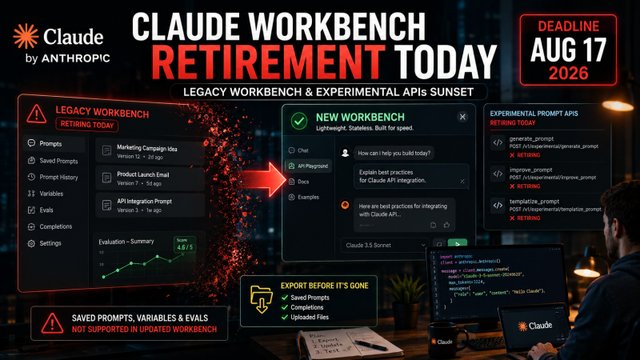
Claude's Legacy Workbench Is Being Retired Today
Anthropic is making a significant change to its developer platform today.
The legacy Claude Workbench is being retired on August 17, 2026, and developers who still rely on the old environment need to pay attention.
The important part is that Claude Workbench itself is not completely disappearing.
Anthropic has introduced a refreshed Workbench that lets developers test Claude models and API features. However, the new version is designed to be more lightweight and stateless, meaning it does not retain the same saved-work functionality as the legacy version.
The legacy Workbench previously allowed developers to save prompts, prompt versions, completions and evaluations.
Those saved items will not carry over to the new Workbench.
Developers who have important data stored in the legacy environment should export it before the retirement deadline. Anthropic says the export can include saved prompts, completions and uploaded files.
At the same time, Anthropic is retiring three experimental prompt APIs:
generate _ prompt
Used for generating prompts.
improve _ prompt
Used for improving prompts.
templatize _ prompt
Used for turning prompts into templates.
These APIs are being retired alongside the legacy Workbench. After removal, requests sent to those endpoints will return errors.
Why Developers Should Care
This might look like a small platform update, but it matters if you built workflows around Anthropic 's experimental tooling.
For example, imagine a developer has:
Application → Experimental Prompt API → Claude
If the application still depends on one of those retired endpoints, that workflow can break after the API is removed.
The same applies to teams that have accumulated important prompts, evaluations or previous Workbench experiments.
The key action is therefore simple:
Check → Export → Update → Test
Check your projects for dependencies on the old Workbench or experimental prompt APIs.
Export any important Workbench data.
Update applications that call the retiring endpoints.
Then test the replacement workflow before relying on it in production.
What Changes After Today?
The old environment:
Legacy Workbench → Retired
The new environment:
Updated Workbench → Available
But the new Workbench does not provide the same saved-prompt and evaluation functionality. Anthropic recommends keeping exported prompts and related work in your own systems, such as a code repository.
This is an important lesson for AI developers:
Don't build critical production workflows around experimental AI features without a migration plan.
AI platforms are evolving extremely quickly. APIs, models and developer tools can change or disappear as companies redesign their platforms.
For developers, keeping prompts, configurations and workflows under your own version control can make these transitions much easier.
The Bottom Line
Anthropic isn't killing Claude Workbench entirely.
It's retiring the legacy Workbench and its associated experimental prompt APIs while moving developers toward a simpler, updated Workbench experience.
If you've used the old Workbench, today is the deadline to export anything you need to keep.