Claude Haiku 5.5 Makes AI Agents Cheaper
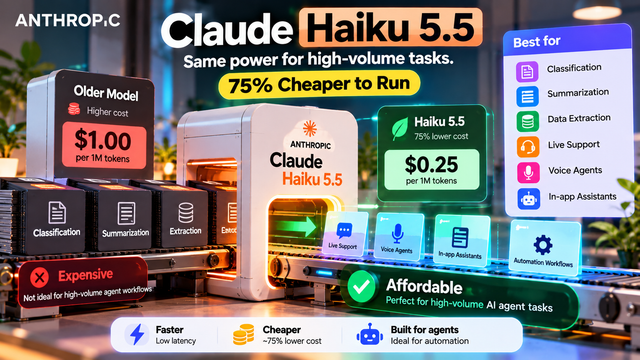
Anthropic’s Claude Haiku 5.5 is built for fast, high-volume AI tasks and costs around 75% less to run than Haiku 4.5 on average.
Claude Haiku 5.5 Makes AI Agents Cheaper
Anthropic has launched Claude Haiku 5.5, the third model in its Claude 5.5 family and a model specifically designed for fast, high-volume and cost-sensitive AI workloads.
While many AI model launches focus on becoming smarter or beating another model on benchmarks, Haiku 5.5 is interesting for a different reason: economics.
Anthropic describes Claude Haiku 5.5 as its fastest, cheapest and most capable small model so far. The company says it costs around 75% less to run on average than Claude Haiku 4.5, making it particularly useful for applications that need to make a large number of AI calls.
That matters because modern AI applications are increasingly moving from one-off chatbot questions toward multi-step agent workflows.
A single AI agent may need to perform dozens of model calls while completing a task.
For example:
User request → research → classify information → extract data → call a tool → summarize → check result → respond
If every step uses an expensive frontier model, the cost can quickly become difficult to justify.
A smaller, faster model such as Haiku 5.5 can potentially handle many of those routine steps while a more powerful model is reserved for the parts that require deeper reasoning.
From one AI call to many agent steps
This is where Haiku 5.5 becomes particularly relevant to automation builders.
Traditional AI applications often look like:
User → AI → Answer
Agentic applications can look very different:
User → Agent → Search → Tool → Subagent → Database → Verification → Final answer
Every additional step can require model inference.
For businesses running thousands or millions of workflows, the cost and latency of those individual calls become important.
Anthropic says Haiku 5.5 is designed for workloads such as summarization, classification, database queries and compaction, as well as speed-sensitive applications including live customer support and browser use.
The model can also work as a subagent alongside larger Claude models.
That creates a useful division of labor.
A larger model can handle the complicated part of a task, while Haiku 5.5 handles smaller repetitive operations around it.
A cheaper agent architecture
Imagine an AI business assistant processing customer requests.
Instead of using one large model for everything, a company could create a workflow like:
Customer message
↓
Haiku 5.5 — classify request
↓
Haiku 5.5 — extract important information
↓
Haiku 5.5 — search or summarize relevant data
↓
Larger Claude model — handle complex reasoning
↓
Haiku 5.5 — format the response
This approach can reduce the amount of expensive model inference required.
It also makes the architecture easier to optimize because developers can choose a model based on the complexity of each individual step.
The pricing change
Anthropic's exact pricing depends on prompt size.
For prompts up to 100,000 tokens, Claude Haiku 5.5 is priced at $0.10 per million input tokens and $0.50 per million output tokens.
For prompts above 100,000 tokens, the prices are $0.50 per million input tokens and $2.50 per million output tokens.
Anthropic says that, on average, Haiku 5.5 costs around 75% less to run than Haiku 4.5. Its pricing can be as much as 90% lower for requests up to 100,000 tokens and 50% lower for longer requests, with the calculation also accounting for differences in token usage between the models.
So the simple “75% cheaper” headline is useful for understanding the overall trend, but actual savings depend on how the model is used.
Speed matters too
Cost isn't the only advantage.
Anthropic says Haiku 5.5 is its fastest model to date and is designed for applications where latency matters.
That makes it suitable for experiences where users expect an immediate response.
Examples include:
Live customer support
In-app AI assistants
Browser-based agents
Classification systems
Data extraction
Summarization
Routing
Subagents
High-volume automation
Anthropic also says early customers reported substantial latency improvements in their testing. One customer, Asana, reported more than a 30% reduction in task-completion latency and up to 2.5× faster inference per agent turn in its testing.
Why this matters for AI agents
The most important part of this release is therefore not simply that Haiku 5.5 is another Claude model.
It is that the economics of running AI agents are changing.
An AI agent becomes more useful when it can perform many small actions without every action becoming expensive.
Consider an automated business workflow:
Read 10,000 customer messages → classify them → detect priority → extract information → route them → summarize important cases
Running a large model for every tiny operation could be unnecessarily expensive.
A smaller model designed for high-volume work can handle many of these steps, while a stronger model can be called only when the workflow encounters something complicated.
This is similar to how software systems already use specialized services for different jobs.
What it means for Indian startups
For Indian startups and automation developers, this trend could be particularly important.
Many businesses want AI agents for customer support, sales operations, document processing, internal search and repetitive administrative work.
But the business case depends on more than whether an AI model can perform a task.
It also depends on:
How fast is it?
How much does each task cost?
How many tasks can the system process?
Can the workflow operate reliably at scale?
Cheaper and faster models can improve those economics.
A startup could potentially use a larger model for complex reasoning while using Haiku 5.5 for the large volume of smaller operations surrounding it.
Haiku 5.5 is not meant for everything
There is an important tradeoff.
Anthropic itself positions Haiku 5.5 for narrower, high-volume tasks, while larger models such as Sonnet 5.5 and Opus 5.5 remain better suited to more complex agentic coding and demanding reasoning workloads.
So the lesson isn't:
“Use Haiku 5.5 for everything.”
The better lesson is:
“Use the right model for each step.”
That model-selection strategy could become an important part of building profitable AI agents.
The bigger trend
AI development is moving from simply asking:
“Which is the smartest model?”
toward a more practical question:
“Which model should handle each part of my workflow?”
Haiku 5.5 is a strong example of that shift.
The future of AI automation may involve a combination of powerful models, small fast models, tools and specialized subagents working together.
That means the winning AI systems may not always be the ones using the biggest model.
They may be the ones that use the cheapest capable model for every individual job.
And that is why Claude Haiku 5.5 matters for the growing agentic-AI economy.