Claude Code Creator Says Stop Micromanaging AI
Boris Cherny, creator of Claude Code, says users should give AI a clear goal and enough context instead of prescribing every step of the task.
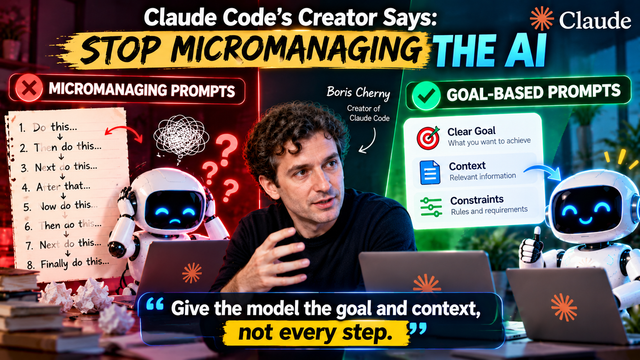
🧠 Claude Code creator says stop micromanaging AI
Boris Cherny, the creator and head of Claude Code at Anthropic, is drawing attention to a simple change in how people should communicate with AI agents: focus on the goal instead of controlling every individual step.
In a post highlighted by The Times of India, Cherny encouraged users to interact with Claude more like they would with a colleague. Instead of writing an extremely detailed procedure, users can explain what they want to accomplish and provide the context needed for the model to understand the task. The Times of India
The idea represents a shift from traditional prompting toward agentic prompting.
A traditional prompt might look like:
“First do this → then open this → next change this → after that run this → finally create the result.”
The newer approach is:
“Here is my goal + here is the context + here are my constraints. Figure out the best way to accomplish it.”
This doesn't mean prompts are no longer important. Context, requirements, examples and constraints still matter. Anthropic's own guidance recommends giving Claude enough information to understand the task, being precise about expected behavior and providing concrete examples where useful. Anthropic Resources
What is changing is who decides the execution plan.
Anthropic's June 2026 analysis of approximately 400,000 Claude Code sessions found that people generally make most of the planning decisions—essentially deciding what needs to be done—while Claude makes more of the execution decisions, determining how to do it. The research also found that users with greater domain expertise tended to get more work done per instruction. Anthropic
That makes goal-based prompting particularly interesting for complex tasks.
For example, instead of telling Claude exactly how to fix a website bug, a developer could say:
Goal: Fix the authentication bug.
Context: Users are receiving a 401 error after session renewal.
Constraint: Don't change the existing authentication API.
The agent can then inspect the relevant code, identify the problem, make the appropriate changes and test the result.
There is still an important boundary: giving an agent freedom does not mean giving it unlimited authority. Anthropic's own framework emphasizes maintaining human oversight, particularly before agents take high-impact actions. Anthropic
So the lesson isn't “shorter prompts are always better.”
The better lesson is:
Don't micromanage what the AI can reasonably figure out. Give it the goal, context and boundaries it needs to make good decisions.
As AI agents become capable of handling longer, multi-step workflows, this style of communication could become increasingly important for developers, creators, students and businesses.