Claude AI: The Battle for Creator Rights
AI companies need human content to build better models, but creators are asking a bigger question: who owns the right to use it?
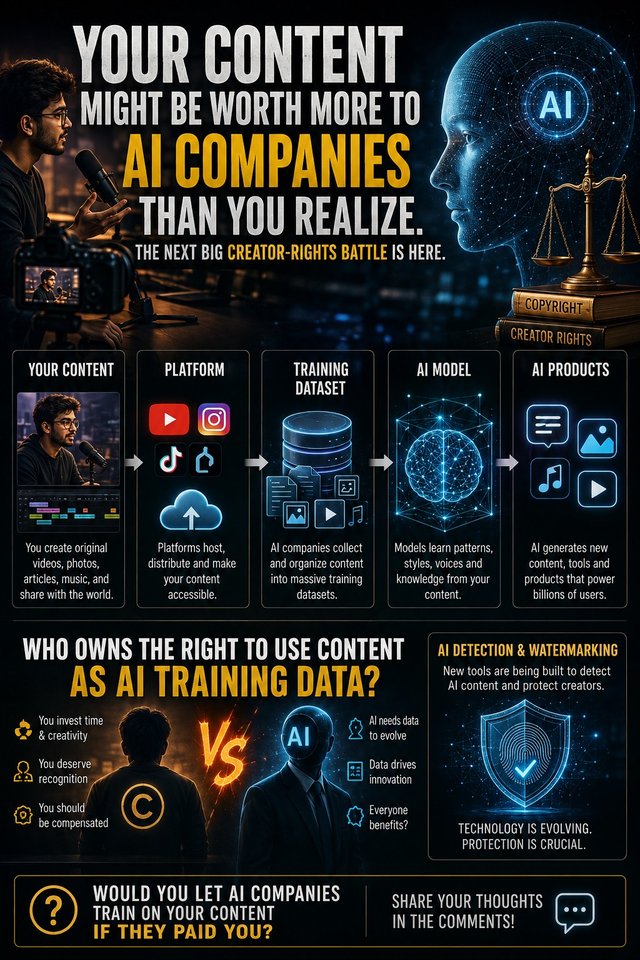
Claude AI: The Cinematic Battle for Creator Rights
For years, creators have fought to answer one question:
How much is my content worth?
A YouTuber looks at views.
A photographer looks at licensing fees.
A writer looks at book sales.
A musician looks at streams.
An Instagram creator looks at followers, engagement, and brand deals.
But artificial intelligence is creating an entirely different question.
What is your content worth to an AI company?
A video you uploaded.
A photograph you created.
An article you wrote.
A song you produced.
A book you published.
A livestream you recorded.
All of these can potentially contain something AI companies desperately want:
high-quality human-created data.
And that is creating what could become one of the biggest creator-rights battles of the AI era.
The fight may no longer be only about whether someone can repost your content.
It could increasingly be about whether AI systems can use your content to build models that generate entirely new products.
The AI industry needs human content
Modern AI systems need enormous amounts of data.
Large language models learn from text.
Image models learn from images.
Video models learn from video.
Music models learn from audio.
The quality of that training data matters enormously.
AI companies therefore have a strong incentive to obtain large amounts of high-quality material.
And creators produce exactly that.
A professional YouTuber may have spent years developing a recognizable presentation style.
A filmmaker may have created thousands of carefully edited frames.
A photographer may have built a portfolio containing years of visual work.
A writer may have produced hundreds of articles.
A musician may have created thousands of recordings.
From the creator's perspective, these are pieces of intellectual property.
From an AI company's perspective, they can also be potential training material.
That's where the conflict begins.
The data race is becoming a creator-rights race
The AI industry is often described as a competition for computing power.
Companies need GPUs.
They need data centers.
They need electricity.
They need massive amounts of infrastructure.
But there is another competition happening underneath all of that.
The competition for high-quality data.
Recent developments show how valuable human-created information has become.
A recent report said Handshake AI is offering professionals up to $30,000 for high-quality work documents that they own and are authorized to share for AI training. The offer specifically targets fields such as consulting, finance, legal work, software engineering, and data science.
That's an important signal.
Companies aren't simply looking for more data.
They want better data.
And they're increasingly willing to pay for it.
Books are already becoming part of the debate
The recent controversy surrounding physical books is another example.
An investigation by 404 Media reported that books purchased through Amazon were tracked to a Las Vegas facility where workers reportedly removed bindings and scanned books for AI-related purposes.
Amazon confirmed that it purchases books through commercial channels to develop and improve products and services.
But the evidence does not establish that every book Amazon purchases is being used to train a particular frontier AI model.
That distinction matters.
Still, the broader trend is obvious.
Companies are looking for concentrated sources of human-created information.
Books are attractive because a single volume can contain hundreds of pages of structured, edited, human-produced material.
The same principle applies to creator content.
A successful YouTube channel isn't just a collection of videos.
It's a huge dataset of human language, visual composition, storytelling, editing decisions, presentation techniques, and audience communication.
That makes creator content potentially valuable beyond its original purpose.
Your content could have a second life
Imagine you upload a five-minute educational video.
You created the script.
You recorded your voice.
You edited the footage.
You designed the graphics.
You published it on a platform.
Your audience watches it.
You earn advertising revenue.
That's the normal creator economy.
But now imagine that same video becomes part of a dataset used to improve an AI system.
The AI doesn't necessarily reproduce your exact video.
Instead, your content may contribute information to a model that learns patterns from enormous numbers of examples.
That creates a completely different economic question.
You aren't simply asking:
"Who watched my video?"
You're asking:
"Who is learning from my video?"
And potentially:
"Should I be compensated for that use?"
The copyright question is far from settled
There is no single global answer to whether copyrighted material can be used for AI training.
Different countries have different laws.
Different courts are reaching different conclusions.
Different companies are taking different approaches.
The U.S. Copyright Office continues to examine copyright questions involving AI training and copyrighted works.
In the European Union, copyright rules allow certain text-and-data-mining activities, while rights holders can reserve their rights against some commercial uses if they do not want their works used or would prefer to license them.
India is also actively debating the issue.
A DPIIT working paper proposed a framework involving compensation for copyright holders when their works are used for AI training, including a possible collective licensing mechanism.
So the debate isn't simply:
"Is AI training legal?"
It's much more complicated.
The real questions include:
Was the content lawfully obtained?
Was permission required?
Was there an opt-out mechanism?
Was the use commercial?
Does the training harm the creator's market?
Should creators be compensated?
Who determines the compensation?
Can creators refuse?
Can they later withdraw their content?
Those questions are going to shape the creator economy.
The battle is already reaching music
This isn't theoretical.
On August 17, 2026, music publisher Round Hill Music filed lawsuits against Anthropic and Suno, alleging unauthorized use of copyrighted song lyrics for AI training. The allegations involve more than 500 songs, with the publisher saying it may expand the claims further.
That is significant because music demonstrates how complicated the problem can become.
A song isn't just "data."
It is the result of writers, composers, performers, producers, publishers, and rights holders.
If an AI system learns from copyrighted music and then generates new music, multiple layers of rights can potentially become relevant.
The question isn't simply whether the AI generated something new.
It's also about what it learned from to become capable of generating it.
Creators are starting to demand control
The creator economy is therefore moving toward a new concept:
training rights.
Imagine a platform where you can choose:
Allow AI training: Yes
or:
Allow AI training: No
Or perhaps:
Allow only these companies.
Or:
Allow training if I receive compensation.
That would fundamentally change the relationship between platforms, creators, and AI companies.
YouTube, for example, has mechanisms for creators to authorize certain third-party AI training uses, with the relevant setting described as opt-in for third-party companies.
This is the direction many creators may want to see more widely adopted:
permission before extraction.
But what does "training on my content" actually mean?
This is where the conversation can become confusing.
Suppose an AI company downloads your video.
Does that mean the AI model memorizes your video?
Not necessarily.
Training generally involves processing enormous datasets and adjusting a model's parameters based on patterns learned from that data.
The final model isn't simply a searchable folder containing every piece of training material.
That distinction is important.
But it doesn't automatically solve the rights question.
A creator can reasonably ask whether their copyrighted work should have been used during the process at all.
That's a legal and ethical question separate from whether the model can reproduce the original material.
The next fight may be about compensation
There are several possible models for the future.
Model one: Free use
AI companies can use publicly available content under applicable legal exceptions.
Creators don't receive direct compensation.
Model two: Opt-out
AI companies can use content unless the creator explicitly tells them not to.
This puts the burden on creators.
Model three: Opt-in
AI companies need permission before using the content.
This gives creators stronger control.
Model four: Licensing
AI companies negotiate directly with publishers, platforms, or rights holders.
Creators receive payment according to the agreement.
Model five: Collective compensation
A centralized system collects royalties and distributes money to creators based on usage.
India's proposed AI-copyright framework has explored this type of approach.
Each model has advantages and problems.
The challenge is building a system that works at internet scale.
Why platforms have enormous power
Here's the part creators should pay attention to.
Individual creators usually don't have the resources to negotiate AI licensing deals with major technology companies.
A creator with 50,000 followers can't realistically call an AI company and negotiate a training contract for every video.
Platforms, however, can.
YouTube.
Twitch.
Instagram.
TikTok.
Stock-image platforms.
Music services.
Publishing platforms.
They already have relationships with millions of creators.
That makes platforms potentially powerful intermediaries between creators and AI companies.
The future could therefore involve platforms giving creators more granular controls over how their content can be used.
Twitch shows how controversial this can become
Twitch recently faced backlash over its approach to AI training involving streamer content.
Reports said Twitch content was being used to train generative AI systems for Amazon, with the system described as opt-out rather than opt-in. The controversy intensified after Twitch's chief product officer reportedly acknowledged that the company believed few creators would voluntarily opt in.
This illustrates the core problem perfectly.
From the platform's perspective, AI training can create new capabilities.
From the creator's perspective, the content is their work.
And from the audience's perspective, there may be an expectation that content uploaded for one purpose won't silently become raw material for something completely different.
That's why transparency matters.
AI watermarking adds another layer
There is another side to this battle.
Creators aren't only worried about AI companies using their content.
They are also increasingly concerned about AI-generated content being mistaken for human-created work.
Anthropic has introduced an invisible watermarking system for Claude-generated text that is designed to remain detectable through copying and some editing. The move is connected to growing demands for transparency around AI-generated content.
That creates an interesting symmetry.
Creators are asking:
"Can AI companies use my work?"
AI companies and regulators are asking:
"Can we identify AI-generated work?"
Both questions are really about attribution.
Who created this?
Who owns it?
Where did it come from?
Who has the right to use it?
And who should get paid?
The strange future of the creator economy
The creator economy originally revolved around attention.
Get views.
Build followers.
Grow engagement.
Make money from advertising.
Sell products.
Get sponsorships.
AI introduces another potential source of economic value:
data licensing.
A creator's content could potentially generate value even when nobody is watching it directly.
A library of thousands of videos could become valuable because it represents years of human-created information.
A photographer's archive could become valuable as licensed training data.
A writer's catalog could potentially become part of a licensed AI dataset.
A musician's catalog could become valuable for AI development.
This could create an entirely new creator revenue stream.
Imagine a future creator dashboard
Imagine opening your creator dashboard ten years from now.
You see:
Views: 12.4 million
Brand revenue: ₹8.2 lakh
Subscriptions: ₹3.1 lakh
And then another section:
AI Training Licenses: ₹2.4 lakh
You could see which companies have permission to use your content.
You could see how much you earned.
You could revoke permissions where legally possible.
You could choose whether new uploads are available for training.
That would turn creator content into a more explicitly licensed digital asset.
Whether the industry actually develops in this direction remains uncertain.
But the economic incentive is obvious.
AI companies also have something to lose
Creators aren't the only side with concerns.
AI companies need high-quality data.
If creators stop allowing their content to be used, the supply of high-quality human-created material becomes more difficult to obtain.
That could make licensed datasets more expensive.
It could also encourage companies to build stronger relationships with publishers, platforms, artists, and creators.
In that sense, creator rights aren't necessarily the enemy of AI development.
They could become part of the infrastructure that makes AI development sustainable.
The AI data economy could become enormous
Think about what happens when AI systems become embedded everywhere.
Search.
Education.
Advertising.
Software.
Entertainment.
Healthcare.
Finance.
Robotics.
Personal assistants.
Every industry will need AI.
And AI systems will need data.
That means the market for high-quality data could become extremely valuable.
The winners may not only be companies with the biggest models.
They may also be companies that have legitimate access to the best datasets.
And creators may suddenly discover that their work is an important part of that supply chain.
The Indian angle is especially interesting
For creators in India, this debate is particularly relevant.
India has a massive creator economy spanning YouTube, Instagram, short-form video, music, education, gaming, and regional-language content.
At the same time, India is actively developing its policy approach to AI and copyright.
The country's DPIIT working paper has proposed mechanisms aimed at balancing AI innovation with compensation for copyright holders.
And in July 2026, the Delhi High Court ruled in favor of OpenAI in an ANI copyright dispute at the interim stage, finding that OpenAI's use of ANI's content for training ChatGPT was prima facie protected under India's fair-dealing framework. The case highlights how complicated the legal landscape remains.
So India's creator economy isn't watching this debate from the sidelines.
It is becoming part of it.
The question every creator should ask
If you create content today, you should probably know the answer to one question:
What does the platform's policy say about AI training and your content?
Don't assume that uploading something automatically means an AI company can use it.
And don't assume the opposite either.
Read the relevant terms.
Look for AI training settings.
Check whether third-party training is opt-in or opt-out.
Understand whether the platform licenses your content to third parties.
And keep records of your original work.
Because the value of your content may not end when the post stops getting views.
The next creator-rights battle
The creator economy was built around attention.
AI could turn it into something broader:
attention + intellectual property + training data.
That's a major shift.
A creator's work could have multiple economic lives.
First, someone watches it.
Then a brand sponsors it.
Then a platform distributes it.
And potentially, an AI company licenses it as training data.
The question is whether creators will participate in that value chain—or simply watch others profit from it.
That's why the next major creator-rights debate may not be:
"How much should I get paid for 1 million views?"
It could be:
"How much should I get paid when an AI system learns from 1 million views worth of my work?"
The future isn't necessarily anti-AI
This debate shouldn't be reduced to:
Creators vs AI.
That's too simplistic.
AI can give creators incredible new tools.
It can help with editing.
Writing.
Translation.
Dubbing.
Animation.
Research.
Design.
Marketing.
Accessibility.
And entirely new forms of storytelling.
The real issue is control and compensation.
Creators can support AI innovation while still asking for transparency.
They can use AI while demanding consent.
They can benefit from AI while protecting their intellectual property.
Those positions aren't contradictory.
The question that could define the next decade
The biggest question isn't whether AI will use human-created content.
It already does in many different ways, and the legal landscape is evolving rapidly.
The bigger question is:
What economic system will exist around that use?
Will creators be paid?
Will they have the ability to opt out?
Will platforms negotiate on their behalf?
Will governments create compulsory licensing systems?
Will AI companies rely increasingly on licensed datasets?
Will creators eventually treat training rights as another form of intellectual property?
Nobody knows exactly where this ends.
But the battle has clearly started.
The AI industry needs human creativity.
Creators need platforms.
Platforms need users.
And everyone is beginning to realize that the content flowing through this ecosystem has enormous economic value.
The next creator economy may therefore have a new currency.
Not just views.
Not just followers.
Not just engagement.
Data rights.
And the creator who understands those rights early could have a very different relationship with AI than the creator who discovers them after their content has already become part of the machine.
Your content may be more valuable than you think.
The question is whether you get a say in how that value is used.