Apple Tightens macOS Permissions for AI Agents|flux ai news
apple plans stronger macOS Full Disk Access controls as increasingly capable AI agents create new privacy and security risks
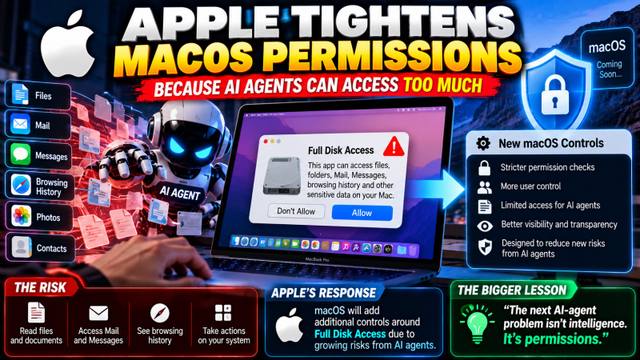
Apple Tightens macOS Permissions for AI Agents
Apple is preparing to strengthen security controls around Full Disk Access in macOS, highlighting a growing problem created by increasingly capable AI agents. The company announced that it plans to introduce additional controls around the powerful permission as AI systems become more autonomous and capable of interacting with computers.
Full Disk Access is one of the most sensitive permissions available to applications on a Mac. When granted, an application can potentially access information across different parts of a user's system, including files, Mail, Messages, browsing history and other sensitive data. While the permission can be useful for legitimate applications, giving it to an increasingly autonomous AI agent creates a different level of risk.
Modern AI agents are designed to do more than generate text. Depending on the software and permissions available to them, agents can read files, interact with applications, use tools, navigate websites and perform actions on behalf of users. This makes the permissions given to an agent an important part of the overall security model.
Apple's announcement suggests that the traditional approach of giving an application broad access may not be sufficient for the agentic AI era. If an AI agent receives extensive system permissions, a mistake, malicious instruction, compromised application or unexpected interaction could potentially expose sensitive information or cause unwanted actions.
However, Apple has not yet revealed the exact design of the new controls or when they will arrive. Therefore, this should not be interpreted as a current change that has already completely replaced the existing Full Disk Access system.
The announcement is nevertheless significant because it shows that operating-system security is adapting to the way AI software is evolving. In the past, an application generally performed a predictable set of tasks. AI agents can behave more dynamically, deciding which tools to use and which actions to take based on changing instructions and context.
This creates an important security question: How much access should an autonomous AI agent receive?
A safer approach could involve more granular permissions, clearer user controls, better visibility into what an agent is accessing and stronger restrictions on high-risk operations. Instead of allowing an agent to access an entire computer, future systems could give it only the specific files, applications or actions required for a particular task.
Apple's move also highlights a broader trend across the technology industry. As AI agents gain the ability to operate computers independently, security may increasingly depend not only on how intelligent the model is, but also on the boundaries placed around it.
The key lesson is simple: the next major AI-agent security challenge may not be intelligence itself — it may be permissions.
For Mac users and developers building autonomous AI software, Apple's upcoming changes could become an important step toward making powerful computer-using agents safer to deploy.