Anthropic Updates Claude AI Usage Policy for 2026
Anthropic has updated Claude’s usage policy with clearer rules covering deceptive campaigns, weapons, surveillance, high-risk applications and abusive behavior toward AI models. The changes take effect on November 12, 2026.
Source: https://www.anthropic.com/news/2026-usage-policy-update
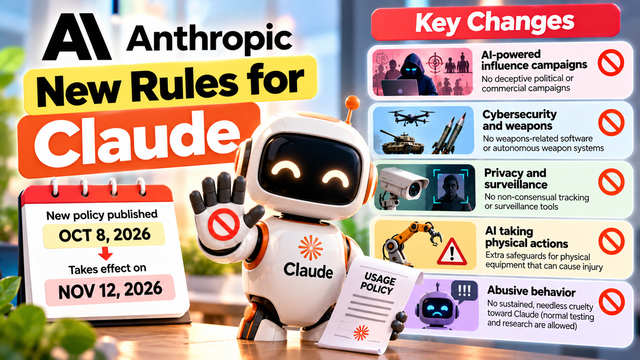
Anthropic Updates Claude AI Usage Policy: What Users Need to Know
Anthropic, the company behind Claude AI, published an updated Usage Policy on October 8, 2026. The revised policy explains more clearly how people and businesses can use Claude as AI systems become capable of completing longer tasks, writing software and interacting with tools and equipment.
The updated policy takes effect on November 12, 2026. It addresses deceptive influence campaigns, election interference, weapons-related development, surveillance, high-risk decisions, autonomous physical actions and abusive behavior toward AI models.
For anyone using Claude for coding, content creation, research, business automation or AI product development, the update is worth understanding. It shows how AI companies are defining responsible use as their tools become more powerful.
1. Why is Anthropic updating its policy?
AI assistants are no longer used only to answer questions or generate paragraphs. Developers can connect them to software tools, databases, coding environments and other systems. Businesses can use them to support workflows that previously required several manual steps.
These capabilities can be useful, but they can also be misused. For example, an AI system could help generate misleading content at scale, support the development of surveillance software or make recommendations in situations where a mistake could affect someone's rights or safety.
Anthropic says most of its latest changes are intended to clarify existing rules and explain how they apply to newer capabilities. Some sections have been reorganized, while additional requirements explain how users should handle higher-risk applications.
This distinction matters: the announcement does not mean that every listed activity has suddenly become prohibited for the first time.
2. Deceptive political and commercial campaigns
One major change is the consolidation of rules against deceptive campaigns and artificial activity.
Anthropic says Claude must not be used to operate deceptive political or commercial campaigns. Examples include creating networks of fake accounts, fabricating news sites, hiding who is responsible for a message or artificially amplifying content through misleading accounts and posts.
The policy also addresses building tools and infrastructure designed to run influence operations.
What does this mean for creators?
AI can help legitimate creators brainstorm ideas, translate posts, prepare educational content and reach audiences in different languages. These activities are not the same as running a deceptive campaign.
The concern is the use of AI to manufacture false identities, mislead audiences or create artificial engagement while concealing who is behind the activity.
For Indian social media creators, the practical lesson is simple: use AI to improve genuine content, not to impersonate people, manufacture fake public support or mislead viewers about the source of information.
3. Clearer rules about elections
Anthropic has also refined its election-related restrictions. The updated policy focuses on preventing users from deceiving voters or disrupting democratic processes.
Examples include spreading false information about candidates or voting procedures, impersonating candidates or election officials, and attempting to suppress voter participation through deception.
The company also explains that some legitimate civic activities can still be allowed. For instance, using AI to translate voter information or help election officials communicate accurate instructions is different from misleading voters.
Anthropic says it removed a blanket prohibition on personalized vote and campaign targeting. However, deceptive targeting and misuse of personal information remain restricted under the policy's other rules.
Key takeaway: AI can support civic education and accessible information, but it should not be used to manipulate voters or undermine democratic participation.
4. Weapons-related software and autonomous systems
Anthropic has clarified that its weapons restrictions cover more than the physical construction of a weapon. They also include software and components that make weapons work, along with activities such as arming drones and other autonomous vehicles.
This matters because AI can assist with coding, technical documentation, simulation and system design. Those same capabilities can create risks when applied to weapon development or control systems.
The update makes the policy's scope more explicit rather than presenting every restriction as a new rule.
For developers and engineering students, the lesson is to consider the real-world application of a project before connecting an AI assistant to technical systems. A task that looks like ordinary software development can carry very different risks depending on what the software is designed to do.
5. Privacy, surveillance and law enforcement
The revised policy explains more precisely how Claude may not be used for surveillance and criminal justice activities.
Anthropic states that tracking people without their consent is prohibited, whether the tracking occurs in real time or uses previously collected information. It also prohibits using Claude to build or improve tools designed for surveillance.
The policy further restricts using Claude to decide or recommend who should be investigated, arrested or charged in law enforcement or criminal justice processes.
However, not every activity involving monitoring is automatically prohibited. Anthropic identifies permitted examples such as agreed-upon fraud monitoring, content moderation, journalism and legal research, subject to the policy's requirements.
Why businesses should pay attention
Companies developing AI-powered security, analytics or monitoring systems should examine what data they collect, whether people have consented and how automated recommendations are used.
For Indian startups, this is a reminder to consider privacy and human oversight during product design rather than treating them as issues to address only after launch.
6. Additional safeguards for high-risk applications
The updated policy clarifies requirements for AI use cases that may affect a person's health, legal rights, finances, livelihood or access to essential services.
Anthropic says these applications require a qualified human in the loop. That means an appropriate person must have the authority to review Claude's recommendations and change them when necessary. The affected individual must also be informed that AI was used.
These requirements are not entirely new; Anthropic says the revision makes them easier to understand.
Consider a business using AI to assist with financial decisions or a healthcare workflow. The AI may help organize information or suggest options, but the company must not assume that its output should automatically determine a consequential outcome.
Human review is especially important when information is incomplete, recommendations are uncertain or a mistake could seriously affect someone.
7. New requirements when AI controls physical equipment
Another important part of the update concerns Claude connected to equipment that can take autonomous physical actions and potentially cause injury.
Anthropic says a qualified operator must be able to observe the equipment and stop it when needed. The equipment must also be capable of remaining in a safe state if Claude becomes disconnected.
This requirement is relevant to robotics, industrial automation, smart devices and other systems in which AI outputs can affect the physical world.
Imagine a factory using an AI-connected robot. A software error should not leave the machine operating dangerously without a way for a responsible operator to intervene.
For developers, the message is that safety must be designed into the complete system. It is not enough for the AI model itself to produce a sensible response; the connected equipment also needs appropriate safeguards.
8. Anthropic addresses abusive behavior toward Claude
One of the most discussed additions is a prohibition on sustained and needless abusive or cruel behavior toward Anthropic's models.
Anthropic says this applies to extreme cases in which someone repeatedly acts cruelly toward a model without a discernible purpose. The company explicitly states that ordinary frustration, pushback, dark creative themes, model testing and research are not covered by this restriction.
This distinction is important. Users can still criticize Claude, question its answers, test its limits and conduct legitimate research.
The policy change builds on an existing measure that allows Claude to end rare conversations involving persistently harmful or abusive interactions. Anthropic says ending such conversations will remain the primary enforcement mechanism.
The update also reflects an ongoing debate about how AI systems should be treated. It does not establish that Claude is conscious or that it has human feelings; Anthropic frames the rule around extreme behavior and its approach to responsible deployment.
9. What should Indian students, creators and developers do?
If you use Claude for everyday tasks, the best response is not to panic. Instead, understand the boundaries relevant to your work.
For students: Continue using AI for learning, explanations, coding practice and legitimate research. Be especially careful when projects involve surveillance, weapons, personal data or systems that can cause physical harm.
For content creators: Use Claude to develop ideas, draft scripts, translate material and improve genuine content. Avoid deceptive campaigns, impersonation and artificial engagement schemes.
For developers: Review the policy before building products on Claude. If your application makes high-impact recommendations, handles personal information or controls physical equipment, design appropriate human oversight and safety mechanisms.
For businesses: Review internal AI workflows, document who is responsible for consequential decisions and make sure teams understand the rules that apply to their use cases.
For startups: Treat safety, consent, transparency and oversight as product requirements. Building these safeguards early can reduce the risk of misuse and costly redesigns later.
10. How to prepare before November 12, 2026
Businesses and developers can take a few practical steps before the updated policy becomes effective:
Read Anthropic's official announcement and the full Usage Policy.
Identify which Claude-powered workflows involve elections, surveillance, weapons, high-impact decisions or physical equipment.
Check whether any system could create fake accounts, deceptive content or unauthorized tracking.
Confirm that qualified humans can review consequential recommendations.
Test physical systems for safe stopping and safe behavior if the AI connection fails.
Explain the relevant requirements to employees and contractors who use Claude.
Revisit the policy whenever the product or its capabilities change.
These steps are general preparation guidance, not a substitute for legal advice or a review of the full policy.
Final takeaway
Anthropic's October 2026 Usage Policy update is a reminder that AI capabilities and responsible-use expectations are evolving together. The changes bring clearer language to deceptive campaigns, elections, weapons, surveillance, high-risk applications and AI-connected physical systems, while introducing an explicit restriction on extreme, needless abuse toward models.
For Indian students, creators, developers and businesses, the practical approach is to keep using AI productively while checking how it is applied. Understand the rules, protect people's privacy, maintain human oversight where required and build safeguards into applications that could affect real people.
Source: Anthropic, “2026 Usage Policy update,” published October 8, 2026. The revised policy takes effect November 12, 2026.