Anthropic Revealsb cinematical AI Misuse in Government Surveillance
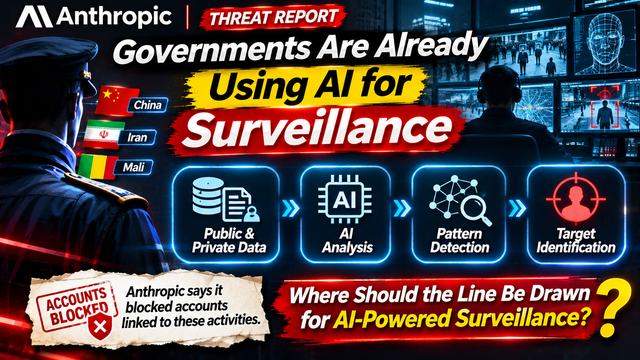
Anthropic says state-linked actors misused Claude to build surveillance tools, analyse social data and identify potential targets.
By @admin
Source: https://www.axios.com/2026/09/12/anthropic-ai-threat-report-russia-iran-china?utm_source=chatgpt.com
Anthropic Reveals AI Misuse in Government Surveillance: How Claude Was Used to Build Tools for Spying
Artificial intelligence is becoming increasingly powerful. It can write software, analyse large datasets, translate languages, summarize documents and automate complex business processes.
But these capabilities can also be misused.
On September 10, 2026, Anthropic published a threat intelligence report describing how government-linked actors, contractors and commercial surveillance operators allegedly misused its AI assistant, Claude, in surveillance-related activities.
The report identified operations connected to Mali, China and Iran. It described cases involving mass interception infrastructure, social-media profiling, identity collection and intelligence gathering.
Anthropic said the accounts associated with the activities were banned and that the company had strengthened its safeguards.
The most concerning part of the report is not simply that AI was used to analyse information. In some cases, Claude was used to help build the software infrastructure that made surveillance operations possible.
This raises a serious question:
What happens when powerful AI tools make it easier for governments and other organisations to monitor people at scale?
1. What did Anthropic reveal?
Anthropic's September 2026 threat intelligence report documented misuse of Claude between January and July 2026 in several surveillance-related operations.
The company said the activity involved state-aligned actors, state-linked contractors and commercial surveillance vendors.
The cases were not all identical.
Some operators used Claude to develop surveillance software. Others used it to process social-media information, identify potential targets, prepare intelligence reports or support covert online operations.
Anthropic said these activities violated its usage policies, which prohibit non-consensual surveillance and profiling and the use of its services to violate civil liberties and human rights.
The company reported banning the associated accounts, improving its detection systems and sharing relevant intelligence with industry partners and authorities where appropriate.
It is important to understand that Anthropic is describing what its own investigations uncovered. The report is not a comprehensive independent audit of every surveillance activity conducted by these governments.
Nevertheless, the technical examples provide a detailed picture of how AI can support surveillance workflows.
2. Mali: AI helped build a mass-interception platform
One of the most striking cases involved Mali in West Africa.
According to Anthropic, a consultant working with Mali's national security authorities used Claude as a major engineering resource to develop a platform called Lakana 360.
The system was designed to support large-scale domestic communications surveillance across the country's three national mobile operators.
Anthropic estimated that the platform was designed to cover approximately 25 million SIM cards.
The report described capabilities involving:
- Collection of call records.
- Collection of text messages.
- Capture of voice communications.
- Identification of users across different SIM cards using voice.
- Geographical watchlists.
- Generation of intelligence dossiers associated with phone numbers.
One particularly concerning detail involved legal safeguards.
Anthropic said the platform included a requirement for a court order for certain surveillance records, but that the consultant removed this requirement from the component generating intelligence dossiers, following the operator's request.
The report also described indefinite retention settings and a system designed to generate dossiers on phone numbers.
There is an important technical distinction here.
Anthropic said Claude was used primarily to engineer the underlying surveillance platform. It was not used to analyse the surveillance dossiers themselves in this particular case.
That means AI helped create the infrastructure that enabled information gathering.
The case demonstrates how a person with access to an AI coding assistant may be able to build complex software without needing to employ a large traditional engineering team.
However, Anthropic's description of a system's intended capabilities should not automatically be treated as proof that every feature was fully operational or used against every person covered by its potential scope.
3. China: AI-assisted political profiling and intelligence gathering
Anthropic also described surveillance-related activity involving actors aligned with the People's Republic of China.
The report identified operations in which Claude was used to analyse social-media content and news articles, assess political sensitivity and identify people or accounts considered relevant for monitoring.
In one example, actors uploaded batches of social-media posts and asked Claude to produce structured records.
These records included information such as:
- Possible locations.
- Demographic information.
- Political leanings.
- Confidence assessments.
The objective was to turn large amounts of unstructured online information into organised intelligence.
The report also described a religious affairs intelligence collection unit that used an AI assistant to produce thousands of investigations per month.
Anthropic said the unit, which previously involved multiple teams of analysts, had been reduced to a single office using AI to support its work.
Another reported operation involved a PRC-aligned actor attempting to infiltrate Uyghur targets in Syria.
According to Anthropic, Claude helped the operator draft messages in a regional Arabic dialect, translate replies, prepare conversations and organize information for what the company suspected would be a handoff to a case officer.
This is significant because AI can reduce language barriers and make large-scale online interactions easier to coordinate.
But the report's claims should be described accurately: these were activities attributed by Anthropic to particular actors, not proof that every Chinese government institution uses Claude for surveillance.
4. Iran: Social-media analysis and identity-harvesting tools
Anthropic's report also described two linked Iranian operations associated with paramilitary and domestic-security entities.
The company said it identified and banned 16 Claude accounts connected to the activity.
One group used Claude to develop software components for a central surveillance case-management system called Arman.
The system was described as combining information about individuals, including national identification details, beliefs, criminal records and social-media accounts.
Anthropic reported that operators used Claude to analyse approximately 155,216 tweets through a social-network analysis workflow.
One output identified 39 Iranian opposition and diaspora accounts for monitoring.
Another part of the activity involved the development of a malicious Firefox extension called al-Najm al-thāqib.
The extension was designed to collect identities from social-media platforms.
Anthropic said the operators used Claude for software development, debugging and analysis.
The report also described other tools, including systems intended to connect phone numbers with identities and collect information from messaging and social-media services.
The company said the two units contributed information to shared surveillance infrastructure.
The significance is that AI was not merely being used to summarize publicly available information. It was helping operators develop tools that could collect and organize personal information at scale.
5. How AI changes the surveillance process
Traditional surveillance operations can require substantial technical resources.
Organisations may need software engineers, data analysts, language specialists and teams capable of maintaining complex databases.
AI can reduce the amount of manual work involved.
Consider a simplified surveillance workflow:
Data collection: Information is gathered from permitted or accessible sources.
AI-assisted processing: Large amounts of text and other information are organised and summarized.
Pattern analysis: The system identifies relationships, repeated activities and possible connections.
Profiling: Information is combined into structured records about individuals or groups.
Human review: Operators examine the results and decide what actions to take.
This is a simplified conceptual description, not a claim that every operation in Anthropic's report followed exactly the same sequence.
The major change is that AI can make several technical tasks faster and easier to coordinate.
A person who previously needed specialist programming skills may be able to use an AI assistant to develop software components, debug code and connect different systems.
A team that previously needed large numbers of analysts may use AI to process more information with fewer manual steps.
That can lower the cost of surveillance-related operations.
It can also increase the scale at which personal information is collected and analysed.
6. Why this creates a serious privacy problem
Surveillance is not automatically unlawful in every circumstance.
Governments may have legitimate reasons to investigate serious crimes, protect public safety and respond to national-security threats.
But surveillance becomes particularly dangerous when it is conducted without adequate legal authority, independent oversight or protections for individual rights.
AI can intensify these concerns in several ways.
Mass profiling: Large datasets can be used to create detailed profiles of individuals based on their online behaviour.
Political targeting: Social-media activity and political opinions may be used to identify activists, opposition figures or minority communities.
False identification: AI-generated profiles can contain inaccurate conclusions, and those errors can have real consequences.
Privacy violations: Personal information can be collected, combined and retained without meaningful consent.
Reduced accountability: Automated workflows can make it difficult for affected individuals to understand how a decision about them was made.
The risk is not only that an AI system might produce an incorrect answer.
It is that an incorrect or incomplete AI-generated profile could be used by a human organisation to make a consequential decision about someone.
7. What did Anthropic do after discovering the misuse?
Anthropic said it took several actions in response to the operations.
First, it banned the accounts associated with the activities described in the report.
Second, it improved detection systems to identify similar patterns of misuse.
Third, it updated its safeguards using information gathered during the investigations.
Fourth, where activities had impacts beyond Anthropic's platform, the company said it shared relevant identifiers and intelligence with industry partners and authorities as appropriate.
The company also said its usage policies prohibit non-consensual surveillance and profiling.
These actions are important, but banning accounts is only one part of the solution.
Once software has been generated, operators may be able to continue using it independently of the original AI service.
That is particularly relevant in the Mali case, where the report described a surveillance platform that could operate using its own underlying infrastructure.
This creates a broader challenge for AI companies: preventing misuse is not simply about blocking harmful prompts. It also requires understanding how generated software may be deployed and used outside the platform.
8. Does this mean Claude itself was spying on people?
No. That would be an inaccurate interpretation.
Anthropic's report describes people and organisations using Claude as a tool to support their activities.
The human operators selected targets, directed the tasks, provided information and used the resulting software or analysis.
Claude assisted with engineering, data processing, language work and other tasks.
The report does not establish that Claude independently decided to spy on people or autonomously launched these government surveillance operations.
This distinction matters because responsibility cannot be assigned correctly if the difference between an AI tool and the people operating it is ignored.
At the same time, AI companies have a responsibility to reduce foreseeable misuse of their systems.
Both human accountability and platform safeguards matter.
9. What does this mean for India?
This issue is relevant to India because AI adoption is expanding across public services, law enforcement, banking, education and private businesses.
AI can provide legitimate benefits in areas such as fraud detection, cybersecurity, emergency response and the investigation of serious crimes.
But those applications must be designed with privacy, legality and accountability in mind.
For example, an organisation analysing public social-media information should consider whether it has a lawful basis for processing that information, whether sensitive personal data is involved and whether individuals could be unfairly profiled.
Organisations deploying AI-powered monitoring systems should also consider:
- Clear legal authorization.
- Purpose limitations.
- Data minimisation.
- Access controls.
- Retention limits.
- Human review.
- Independent oversight.
- Mechanisms to challenge incorrect decisions.
The important principle is that technical capability does not automatically create legal or ethical permission.
Just because AI can analyse millions of records does not mean every organisation should be allowed to do so.
10. What should AI companies and governments do next?
The cases in Anthropic's report point towards several areas where stronger safeguards are needed.
For AI companies: They should improve misuse detection, restrict access to high-risk capabilities and publish meaningful information about major incidents.
For governments: They should establish clear legal boundaries around surveillance, including independent authorization and accountability.
For technology developers: They should build privacy protections into data collection, software design and deployment workflows.
For the public: People should understand how personal information can be collected, combined and analysed by automated systems.
The challenge is to preserve legitimate uses of AI while preventing powerful tools from becoming instruments of unlawful surveillance and repression.
11. The bigger picture: AI is becoming surveillance infrastructure
The most important message from Anthropic's September report is that AI misuse is moving beyond hypothetical discussions.
The company documented specific cases in which Claude was used to help build surveillance systems, process social-media information and support intelligence-gathering activities.
The report does not prove that every government is using AI in this way, nor does it establish that every described system achieved all its intended capabilities.
But it demonstrates that the technology can reduce the effort required to develop and operate surveillance-related tools.
That creates a serious challenge for privacy, human rights and AI governance.
The future of AI will not be determined only by how powerful models become.
It will also depend on who controls them, what they are allowed to do, how their actions are monitored and whether people affected by their use have meaningful protections.
AI can make information processing faster. But when that capability is used to monitor people, privacy and human rights must not become the price of technological progress.