Anthropic MHS: AI Agents Can Control Physical Machines
Anthropic’s MHS creates a common interface for AI agents to interact with programmable physical machines, pushing AI beyond computers into the real world
By singamankitha
Source: https://www.anthropic.com/news/model-hardware-standard-research-preview?utm_source=chatgpt.com
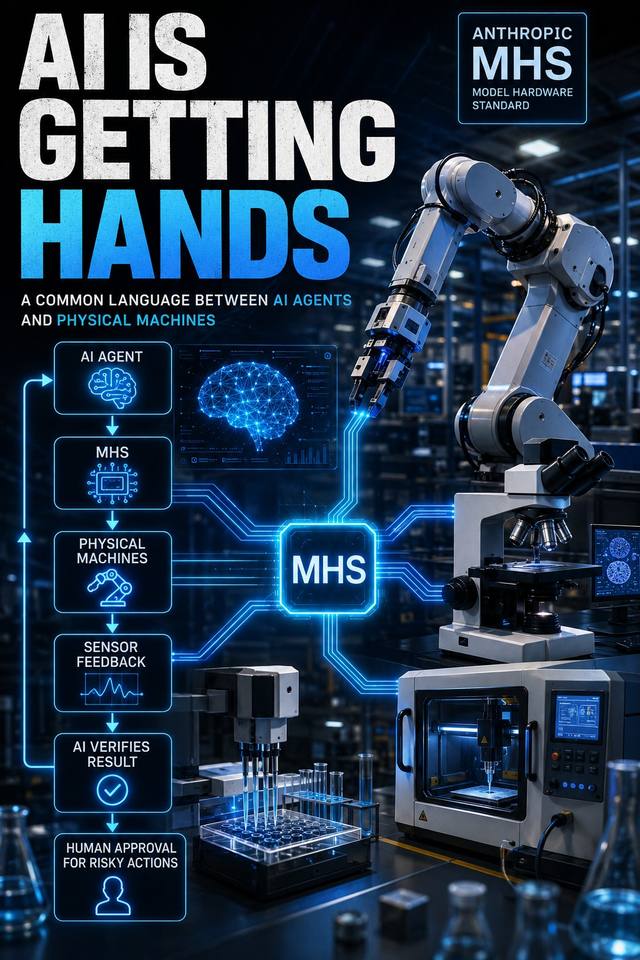
AI Agents Are Getting Hands
AI agents have mostly lived inside computers.
They browse websites, write code, analyze information, use software, call APIs, and perform increasingly complex digital tasks.
But the physical world is different.
A microscope, robotic arm, laboratory instrument, or manufacturing machine can have its own software, commands, protocols, sensors, and control systems.
If you want an AI agent to operate each machine, developers may have to build a separate integration for every device.
Anthropic is now working on a way to address that problem.
On August 27, 2026, Anthropic introduced a research preview of the Model Hardware Standard, or MHS — a specification designed to help AI agents safely operate programmable physical devices.
The bigger story isn't simply a new technical standard.
It's the possibility of moving AI agents from digital environments into the physical world.
From AI → Website → Computer → Machine
Think about how AI has evolved.
Initially, AI mainly generated information.
AI → Text
Then AI started interacting with online services.
AI → Website
Then AI agents began using computers and software.
AI → Computer
Now we're moving toward:
AI → Physical Machine
That could mean AI agents interacting with robots, laboratory instruments, microscopes, manufacturing equipment, and other programmable devices.
This is part of the broader movement toward Physical AI.
Instead of an AI simply telling a person what to do, the AI could potentially perform an action in the physical world.
What Is the Model Hardware Standard?
MHS is intended to provide a common interface between AI agents and physical hardware.
Imagine a laboratory with:
A microscope
A robotic arm
A liquid-handling system
Scientific sensors
Other programmable instruments
Without a common interface, each device may require its own integration.
That creates a lot of development work.
The architecture could look something like this:
AI Agent
↓
Model Hardware Standard
↓
Physical Device
↓
Sensor Feedback
↓
AI Agent
The important concept is the middle layer.
MHS is designed to provide a standardized way for AI agents to interact with compatible hardware instead of requiring completely different approaches for every individual machine.
Why Does Standardization Matter?
Imagine there are hundreds or thousands of different machines.
If an AI company has to create a custom integration for every machine, the complexity can become enormous.
One machine might use one API.
Another might use a completely different protocol.
Another might expose only certain controls.
Another might require specialized software.
Another might have completely different safety requirements.
A common standard could reduce some of that fragmentation.
The concept is similar to what standards have done elsewhere in computing.
Instead of every device speaking a completely different language, a shared interface gives different systems a common way to communicate.
That's the potential value of MHS.
What Could an AI Agent Actually Do?
This is where things get interesting.
Suppose a researcher gives an AI agent a goal:
"Run an experiment and determine which configuration produces the best result."
A future system could potentially work like this:
Step 1 — Understand the goal
The AI interprets what the researcher wants to accomplish.
Step 2 — Create a plan
The agent determines which instruments and actions are required.
Step 3 — Control the equipment
The agent sends appropriate commands through the hardware interface.
Step 4 — Collect data
The instruments perform measurements and return information.
Step 5 — Analyze the results
The AI interprets the measurements.
Step 6 — Decide what happens next
The agent determines whether the experiment succeeded or whether another action is required.
Step 7 — Repeat
The system can continue the cycle.
So the workflow becomes:
Goal
↓
Plan
↓
Act
↓
Observe
↓
Analyze
↓
Correct
↓
Act again
That's much more powerful than simply asking an AI for instructions.
The Feedback Loop Is the Real Story
A physical AI system has to deal with reality.
Reality is unpredictable.
A robotic arm might not move exactly as expected.
A sensor could report an unexpected value.
A laboratory experiment might produce a surprising result.
A machine might encounter an error.
So an intelligent physical system can't simply execute a fixed list of commands and stop.
It needs feedback.
The loop becomes:
Sense → Reason → Act → Observe → Adapt
This is one of the fundamental ideas behind autonomous systems.
The AI takes an action.
The machine reports what happened.
The AI evaluates the result.
Then it decides what to do next.
That creates a continuous interaction between intelligence and the physical environment.
Where Could MHS Be Used?
Anthropic's initial focus includes scientific instruments and advanced manufacturing equipment.
That creates several potential applications.
Scientific Research
Researchers often work with complicated laboratory equipment.
An AI agent could potentially coordinate instruments, automate repetitive operations, analyze measurements, and assist with experimental workflows.
Instead of manually controlling every step, researchers could focus more on designing experiments and interpreting important findings.
Microscopes
Modern microscopes can produce enormous quantities of visual information.
An AI system could potentially control the microscope, select relevant observations, analyze images, and decide which measurements should be taken next.
This could make certain scientific workflows much more automated.
Laboratory Automation
Laboratories often contain multiple programmable instruments.
If those devices expose standardized interfaces, an AI agent could potentially coordinate several machines as part of one larger workflow.
Instead of:
Human → Machine A
Human → Machine B
Human → Machine C
the workflow could become:
Human → AI Agent → Multiple Machines
with appropriate permissions and supervision.
Manufacturing
Factories already use robotic systems and automated machinery.
The next layer could involve AI agents operating those systems at a higher level.
A human could specify an objective.
The AI could potentially break the objective into physical operations, interact with compatible machines, observe the results, and adjust its actions.
That would bring AI reasoning closer to industrial automation.
MHS Doesn't Mean Every Robot Can Now Be Controlled by AI
This distinction is extremely important.
MHS is currently a research preview.
It is not an established universal industry standard that every robot manufacturer has adopted.
It doesn't mean every robot can suddenly connect to Claude.
It doesn't mean factories are becoming fully autonomous overnight.
And it doesn't mean AI has solved physical robotics.
The real announcement is much more specific:
Anthropic is proposing and testing a standardized way for AI agents to interact with programmable physical devices.
That's significant.
But it's still an early-stage development.
Anthropic says it plans to open-source the framework after safety evaluations.
The real test will be whether hardware manufacturers, developers, researchers, and other AI companies actually adopt it.
Model-Agnostic AI Matters
Another interesting aspect is the goal of making MHS model-agnostic.
That means the hardware interface isn't necessarily supposed to belong exclusively to one AI model.
This matters because AI models change extremely quickly.
Today's best model may not be tomorrow's best model.
If hardware integrations are tightly tied to one particular model, changing AI systems could require rebuilding the entire setup.
A model-independent hardware layer could instead look like:
AI Model A
↘
MHS
→ Physical Machine
↗
AI Model B
This could make physical AI systems more flexible.
It also creates the possibility of different AI models interacting with the same standardized hardware layer.
Safety Becomes a Completely Different Problem
This is probably the most important issue.
If an AI gives you a bad answer, you can usually ignore it.
If an AI controls a physical machine incorrectly, the consequences can be much more serious.
Imagine an AI controlling:
A robotic arm
Manufacturing machinery
Laboratory equipment
High-temperature equipment
Precision scientific instruments
A wrong action could damage equipment, destroy samples, waste materials, or potentially injure people.
That's why physical AI requires strong safety mechanisms.
A safer architecture could involve:
AI proposes an action
↓
Permissions are checked
↓
Safety constraints are evaluated
↓
Human approval when necessary
↓
Machine executes
↓
Sensors verify the result
↓
AI receives feedback
The goal isn't simply to make AI powerful.
It is to make AI controllable and predictable enough to operate around physical systems.
Human Approval Could Remain Critical
Not every action should have the same level of autonomy.
For example, an AI might be allowed to automatically adjust a harmless software parameter.
But operating dangerous industrial machinery could require human approval.
This creates different levels of autonomy.
Low-risk action
AI acts automatically.
Medium-risk action
AI acts within predefined limits.
High-risk action
AI proposes the action but waits for human approval.
Emergency situation
The system stops the operation.
This type of permission system could become increasingly important as AI agents gain access to physical infrastructure.
Why This Could Become Bigger Than One Anthropic Project
The interesting part of MHS isn't necessarily Anthropic itself.
The larger question is whether the industry moves toward standardized AI-to-hardware interfaces.
If multiple companies eventually support common interfaces, developers could build AI agents that work across different types of equipment.
That could create an entirely new software layer.
Think of the future technology stack:
AI Models
↓
AI Agents
↓
Hardware Interfaces
↓
Robots & Machines
↓
Physical Environment
The hardware interface becomes the bridge between AI reasoning and physical action.
That bridge could become extremely valuable.
New Opportunities Could Appear
If AI agents start interacting with physical machines at scale, new categories of businesses could emerge.
For example:
AI robotics platforms
Companies could build systems that allow agents to control different robotic hardware.
Industrial AI
Factories could use AI agents to coordinate machines and optimize production workflows.
AI laboratories
Scientific organizations could build automated research environments where AI assists with experiments.
Hardware infrastructure
Companies could build standardized interfaces and middleware between AI systems and machines.
Safety systems
As AI gains physical control, monitoring, authorization, verification, and emergency systems become increasingly important.
The opportunity isn't only:
"Build a better robot."
It could also be:
"Build the infrastructure that lets AI agents operate thousands of different robots and machines."
Physical AI Could Change How We Think About AI Agents
Today, when people hear "AI agent," they often imagine software.
An agent that:
Opens websites
Uses applications
Writes code
Sends messages
Searches databases
Executes digital tasks
Physical AI expands that definition.
A physical AI agent could potentially:
See through cameras
Read sensors
Operate machinery
Move objects
Perform experiments
Manipulate tools
Adapt to physical environments
The agent becomes a bridge between digital intelligence and physical action.
That's a major conceptual shift.
The Long-Term Possibility
Imagine walking into a laboratory in the future.
Instead of manually operating ten different machines, a researcher could tell an AI:
"Run this experiment, test these five configurations, analyze the results, and stop if anything falls outside the safety limits."
The AI could potentially:
Plan the experiment
↓
Configure instruments
↓
Run measurements
↓
Analyze results
↓
Adjust parameters
↓
Run the next test
↓
Generate a report
All while operating under predefined safety constraints.
That doesn't mean this future is guaranteed.
But standardized hardware interfaces could make this kind of workflow easier to build.
What Happens Next?
MHS is still early.
The next important signals to watch are:
1. Open-source release
Anthropic says it plans to open-source the framework after safety evaluations.
2. Hardware adoption
Will manufacturers actually implement MHS?
3. Developer adoption
Will developers build useful AI-agent applications around it?
4. Other AI companies
Will other AI companies support the same standard?
5. Safety research
Can AI systems safely operate physical machines without creating unacceptable risks?
6. Real-world deployments
Will companies use these systems outside demonstrations and research environments?
These factors will determine whether MHS becomes an important industry layer or remains primarily an interesting research project.
The Bigger Picture
The most important takeaway isn't:
"Anthropic created a hardware standard."
The bigger story is that AI agents are gradually moving closer to the physical world.
We've already seen the progression:
AI → Text
↓
AI → Tools
↓
AI → Websites
↓
AI → Computers
↓
AI → Robots & Machines
MHS represents an attempt to make the final connection easier.
The computer was one of the first environments AI learned to operate.
Now the industry is working toward giving AI access to physical environments.
That could eventually change laboratories, factories, robotics, manufacturing, and scientific research.
But there's an important line between possibility and reality.
MHS is currently a research preview.
Its success depends on safety, implementation, hardware support, and industry adoption.
So don't think:
"AI can now control every machine."
Think:
"AI companies are beginning to build the infrastructure that could allow AI agents to control many different machines."
And that distinction matters.
Because once AI can reliably move from:
Reasoning → Action → Feedback → Adaptation
we are no longer talking about AI that only works inside a screen.
We're talking about AI that can interact with the physical world.
And the biggest question of all becomes:
If AI agents can eventually control machines, how much control should we actually give them?
Key Takeaways
1. MHS = Model Hardware Standard.
A research-preview specification from Anthropic for connecting AI agents with programmable physical devices.
2. The goal is standardization.
Instead of building completely different integrations for every machine, MHS aims to provide a common interface.
3. The initial focus includes scientific and manufacturing hardware.
Potential examples include microscopes, laboratory equipment, robotic arms, and manufacturing systems.
4. Feedback is critical.
Physical AI needs to sense what happened, evaluate it, and adapt its next action.
5. Safety is essential.
Controlling physical machines introduces risks that don't exist when AI is only generating text.
6. MHS is not yet a universal industry standard.
It is currently a research preview.
7. Adoption will determine its impact.
Hardware manufacturers, developers, researchers, and AI companies would need to support the approach for it to become widely useful.
8. The bigger trend is Physical AI.
AI is moving from generating information toward interacting with computers, machines, and eventually broader physical environments.
Final Thought
The next generation of AI may not just answer your questions.
It may operate the machines that act on the answers.
AI agents are getting closer to having hands.