Andrew Tulloch Leaves cinematical Meta to Join Anthropic
The AI researcher behind major model projects is moving to Anthropic, intensifying the battle for top AI talent.
By @admin
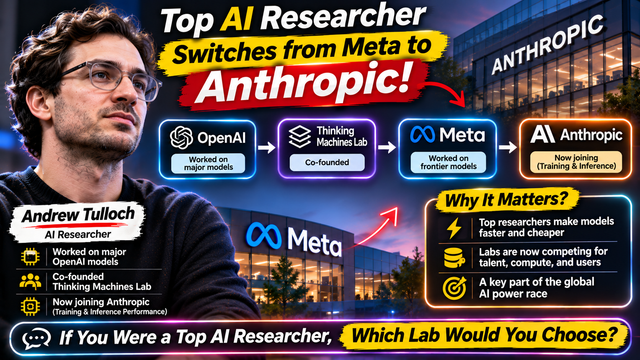
Andrew Tulloch Leaves Meta for Anthropic: Another Major Move in the AI Talent War
The competition between the world's leading artificial intelligence companies is no longer limited to building bigger models or buying more computing power. A major part of the race is happening behind the scenes: attracting the researchers and engineers who know how to build, train and operate advanced AI systems.
In September 2026, prominent AI researcher Andrew Tulloch became the latest high-profile name to move between frontier AI companies. After leaving Meta, he is set to join Anthropic, where he will work on its inference and performance team.
The move is significant because Tulloch has worked across several influential organisations in the AI industry, including Meta, OpenAI and Thinking Machines Lab. His experience connects him to some of the teams and projects shaping modern AI development.
But why does one researcher's move matter so much? And why are companies competing so aggressively for a relatively small group of AI specialists?
1. Who is Andrew Tulloch?
Andrew Tulloch is an AI researcher and engineer known for his work on machine learning systems and large-scale model training.
He spent approximately 11 years at Meta before leaving in 2023 to join OpenAI. During his time at OpenAI, he contributed to work on major models, including GPT-4o, GPT-4.5 and o3, according to reporting and his professional history.
In 2025, Tulloch co-founded Thinking Machines Lab alongside former OpenAI CTO Mira Murati and other researchers. The startup attracted considerable attention because of its founding team and ambitious plans for AI research.
However, his time at the startup was relatively short. He subsequently returned to Meta, joining its AI research organisation as the company increased its investment in advanced AI development.
Now, less than a year after returning to Meta, Tulloch is preparing to join Anthropic.
His career path illustrates how quickly senior AI researchers can move between major research organisations and ambitious startups.
2. Why is he moving to Anthropic?
According to Business Insider, Tulloch is joining Anthropic's inference and performance team.
The team focuses on improving how AI models are trained and how efficiently they respond to users. That may sound like a technical detail, but it is one of the most important challenges facing AI companies.
Building a capable AI model is only part of the problem. Companies also need to serve that model to millions of users without making every request unnecessarily expensive or slow.
This is where inference optimisation becomes important.
Inference is the process of using a trained AI model to generate an answer, produce an image, write code or perform another task. Every time someone sends a prompt to an AI system, the model performs inference.
Improving inference can reduce response times, computing requirements and operating costs.
Training efficiency matters too. Training advanced models requires enormous computing resources, and even relatively small improvements can have substantial financial and operational effects when applied at scale.
Tulloch's experience with large-scale machine learning systems makes this area particularly relevant to his new role.
Anthropic is competing with OpenAI, Google, Meta and other companies to build capable AI systems while making them practical to operate. Experienced researchers who understand both model development and performance optimisation can be strategically valuable.
3. His journey across the AI industry
Tulloch's career is interesting because it connects four important organisations.
Meta: He spent around 11 years working on machine learning systems at Meta before moving to OpenAI. He later returned to Meta in 2025.
OpenAI: He joined OpenAI in 2023 and contributed to work on GPT-4o, GPT-4.5 and o3.
Thinking Machines Lab: In 2025, he co-founded the AI startup with Mira Murati and other researchers.
Anthropic: In September 2026, reports confirmed that he was leaving Meta to join Anthropic's inference and performance team.
This movement is a useful example of how talent circulates across the frontier AI ecosystem.
However, it is important to understand that these organisations are not interchangeable. Each has its own research priorities, products, infrastructure, leadership and business strategy.
A researcher moving between them can bring valuable experience, but that does not automatically mean the new company will immediately outperform its competitors.
4. The reported $1.5 billion compensation story
One detail that attracted enormous attention during Tulloch's earlier recruitment by Meta was a reported compensation package potentially worth as much as $1.5 billion over six years.
That figure became a symbol of how aggressively major technology companies were competing for scarce AI talent.
But there is an important qualification: the reported package was disputed, and the headline figure should not be interpreted as confirmed cash paid to Tulloch.
Large technology compensation packages can include stock awards, performance conditions, vesting schedules and other components. A maximum potential value is not the same as guaranteed compensation or money already received.
There is also no reason to assume that the reported Meta package explains his move to Anthropic. The public reporting does not establish his personal reasons for leaving.
The more reliable takeaway is that leading AI companies are willing to compete intensely for researchers with experience in frontier model development.
5. Why are AI companies fighting for researchers?
The AI industry has three major requirements: computing power, advanced research and the ability to turn that research into useful products.
Money can help companies buy computing infrastructure. It can also fund data centres, hardware and engineering teams.
But experienced researchers are harder to replace.
A researcher who understands large-scale model training may know how to improve training stability, use computing resources more efficiently or solve performance bottlenecks.
An inference specialist may help reduce the cost of serving AI models while improving their speed and reliability.
These improvements can create a competitive advantage.
For example, imagine two companies offering AI assistants with similar capabilities. If one company can deliver comparable answers at a lower operating cost, it may be able to offer cheaper subscriptions, serve more users or improve its profit margins.
That is why AI companies are competing for people who can improve not only model intelligence but also the economics of running those models.
6. Why inference efficiency is becoming a major battleground
The AI industry initially attracted attention through increasingly capable models. But as millions of people began using AI products, the cost of running those models became a major business challenge.
Every user request requires computing resources. More complex requests can require more processing, and large-scale products must handle enormous numbers of requests.
Inference optimisation can involve several areas:
- Hardware utilisation: Getting more useful computation from available accelerators.
- Model optimisation: Improving the efficiency of model operations.
- Memory management: Reducing unnecessary memory usage during generation.
- Serving infrastructure: Distributing requests efficiently across computing systems.
- Latency reduction: Helping users receive responses faster.
- Cost management: Reducing the expense associated with each request.
These improvements matter because a powerful model that is too expensive or slow to serve may struggle as a mass-market product.
The next stage of AI competition will therefore involve more than simply announcing a model with better benchmark results. Companies will also need to make their systems affordable, fast and reliable at scale.
7. What does this mean for India and the global AI ecosystem?
For India, this development is relevant because the country has a growing ecosystem of AI startups, software developers, technology service providers and businesses adopting AI.
Many Indian companies use third-party AI models to build chatbots, automation systems, coding assistants and other products.
When frontier labs improve inference efficiency, those improvements can eventually influence the cost and performance of AI services available to developers and businesses.
For example, a startup building a customer-support agent may benefit if the underlying model becomes faster or cheaper to operate. A software company may be able to offer more AI-powered features without increasing its infrastructure costs at the same rate.
Students and developers should also pay attention to the skills involved in this competition.
Understanding machine learning, distributed systems, GPU computing, model training, inference and optimisation can open opportunities beyond simply learning how to write prompts.
The industry needs people who can build and improve the underlying technology, not only people who know how to use AI applications.
8. The bigger picture: The AI talent war is far from over
Andrew Tulloch's move is one example of a much larger competition.
Meta, Anthropic, OpenAI, Google and emerging AI startups are all trying to attract researchers with specialised knowledge. Some are building new research teams, others are investing in infrastructure, and many are offering highly competitive compensation packages.
But there is no guarantee that hiring a prominent researcher will automatically produce a breakthrough. Research outcomes depend on teams, computing resources, leadership, organisational culture and the ability to execute ideas.
The significance of this move is that it highlights the growing importance of performance engineering and inference efficiency in the AI industry.
The next big advantage may not come only from building the largest model. It could come from building a model that delivers strong results faster, at lower cost and with greater reliability.
For now, Tulloch's move gives Anthropic another experienced researcher as it competes in the frontier AI market.
And the bigger question remains: in the race to build the next generation of AI, which company will be able to attract and retain the people who make it possible?