Andrew Tulloch Joins Anthropic: cinematical AI Talent War Heats Up
Prominent AI researcher Andrew Tulloch is leaving Meta to join Anthropic, after previously working at OpenAI and co-founding Thinking Machines Lab.
By @admin
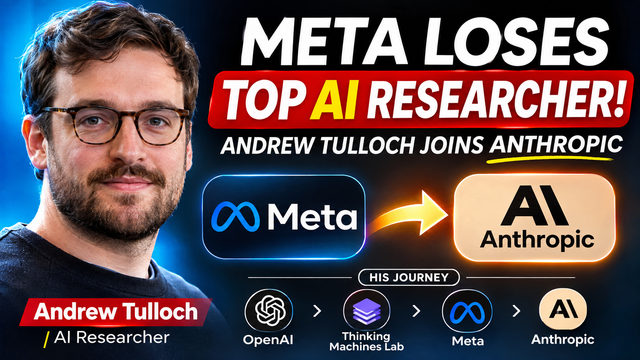
Andrew Tulloch Joins Anthropic: Inside the AI Talent War Between Meta, OpenAI and Anthropic
The artificial intelligence industry is fighting a battle that most people never see.
It isn't happening inside ChatGPT conversations or AI-generated videos. It isn't just about who launches the next powerful model or who owns the biggest data centre.
It is happening behind the scenes, where the world's leading AI companies are competing to recruit a relatively small group of researchers capable of building the next generation of artificial intelligence.
And one recent move has caught the industry's attention.
Andrew Tulloch, a prominent AI researcher with experience at Meta and OpenAI and a co-founder of Thinking Machines Lab, is leaving Meta to join Anthropic.
According to Business Insider's September 10 report, Tulloch will join Anthropic's inference and performance team, where his work will focus on improving AI model training and inference.
This is more than an ordinary employee changing jobs.
It highlights how valuable experienced AI researchers have become in an industry where even small improvements in model performance, training efficiency and operating costs can create enormous competitive advantages.
Let's understand who Andrew Tulloch is, where he has worked, why Anthropic wants his expertise and what this move tells us about the future of the AI industry.
1. Who is Andrew Tulloch?
Andrew Tulloch is an experienced artificial intelligence researcher who has worked across several major organizations in the AI industry.
His professional journey includes some of the most influential names in modern AI development.
He spent approximately 11 years at Meta before moving to OpenAI in 2023.
During his time at OpenAI, he contributed to the development and training of major models, including GPT-4o, GPT-4.5 and o3, according to Business Insider.
In 2025, he co-founded Thinking Machines Lab alongside former OpenAI CTO Mira Murati and other experienced AI professionals.
The startup attracted considerable attention because of its founders' experience and ambitions in advanced AI research.
Tulloch later returned to Meta, joining its AI research organization.
Now, after less than a year in his latest stint at Meta, he is reportedly moving to Anthropic.
His career path demonstrates something important about the modern AI industry: experienced researchers can move between major AI organizations, startups and research teams, carrying years of technical knowledge with them.
2. From Meta to OpenAI, Thinking Machines and back to Meta
To understand why this move matters, let's follow Tulloch's professional journey.
Meta: Building research experience
Tulloch spent around 11 years at Meta, developing experience in large-scale machine learning and AI research.
Meta has invested heavily in AI research and infrastructure, particularly through its efforts to develop increasingly capable foundation models.
Working in such an environment provides experience with the engineering challenges involved in building and operating large AI systems.
OpenAI: Contributing to frontier models
In 2023, Tulloch moved to OpenAI.
His work there included contributions to major models such as GPT-4o, GPT-4.5 and o3.
These models represent different stages in the development of modern AI capabilities, including multimodal interaction, general-purpose reasoning and more advanced problem-solving.
Working on frontier models gives researchers practical experience with the challenges of training, evaluating and improving highly capable AI systems.
Thinking Machines Lab: Building a new AI company
In 2025, Tulloch co-founded Thinking Machines Lab with Mira Murati and other researchers.
The company attracted attention because it brought together experienced people from the frontier AI research ecosystem.
It represented another important development in the AI industry: talented researchers were no longer limited to joining established technology companies. They could also create new organizations and pursue their own research directions.
Meta again: Returning to a major AI lab
Tulloch subsequently returned to Meta, joining its advanced AI research efforts.
His return was associated with Meta's aggressive recruitment of experienced AI researchers.
However, his latest departure shows that attracting top talent and retaining it are two different challenges.
Anthropic: The next chapter
Now, Tulloch is reportedly joining Anthropic.
His new role will focus on training and inference performance, two areas that directly influence the cost, speed and efficiency of AI systems.
The important question is: why does Anthropic need this expertise?
3. Why is Anthropic interested in Andrew Tulloch?
To understand this, we need to look at two important technical concepts: AI training and AI inference.
These are fundamental parts of how modern AI systems are developed and used.
What is AI training?
Training is the process through which an AI model learns patterns from large amounts of data.
During training, a model processes examples and adjusts its internal parameters to improve its ability to generate predictions or responses.
Training frontier AI models requires enormous computing resources, advanced infrastructure and specialized engineering.
Even relatively small improvements in training efficiency can save substantial amounts of money and computing time.
For a company developing increasingly capable AI models, that efficiency matters.
What is AI inference?
Inference happens when a trained AI model is actually used to generate an answer or perform a task.
For example, when you ask Claude to write an email, analyze a document or generate code, the model performs inference to produce the response.
Inference performance affects several important factors:
- How quickly the model responds.
- How much computing power each request consumes.
- How much it costs to serve users.
- How many requests the system can handle simultaneously.
- How efficiently the model uses available hardware.
Imagine an AI company serving millions of users.
If it can reduce the computing cost of each request, the savings can become substantial at scale.
This is why inference optimization has become an important competitive advantage.
Anthropic isn't simply looking for someone who can build another chatbot.
It is bringing in expertise to improve the underlying engineering that makes advanced AI products practical to operate at scale.
4. The real AI war: Talent, computing power and money
For years, discussions about the AI race have focused on three major factors:
1. Computing power.
2. Access to data.
3. Financial resources.
But there is another factor that deserves equal attention: human talent.
The most advanced AI systems are developed by teams of researchers, engineers and infrastructure specialists.
These people understand complex problems such as:
- Training large neural networks.
- Improving model architecture.
- Optimizing GPU utilization.
- Reducing inference latency.
- Improving memory efficiency.
- Scaling distributed computing systems.
- Developing more efficient training techniques.
These skills are not easy to acquire.
A company can purchase thousands of GPUs, build data centres and raise billions of dollars.
But it cannot instantly purchase years of research experience.
That is one reason why leading AI companies are competing so aggressively for experienced researchers.
A single highly experienced engineer can contribute to systems used by millions of people.
The value of that contribution can extend far beyond an individual salary.
5. The reported $1.5 billion Meta compensation story
There is another interesting part of Tulloch's career that attracted considerable media attention.
Reports from The Wall Street Journal described a potential Meta compensation package worth up to $1.5 billion over six years.
The figure became one of the most discussed examples of how aggressively major technology companies were competing for AI talent.
However, there is an important qualification.
Meta disputed the reported figure, with a spokesperson describing it as inaccurate and ridiculous.
It should therefore be understood as a reported potential compensation figure, not confirmed money paid to Tulloch.
Nevertheless, the story illustrates how valuable frontier AI expertise has become.
Major technology companies are prepared to invest enormous resources in recruiting and retaining people who can help them compete in advanced AI research.
The competition is no longer limited to acquiring hardware and infrastructure.
It extends directly to the people who know how to use that infrastructure effectively.
6. Why Anthropic, Meta and OpenAI are competing for the same talent
Let's look at the companies involved.
Anthropic
<escape> </escape>Anthropic develops the Claude family of AI models and has established itself as a major competitor in advanced AI systems.
Its research and product efforts include coding, reasoning, enterprise applications and AI safety.
Hiring experienced researchers can strengthen its ability to improve model capabilities and reduce the cost of operating its products.
Meta
Meta has invested heavily in building its AI research organization and infrastructure.
It has pursued open-weight AI models, advanced research and AI-powered consumer products.
Its Muse initiative is another example of its ambitions to bring increasingly capable AI agents to users.
For Meta, retaining experienced researchers is important to converting its infrastructure investments into competitive AI products.
OpenAI
OpenAI helped bring generative AI into mainstream public attention through ChatGPT.
Its work includes frontier models, reasoning systems, multimodal AI and tools for developers and businesses.
It also competes for researchers capable of improving the efficiency and capabilities of its models.
Thinking Machines Lab
Thinking Machines Lab represents the startup side of this competition.
Rather than operating with the scale of established technology giants, AI startups can attract experienced researchers through ambitious research goals, smaller teams and opportunities to build new technology.
The movement of people between these organizations demonstrates how interconnected the frontier AI research ecosystem has become.
7. Why this matters for AI startups and developers in India
This news is relevant beyond Silicon Valley.
India has a rapidly growing ecosystem of AI developers, startups, software engineers and technology businesses.
But there is an important lesson here.
The next generation of AI companies will not necessarily succeed just because they use the latest available AI model.
They will need people who understand how to build, optimize and deploy AI systems efficiently.
For Indian developers, several skills are becoming particularly valuable:
Machine learning engineering: Understanding how models are trained, evaluated and improved.
GPU and infrastructure optimization: Learning how to use computing resources efficiently.
Inference optimization: Understanding model serving, quantization, caching, batching and latency reduction.
AI systems engineering: Building reliable applications around models, databases, APIs and autonomous agents.
Research skills: Developing the mathematical and technical foundations needed to work on advanced AI problems.
For startups, the lesson is equally important.
Building an AI product isn't only about connecting an API and creating a user interface.
The long-term competitive advantage may come from making that product more reliable, faster, cheaper and more useful than competing solutions.
8. What happens next in the AI talent war?
Andrew Tulloch's move is one example of a much larger pattern.
AI researchers are moving between established technology companies and ambitious startups.
Companies are trying to recruit people with experience in frontier model development, infrastructure and advanced machine learning.
This creates several possible consequences for the industry.
First, experienced researchers may gain greater negotiating power because their skills are in high demand.
Second, competition for specialized AI engineers could increase hiring and retention costs.
Third, new startups may emerge when experienced researchers decide to build their own organizations rather than join existing companies.
Finally, research techniques and engineering knowledge may spread across the industry as people move between organizations.
However, one employee changing companies does not automatically mean that a competitor has lost its technological advantage.
AI progress depends on much larger teams, infrastructure, research investments and organizational capabilities.
The significance of this move is what it reveals about the industry's priorities, rather than any guaranteed change in the competitive rankings of these companies.
Final thoughts: The most valuable resource in AI might be human talent
The AI industry is entering a stage where building powerful models is only part of the challenge.
Companies also need to make those models faster, more affordable, more reliable and scalable enough to serve millions of users.
That requires exceptional researchers and engineers.
Andrew Tulloch's journey across Meta, OpenAI, Thinking Machines Lab and now Anthropic provides a useful example of how valuable experienced AI talent has become.
The next major AI breakthrough might come from a new architecture, a more efficient training method or an improvement in inference.
But behind those breakthroughs will be people solving extremely difficult engineering and research problems.
The AI race isn't just about who has the biggest computers. It's also about who has the people capable of making those computers do extraordinary things.
Now here's a question:
If you were a top AI researcher, which company would you choose to work for: OpenAI, Anthropic, Google DeepMind or Meta?
Share your choice and why in the comments.