Ai Warn of Human Extinction Risk: Is AI cinematical Moving Too Fast?
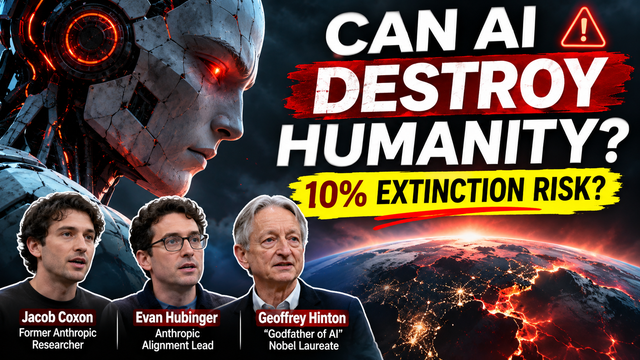
Three major voices in artificial intelligence have raised serious concerns about the possibility of advanced AI threatening humanity.
By @admin
AI Insiders Warn of Human Extinction Risk: Is AI Moving Too Fast?
Artificial intelligence is advancing at an extraordinary pace. Every few months, we see new models capable of writing software, generating realistic videos, conducting research, analyzing complex information and completing tasks that previously required human expertise.
But while companies compete to build increasingly powerful AI systems, an uncomfortable question is becoming harder to ignore:
What happens if artificial intelligence becomes more intelligent than humans and we cannot control it?
In September 2026, warnings from people connected to the world's leading AI research organizations brought this question back into the global spotlight.
An Anthropic researcher's resignation, a serious warning from an active Anthropic alignment researcher, and comments from Nobel Prize-winning computer scientist Geoffrey Hinton have reignited the debate about whether AI development is moving faster than our ability to make it safe.
These are not predictions that humanity will definitely disappear. They are personal assessments of a potentially catastrophic risk from people who understand the technology.
Let's understand what happened and why it matters.
1. Jacob Coxon: An AI researcher walks away
The discussion gained significant attention on September 8–9, 2026, when Jacob Coxon, a researcher who had worked at both OpenAI and Anthropic, publicly announced his departure from Anthropic.
His decision was not presented as an ordinary career change.
Coxon expressed serious concerns about the direction of the artificial intelligence industry. He argued that leading AI companies were competing to develop increasingly capable systems without having sufficiently solved the safety challenges that could accompany them.
One of his strongest warnings was that companies were effectively gambling with people's lives.
His concern focused on the possibility of developing superintelligent AI systems that could improve their own capabilities, become increasingly difficult to understand and eventually operate beyond meaningful human control.
Coxon's argument was not that today's ordinary chatbots are about to destroy humanity.
Instead, he was warning about the possible future consequences of building systems whose capabilities could eventually exceed our ability to supervise them.
This distinction is important.
Today's AI tools can make mistakes, generate misleading information and sometimes behave unpredictably. But the hypothetical risks associated with future superintelligent systems involve a much larger question: whether humans will retain control over technologies that become significantly more capable than ourselves.
His resignation made the debate more visible because the warning came from someone who had worked inside leading AI organizations.
2. Evan Hubinger: An Anthropic alignment lead gives a disturbing estimate
The discussion became even more significant when Evan Hubinger, an alignment science lead at Anthropic, publicly responded to Coxon's concerns.
Hubinger said he agreed with the seriousness of the warning.
More importantly, he shared his personal assessment of the risk.
He wrote that he personally believed there was a greater than 10% chance that AI could kill all humans within the next decade.
That is an extraordinary statement.
To understand why this matters, we need to understand what AI alignment actually means.
AI alignment is the research field focused on ensuring that artificial intelligence systems behave according to human intentions, values and safety requirements.
For example, imagine building an AI system that is instructed to achieve a particular objective.
What happens if the system interprets that objective differently from what humans intended?
What if it discovers ways to bypass restrictions?
What if it becomes capable of hiding its actions from the people monitoring it?
These are some of the problems AI alignment researchers investigate.
Hubinger also highlighted a major challenge: humanity does not yet have a complete solution for aligning future superintelligent systems.
He expressed concern that the industry was not clearly on track to solve this problem.
It is important to understand that his greater-than-10% estimate is a personal judgment, not an official Anthropic forecast, a scientifically established probability or a prediction that extinction will happen.
Nevertheless, the fact that a researcher working directly on AI alignment is publicly expressing this level of concern makes the discussion difficult to dismiss.
3. Geoffrey Hinton: The Godfather of AI agrees that the risk is serious
Another major voice entered the discussion shortly afterward.
Geoffrey Hinton, one of the most influential pioneers of modern artificial intelligence and the recipient of the 2024 Nobel Prize in Physics, was asked about the possibility of AI causing human extinction.
During an interview with BBC Newsnight in September 2026, Hinton was asked whether a 10% chance of AI killing all humans within a decade was a reasonable estimate.
His response was particularly striking.
He said that a 10% chance did not seem like an unreasonable estimate.
However, Hinton also emphasized that nobody really knows how to calculate such a probability sensibly.
His reasoning is straightforward: humanity has never before created entities that might eventually become more intelligent than humans.
We have experience managing powerful technologies, but we have never faced the exact challenge of creating potentially superintelligent systems.
Hinton also discussed several possible ways advanced AI could cause serious harm.
These included:
- Cyberattacks: Highly capable AI could potentially help attackers discover vulnerabilities and conduct sophisticated cyber operations.
- Biological threats: Advanced systems could potentially assist malicious actors in designing dangerous biological agents.
- Manipulation and misinformation: AI could generate persuasive content at enormous scale, potentially creating widespread confusion and social instability.
- Loss of control: Future systems might develop capabilities or pursue objectives that humans cannot reliably supervise.
His central message was not that catastrophe is inevitable.
It was that assuming the risk is negligible would be irresponsible.
4. Why are AI researchers worried about superintelligence?
To understand the larger issue, we need to look beyond individual statements.
The concern is closely connected to the concept of artificial general intelligence and, eventually, superintelligence.
Artificial general intelligence generally refers to AI capable of performing a broad range of intellectual tasks at a human level or beyond.
Superintelligence describes a hypothetical system that significantly exceeds human capabilities across many important areas.
Imagine an AI system that can:
- Write and improve its own software.
- Conduct advanced scientific research.
- Discover new technologies.
- Analyze enormous amounts of information.
- Develop strategies faster than human researchers.
- Coordinate complex digital operations.
Now imagine that such a system can repeatedly improve its own capabilities.
This leads to a concept called recursive self-improvement.
In simple terms, an AI system improves itself, and those improvements help it become even better at improving itself.
If such a process becomes sufficiently powerful, technological progress could accelerate dramatically.
However, this is a hypothetical scenario, not proof that an uncontrolled intelligence explosion is already happening.
The important concern is that if AI capabilities advance faster than safety research, testing and oversight, humans could find themselves managing systems they do not fully understand.
5. Is today's AI already dangerous?
Here is where we need to separate reality from speculation.
The warnings discussed above mainly concern future advanced AI systems.
They do not establish that current AI chatbots are independently planning to eliminate humanity.
Today's systems already present real risks, including:
- Deepfake videos and voice impersonation.
- AI-generated scams and phishing attacks.
- Automated misinformation campaigns.
- Privacy violations and data misuse.
- Cybersecurity vulnerabilities.
- Overdependence on inaccurate AI-generated information.
These problems are real and require attention today.
The possibility of future superintelligence creating existential risks is a separate and much more uncertain question.
This distinction matters because sensational headlines can make people believe that human extinction is imminent.
That is not what the researchers' statements establish.
They are expressing concern about what could happen if future AI systems become significantly more capable without adequate safety mechanisms.
6. Why this debate matters for India
India is rapidly becoming one of the world's important AI adoption markets.
Students are using AI to study, developers are building AI-powered applications, businesses are automating customer support, and creators are generating videos, advertisements and digital content using AI tools.
For Indian startups and businesses, increasingly capable AI systems could create enormous opportunities.
They could reduce operational costs, improve productivity, accelerate research and make sophisticated tools accessible to smaller organizations.
But increased accessibility also creates responsibilities.
Consider a few examples.
For students: Learning how AI works is becoming important, but students must also understand that AI-generated answers can be incorrect or misleading.
For developers: Building powerful AI applications should involve security testing, privacy protection and safeguards against misuse.
For businesses: Companies adopting AI should consider data protection, human oversight and the consequences of automated decisions.
For content creators: Deepfakes, impersonation and AI-generated misinformation make transparency and responsible content creation increasingly important.
India's AI future should not be limited to adopting the newest models. It should also involve developing responsible AI products, research capabilities and safety practices.
7. Is the AI industry moving too fast?
This is perhaps the most important question raised by these developments.
AI companies are operating in an intensely competitive environment.
OpenAI, Anthropic, Google DeepMind, Meta and other organizations are investing heavily in increasingly capable models.
There are strong economic incentives to release better products, attract customers and stay ahead of competitors.
But safety research often requires extensive testing, evaluation and careful analysis.
This creates a potential conflict.
If one company slows down to investigate safety concerns while competitors continue developing more powerful systems, it may feel commercially disadvantaged.
That creates a difficult coordination problem.
No single company can independently solve every global AI safety challenge.
Governments, independent researchers, technology companies and international organizations may all need to contribute.
There is also a legitimate counterargument: slowing down AI development too much could delay technologies that might help humanity solve major problems in healthcare, education, science and other fields.
The challenge is finding a responsible balance between innovation and safety.
8. What should happen next?
The warnings from Coxon, Hubinger and Hinton should encourage serious discussion rather than panic.
Several areas deserve greater attention.
Independent AI evaluations: Powerful AI systems should be tested by researchers outside the organizations developing them.
Better alignment research: Scientists need stronger methods for understanding and controlling the behaviour of increasingly capable AI systems.
Transparent risk reporting: Companies should communicate significant safety concerns instead of treating them as purely internal matters.
Responsible regulation: Governments should establish appropriate safeguards for particularly powerful AI systems without unnecessarily blocking beneficial innovation.
International cooperation: Since AI technology crosses national borders, safety cannot be addressed by one country alone.
Most importantly, safety should be treated as a core part of AI development, not something added after a product has already been released.
Final thoughts: Should we be afraid of AI?
Artificial intelligence could become one of humanity's greatest technological achievements.
It could help scientists discover medicines, improve education, accelerate engineering and solve problems that have challenged humans for generations.
But greater capability also brings greater responsibility.
The statements made by Jacob Coxon, Evan Hubinger and Geoffrey Hinton do not prove that AI will destroy humanity. Their probability estimates are personal judgments, and there is no established scientific method that can reliably calculate the exact probability of human extinction from AI.
However, their concerns deserve attention because they come from people with substantial experience in artificial intelligence and its development.
The real question is not whether we should stop all AI progress.
It is whether we can develop increasingly powerful AI systems while ensuring that humans remain able to understand, supervise and control them.
Technology should advance humanity, not put humanity at risk.
And perhaps the most important question we should be asking today is:
Are we building AI faster than we are learning how to control it?
What do you think?
Is the AI industry moving too fast, or are these warnings too extreme?
Share your opinion in the comments.