AI Agents Are Becoming Full Software Teams|Flux AI news
Kiro now supports more autonomous software workflows, while Unified.to released 100+ reusable Agent Skills for AI coding agents.
Source: https://unified.to/blog/september_2026_product_update
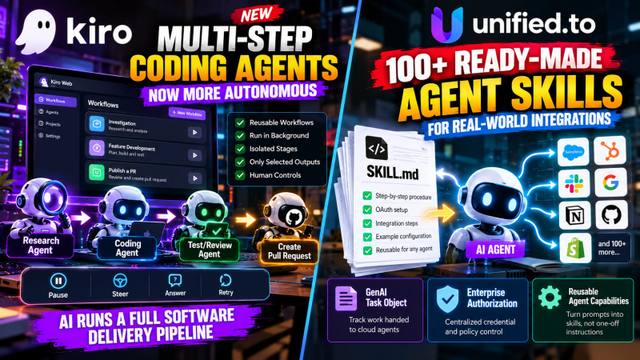
AI coding is moving beyond simply asking a model to write a piece of code. The latest developments from Kiro and Unified.to point toward a future where AI agents can coordinate multi-step development work and reuse specialized capabilities across real-world integrations.
Kiro Web is pushing toward more autonomous software development. Its autonomous mode allows an agent to take a high-level goal, build a plan, delegate work to specialized sub-agents, execute the work and ultimately open a pull request. Kiro Web also supports cloud sessions, allowing work to continue in an isolated environment while the user is away.
The important shift is from “AI writes code” to “AI runs a software-delivery workflow.”
Instead of manually moving between research, implementation, testing and review, agentic workflows can coordinate these stages. A typical pipeline can look like:
Research agent → Coding agent → Test/Review agent → Pull Request
Kiro's documentation also describes workflows as a way to orchestrate multiple agents through explicit stages, including pipelines where one stage's output becomes the input for another and separate agents can verify results.
At the same time, Unified.to is making another important part of agent development more reusable: skills.
In its September 2026 product update, Unified.to announced more than 100 free Agent Skills in SKILL.md format. These skills teach coding agents how to build integrations using specific APIs, including authentication, endpoints, pagination, SDK usage and synchronization patterns. More than 80 of the skills guide agents through registering OAuth2 applications in vendor developer portals.
Unified.to also added a GenAI Task capability for work handed to cloud coding agents. The task model can track information such as instructions, status, repository, branches, pull-request URL, files changed and token usage.
This creates a broader trend: prompts are becoming reusable agent capabilities.
Instead of repeatedly explaining how to connect an application to Salesforce, HubSpot, accounting software or another service, developers can provide an agent with a structured skill that contains the procedure it needs.
The bigger picture is clear: AI development is moving from individual prompts toward orchestration, reusable skills and autonomous workflows.
The next generation of coding tools may not just write your code. They may research the problem, build the feature, test it, connect external services and prepare the pull request—with humans still reviewing the final result.