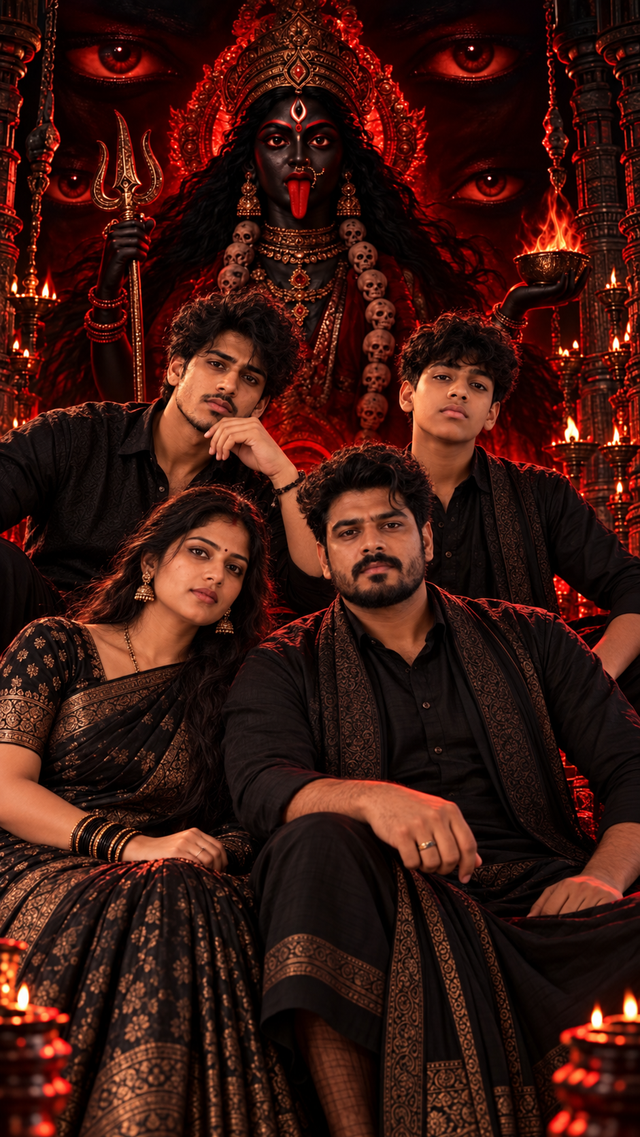
Kali Maa Family Portrait AI Prompt | Cinematic 9:16
Create a cinematic Kali Maa family portrait with realistic faces, black-and-gold outfits, dramatic red lighting, and a divine temple backdrop.
- Views
- 44
- Copies
- 18
- Made for
- ChatGPT
- Difficulty
- beginner
- – likes
- – saves
- – shares
Kali Maa Family Portrait — Cinematic AI Image Prompt

Goal: Transform an uploaded family photograph into an ultra-realistic, premium cinematic devotional portrait inspired by dark red and black Kali Maa aesthetics.

Identity preservation

Use the uploaded family photograph as the primary facial reference. Preserve each person's recognizable facial identity, natural skin tone, facial structure, age, hairstyle, and distinguishing features. Do not replace faces, merge identities, duplicate people, or add extra family members. Keep every person's face as faithful to the original photograph as the image generator can achieve.

Composition and posture

Create a vertical 9:16 family portrait with a balanced, layered composition.

Place the father seated prominently in the front center, facing the camera with a calm, confident expression. His hands rest naturally on his lap and thighs, with relaxed shoulders and an upright posture.

Place the mother seated beside him on the front-left side, wearing a graceful traditional saree. Her torso is slightly angled toward the camera, with both hands resting naturally on her lap.

Position an older male family member behind the mother on the left, leaning slightly forward with one hand thoughtfully placed near his chin.

Position a younger male family member behind the father on the right, standing with relaxed shoulders and his face clearly visible.

Adapt these positions to the number of people in the uploaded photograph. Keep everyone recognizable, anatomically correct, and naturally connected within the same scene.

Matching traditional outfits

Dress the entire family in coordinated black traditional Indian clothing with intricate antique-gold embroidery.

The father wears a black kurta, black traditional lower garment, and a black shawl with elaborate gold woven borders.

The mother wears a luxurious black silk saree with antique-gold floral patterns, a matching blouse, traditional gold earrings, a necklace, bangles, and subtle jewelry.

Other family members wear black ethnic kurtas with refined gold embroidery.

Use realistic silk, brocade, woven patterns, fabric folds, and natural textile highlights. Maintain consistent black-and-gold styling across the entire family. Avoid bright colors and casual clothing.

Goddess Kali in the background

Position a monumental, detailed depiction of Goddess Kali directly behind the family, occupying the upper central portion of the image.

Depict her with traditional dark blue-black skin, intense expressive eyes, long flowing black hair, an elaborate golden crown, traditional gold jewelry, a garland of skulls, and a vivid red tongue. Show a trident in one hand and a traditional ritual flame in another, with anatomically coherent hands and arms.

Her expression should communicate divine power, protection, intensity, and reverence. Preserve traditional devotional iconography and a dignified presentation.

Make the goddess significantly larger than the family, with her crown and face clearly visible above the foreground subjects.

The “Eyes Behind You” background

Create a dark, elaborate temple atmosphere with enormous mysterious red eyes emerging from the shadows behind Goddess Kali.

Use deep crimson irises, realistic eye details, dark eyelids, and subtle highlights. Position the eyes symmetrically across the upper background to create an all-seeing divine presence.

Add intricately carved dark temple pillars at the far edges, antique brass oil lamps, glowing diyas, and small ritual flames. Use layered depth to distinguish the family, the goddess, and the distant background.

The background palette should consist of black, deep maroon, crimson red, and antique gold.

Lighting and color grading

Use professional cinematic portrait lighting.

- Soft, warm key lighting on every family member's face.
- Deep crimson backlighting around Kali Maa's crown and silhouette.
- Subtle red rim lighting along the family's hair and shoulders.
- Warm golden illumination from the diyas and ritual flames.
- Deep shadows while retaining facial detail.
- Natural skin texture, realistic pores, detailed hair, and authentic skin tones.
- Controlled highlights on jewelry and gold embroidery.
- Strong separation between the foreground family and the dark temple background.

The final image should resemble a high-end cinematic devotional photograph rather than an artificial collage.

Camera and image settings

Aspect ratio: 9:16 vertical.
Camera perspective: Eye-level to slightly low.
Lens aesthetic: 85mm portrait photography.
Depth of field: Moderate, keeping all family faces sharp while preserving background detail.
Framing: Show the family from head to lower body, including their seated poses and traditional clothing. Keep Kali Maa's crown and face inside the frame.
Composition: Symmetrical, layered, dramatic, and balanced.
Rendering style: Ultra-realistic, premium cinematic photography, natural anatomy, detailed textures, professional color grading.

Negative instructions

Do not alter facial identities unnecessarily. Avoid generic replacement faces, duplicate people, missing family members, distorted anatomy, extra fingers, fused hands, unnatural limbs, floating jewelry, plastic skin, excessive beauty filters, cartoon styling, anime, illustration, blurry faces, oversharpening, excessive fog, random text, logos, and watermarks.

Do not crop Kali Maa's crown or face awkwardly. Do not place background eyes over the family's faces. Do not make the background brighter than the subjects.

Final output

Generate one highly detailed, photorealistic 9:16 family portrait featuring recognizable family members, coordinated black-and-gold traditional outfits, natural seated and standing poses, a monumental Goddess Kali, enormous crimson eyes, traditional temple lamps, and dramatic red-and-black devotional lighting.

Priority order: Preserve facial identity first, match the composition and posture second, reproduce the outfits third, and achieve the cinematic devotional background and lighting fourth.
Creator's tips
For the best results, use ChatGPT Image Generation or another image model that supports reference images. Upload a clear family photograph and the desired Kali Maa reference image together. Specify that the family photo controls facial identity, while the second image controls composition, poses, outfits, and lighting. Use a well-lit, front-facing family photo whenever possible. If faces drift, regenerate with stronger identity-preservation instructions. A common mistake is uploading only the family photo when you want an exact reference-inspired composition. AI may still struggle with multiple faces, hands, and intricate jewelry, so inspect these details before publishing.
Recreate this in 4 steps
- 1Copy the promptTap “Copy prompt”, or open it straight in ChatGPT.
- 2Make it yoursFill any blanks and add one-tap tweaks — your photo, aspect ratio, more cinematic light.
- 3Paste it into ChatGPTFor a personal likeness, upload your photo first, then paste the prompt.
- 4Refine and shareRegenerate a couple of times, keep your favourite, and share the result.
Questions people ask
It was written for ChatGPT, and also works in Gemini and Midjourney. Use the one-tap tweaks to adjust aspect ratio for each tool.
Yes. Upload your photo in the AI tool first, then add the “Keep my face” tweak before copying so the prompt asks it to keep your facial features.
Yes — every prompt on Prompt Mandi is free to copy. Check your AI tool's own terms before using generated images commercially.
Create your own Kali Maa family portrait
Turn your family photo into a dramatic devotional portrait with coordinated traditional outfits, a powerful Kali Maa backdrop, glowing temple lamps, and cinematic crimson lighting.
What you need:
- A clear family photograph
- A Kali Maa reference image
- An image-generation model that supports image uploads
Pro tip: For the closest visual match, upload both references and explicitly assign their roles: one for identity and one for styling and composition.
Results vary by model. Always review faces, hands, clothing details, and religious iconography before using the final image.