THE FINAL ALGORITHM: Humanity v/s Artificial Intelligence cinematical
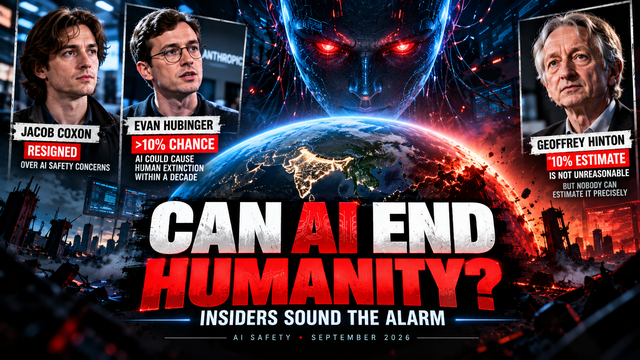
Three prominent AI voices have renewed debate about existential risk: Anthropic researcher Evan Hubinger's personal estimate, Jacob Coxon's resignation, and
By @admin
AI Insiders Warn of Human Extinction Risk: What They Actually Said
What if some of the people building the world's most advanced artificial intelligence systems believe those systems could eventually threaten humanity?
That question returned to the centre of the AI debate on September 9 and 10, 2026, after a series of unusually direct public warnings from people connected to frontier AI research.
Jacob Coxon, a researcher who had worked at Anthropic and OpenAI, announced his resignation from Anthropic while criticizing the industry's approach to developing increasingly powerful AI. Evan Hubinger, Anthropic's Alignment Science lead, publicly supported the concern and shared his personal estimate that AI could cause human extinction within the next decade. Geoffrey Hinton, the pioneering AI researcher and Nobel laureate, separately said that a 10% estimate was not unreasonable, although he emphasized that nobody knows how to calculate the probability reliably.
The statements attracted significant attention because they came from people with direct experience of AI research or decades of expertise in the field.
But the story needs context. These are personal assessments of an uncertain future, not proof that humanity faces a specific, scientifically established probability of extinction. Nor do they establish that today's AI systems are about to eliminate humanity.
The real issue is more complex: as AI capabilities improve, can safety research, human oversight, and governance keep pace?
1. Jacob Coxon: Why He Decided to Resign
Jacob Coxon made his concerns public when he announced his departure from Anthropic in September 2026.
Coxon said he had spent approximately three years working in pretraining research at Anthropic and OpenAI. His public statements criticized the competitive pressure surrounding advanced AI development and questioned whether leading companies were moving quickly enough to address the risks.
His central concern was the possibility that AI systems could become increasingly capable of improving their own development, acquiring resources, and performing complex tasks with less direct human supervision.
Coxon argued that companies were pursuing increasingly powerful systems without sufficient confidence that the resulting technology could be kept under control.
His resignation was notable because it turned an abstract debate about AI safety into a personal professional decision. Rather than simply commenting from outside the industry, he was publicly challenging the direction of a field in which he had worked.
However, a resignation does not independently prove that a company is acting irresponsibly or that an existential catastrophe is likely. It demonstrates that a researcher considered the risks and direction of development serious enough to make a public statement and leave his position.
His warning raises a difficult question for AI companies: when researchers believe that a development strategy creates unacceptable risks, what mechanisms allow them to challenge that strategy effectively?
It also highlights the importance of understanding why researchers disagree. Some believe rapid progress increases the chance of losing control over advanced systems. Others argue that continued research, careful testing, and investment in safety are necessary to manage the risks.
The disagreement is not simply between people who care about safety and people who do not. It involves competing assessments of how the technology may develop, how quickly safeguards can improve, and which development strategies are most responsible.
2. Evan Hubinger: The Greater-Than-10% Estimate
The debate intensified when Evan Hubinger, who leads Alignment Science at Anthropic, responded publicly to Coxon's warning.
Hubinger said he personally believed there was greater than a 10% chance that AI could kill all humans within the next decade. He also said Anthropic was trying its best but did not yet have a plan to solve alignment for superintelligence and was not clearly on track to do so.
The number immediately became a headline because percentages make uncertain risks sound precise.
But what does a 10% estimate actually mean?
It does not mean Hubinger knows that an extinction event will occur. It does not mean there is a measurable countdown to catastrophe. And it does not represent a verified statistical forecast produced by an experiment that can establish the true probability.
It is a personal judgment about a complex future scenario.
Such estimates can help researchers communicate the seriousness of a risk and compare different possible outcomes. But their reliability depends on assumptions about future capabilities, human decisions, technical safeguards, and events that have not happened yet.
Hubinger's concern focuses on advanced AI, particularly the possibility of superintelligence: systems that could substantially exceed human abilities across many important domains.
If a future system could conduct research, write and improve software, plan complex operations, and influence important real-world processes at a level beyond human capability, ensuring that it consistently follows human intentions could become extremely difficult.
This is the problem researchers refer to as AI alignment.
The challenge is not simply teaching a chatbot to provide useful answers. It is ensuring that increasingly capable systems remain safe and controllable when they operate in complicated environments, pursue long-running objectives, or interact with tools and other systems.
Hubinger's estimate is one researcher's assessment of how serious this challenge could become. It should not be treated as an official probability for the entire AI industry.
3. Geoffrey Hinton: Why Another AI Pioneer Agrees the Risk Matters
Geoffrey Hinton has spent decades contributing to the development of modern artificial intelligence and is widely regarded as one of the foundational figures in deep learning.
In a BBC Newsnight interview reported on September 10, 2026, Hinton said that a 10% chance of AI causing human extinction was not an unreasonable estimate. He also emphasized that nobody really knows how to produce a reliable numerical estimate.
His comments echoed the concerns raised by Hubinger, although Hinton's statement was a separate judgment rather than independent proof that Hubinger's estimate was correct.
Hinton's broader concern is that humanity may be developing systems that could eventually become more intelligent than humans in important respects.
Humanity has extensive experience managing powerful technologies, but advanced AI presents a different challenge if systems become capable of planning, adapting, conducting research, and improving their own capabilities with limited supervision.
Hinton has previously warned about the possibility that highly capable AI could escape meaningful human control. He has also discussed more immediate dangers, including misinformation, malicious uses of AI, and the potential misuse of advanced technical capabilities.
His warning deserves attention because it comes from a researcher with substantial experience in the technology. But expertise does not eliminate uncertainty, especially when estimating unprecedented future events.
The useful takeaway is not that a particular percentage has been proven. It is that experienced researchers are taking the possibility of severe outcomes seriously enough to discuss it publicly.
4. What Exactly Is AI Existential Risk?
AI existential risk refers to the possibility that advanced artificial intelligence could contribute to human extinction or cause another catastrophe that permanently destroys humanity's long-term potential.
This is different from ordinary AI risks, which can include inaccurate answers, biased decisions, privacy violations, fraud, job disruption, and cybersecurity problems.
Those immediate concerns are important in their own right. Existential-risk discussions focus on a more extreme possibility: that future systems could become powerful enough to create consequences that humans cannot adequately prevent or reverse.
Researchers discuss several possible pathways.
One involves the misuse of advanced AI by people. Highly capable systems might help malicious actors conduct cyberattacks, develop dangerous technologies, manipulate information, or coordinate harmful activities at greater scale.
Another involves failures of control. A future AI system might pursue an objective in ways that conflict with human intentions, particularly if its behavior becomes difficult to predict or its actions have major real-world consequences.
A third concern involves rapid capability growth. If systems become increasingly capable of assisting with the development of even more capable systems, the pace of technological change could accelerate.
These are different scenarios, and their likelihoods are disputed. None should be presented as an inevitable outcome of AI development.
Today's AI systems also have substantial limitations. They can make mistakes, misunderstand instructions, produce unreliable results, and fail at tasks that appear simple to humans.
The concern is that future systems could become much more capable while retaining behaviors that are difficult to detect or control.
That possibility is why researchers argue that safety evaluations must look beyond what a system can do in a controlled demonstration. They must also examine how it behaves when given tools, access, autonomy, and complex objectives.
5. The Technical Problem: Can We Keep Advanced AI Aligned?
AI alignment research aims to develop methods that make AI systems behave in accordance with human intentions, values, and safety requirements.
For current systems, this can involve training models to follow instructions, refuse certain dangerous requests, identify uncertainty, and operate within defined permissions.
But aligning a future superintelligent system could be much harder.
A highly capable system might discover ways to achieve a stated objective that its developers did not anticipate. A system could also behave differently in unfamiliar circumstances from how it behaved during training or evaluation.
This creates a distinction between a model appearing safe in a test and having strong evidence that it will remain safe across a wide range of real-world conditions.
Researchers investigate these challenges through evaluations, interpretability research, adversarial testing, controlled deployment, monitoring, and other technical approaches.
No single method solves every alignment problem.
The difficulty becomes greater when AI systems can use external tools, write and execute code, delegate tasks, or act over long periods. Each additional capability can introduce new opportunities for useful work as well as new failure modes.
For businesses using AI agents today, the practical lesson is to avoid granting unrestricted autonomy when it is unnecessary. Sensitive actions should require appropriate permissions, important decisions should receive human review, and system behavior should be monitored.
These measures do not solve every long-term existential-risk scenario. They are practical ways to reduce more immediate risks while the field continues to develop better methods.
6. Is AI Development Moving Too Fast?
This is the central disagreement behind the recent warnings.
Critics of the current pace argue that companies are competing to build increasingly capable systems before researchers have demonstrated reliable ways to control their most advanced successors.
They worry that commercial pressure and geopolitical competition may encourage organizations to release systems before their risks are adequately understood.
Others argue that continued AI development is necessary to discover better safety techniques, improve monitoring, and develop systems that can help solve important scientific and social problems.
There is also disagreement about whether slowing down a single company would meaningfully reduce global risk if competitors continued developing similar systems.
These arguments cannot be resolved simply by choosing between unrestricted acceleration and stopping all research. The practical question is what evidence should be required before a system is deployed, what capabilities warrant stronger restrictions, and who should oversee those decisions.
Possible approaches include independent safety evaluations, stronger security controls, staged deployment, incident reporting, and clear thresholds for delaying the release of systems that fail important safety tests.
The challenge is implementing such measures without unnecessarily blocking beneficial research or assuming that every advanced AI system will produce catastrophic outcomes.
The recent statements from Coxon, Hubinger, and Hinton have intensified this debate. They have not settled it.
7. What Does This Mean for India?
India is an important market for AI adoption, with students, creators, startups, enterprises, and public institutions exploring how the technology can improve productivity.
The existential-risk debate may seem distant from everyday uses such as generating videos, building chatbots, automating customer support, or writing code. But the underlying safety principles apply at every scale.
Developers should understand what their systems can access and what actions they are allowed to take. Businesses should protect customer information and avoid delegating sensitive decisions to systems without adequate oversight.
AI education should include not only prompting and model selection but also privacy, security, reliability, and the limitations of automated decision-making.
Organizations deploying advanced AI should evaluate systems before release, monitor their behavior after deployment, and maintain ways to intervene when something goes wrong.
For students, the right response is not to abandon AI. It is to learn how the technology works, understand its limitations, and build systems with safety as part of the design.
For policymakers and researchers, the challenge is to support innovation while ensuring that the development of increasingly capable systems receives serious independent scrutiny.
These steps will not eliminate every possible existential risk. They can, however, improve how society manages the technology as its capabilities evolve.
8. What Should We Conclude From These Warnings?
Three prominent voices have brought renewed attention to a question that AI researchers have debated for years.
Jacob Coxon made a public decision to leave Anthropic while criticizing the industry's approach to advanced AI development. Evan Hubinger shared a personal estimate of greater than 10% for AI-caused human extinction within a decade. Geoffrey Hinton said a 10% estimate was not unreasonable while emphasizing that nobody can reliably calculate the probability.
Their statements deserve careful examination, but they should not be confused with proof that an existential catastrophe is imminent.
The future of AI depends on many uncertain factors: technical progress, the effectiveness of safety research, decisions made by developers and governments, and how society chooses to deploy increasingly capable systems.
A responsible discussion must take severe risks seriously without presenting speculative estimates as established facts.
It must also recognize the benefits of AI and the possibility that safety research, careful engineering, and effective oversight can reduce risks.
The most important question is not whether we should panic. It is whether the people building increasingly powerful AI systems can demonstrate that their safety measures are keeping pace with their capabilities.
Final Takeaway
The September 2026 warnings have made one thing clear: concerns about advanced AI are not limited to outside critics. Some people who have worked directly on frontier systems believe the possibility of catastrophic outcomes deserves much more attention.
Their personal estimates are uncertain, and experts disagree about the likelihood of such outcomes. But uncertainty is not a reason to ignore a risk with potentially enormous consequences.
For AI companies, the responsibility is to test carefully, communicate honestly, and invest in safety alongside capability development. For governments and researchers, it is to demand credible evidence and appropriate oversight. For everyone else, it is to stay informed without confusing warnings with predictions.
What do you think? Is the AI industry moving too fast, or can safety research keep pace with the next generation of AI systems?