TCS Enterprise AI Agents: New Governance Platform
TCS is developing a governance platform to manage enterprise AI agents across business applications. Discover how AI agent orchestration,security,cost control,and automation could transform businesses and create new opportunities for Indian students and creators.
TCS Enterprise AI Agents: Why AI Governance Matters
Introduction
Artificial intelligence is moving beyond answering questions and generating text. Businesses are increasingly exploring AI agents that can use tools, interact with software applications, coordinate tasks, and automate complex workflows. However, deploying multiple AI agents across a large company creates new challenges involving security, cost, reliability, and control.
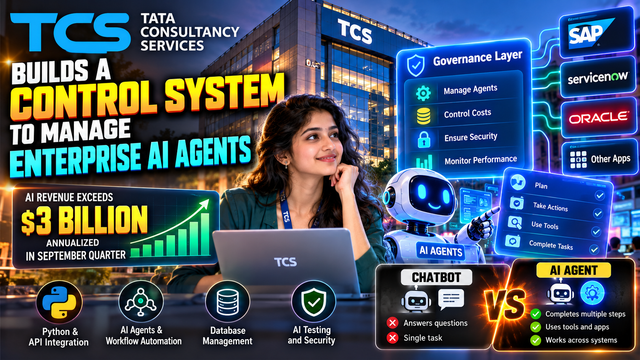
Tata Consultancy Services (TCS) is developing an enterprise AI platform with a governance layer designed to coordinate AI agents from different providers. The initiative reflects a broader shift toward making AI agents useful in real business environments.
According to The Financial Express report published on October 12, 2026, TCS is working on a system intended to help businesses manage AI agents across enterprise applications, including SAP, ServiceNow, and Oracle. The report also states that TCS's annualized AI revenue exceeded $3 billion in the September quarter.
What Is TCS Building?
The central idea is to provide businesses with a way to manage AI agents operating across different systems.
Large organizations use many software platforms for finance, customer support, human resources, supply chains, and other business functions. If AI agents are introduced separately into each application, companies may find it difficult to monitor their activities and manage their overall performance.
A governance layer can help coordinate these agents and provide centralized oversight.
For example, imagine a company using one AI agent to summarize customer requests, another to check inventory, and a third to prepare an order in an enterprise application. A coordinated system could help manage the agents' interactions while enforcing appropriate access permissions and monitoring their activities.
The exact capabilities of TCS's platform will depend on its implementation and future product details. The overall objective is to make enterprise AI easier to manage at scale.
Why Do Businesses Need AI Governance?
AI agents can potentially perform several steps in a workflow, but giving software greater autonomy also introduces risks.
1. Security and permissions
Agents may access business information or perform actions through connected applications. Companies need safeguards to ensure that agents only access authorized data and perform permitted actions.
2. Cost management
Organizations may operate numerous AI agents using different models and services. Monitoring usage and performance can help them understand costs and identify inefficient workflows.
3. Coordination between systems
An AI agent working in one application may need information from another. Integrations and orchestration can help different systems exchange information and complete connected tasks.
4. Monitoring and accountability
Businesses need ways to review agent activities, detect failures, investigate unexpected outcomes, and determine when human approval is necessary.
5. Reliability
An agent can misunderstand a request, use an unsuitable tool, or produce an incorrect result. Testing, monitoring, and human oversight remain important when AI is used in business-critical processes.
AI Chatbots vs AI Agents
Traditional chatbots mainly respond to questions or provide information. AI agents can go further by using tools and carrying out multiple steps toward a goal, depending on their permissions and configuration.
Consider a simple example: a user asks for help arranging a business meeting.
A chatbot might suggest an agenda and draft an invitation. An AI agent connected to authorized calendar and email tools might check availability, prepare an invitation, and request approval before sending it.
This does not mean every AI agent can operate independently or complete every task successfully. Its abilities depend on the model, connected tools, permissions, and safeguards.
For companies, the challenge is not simply building an agent. It is ensuring that agents work reliably and safely across existing systems.
What Does the $3 Billion AI Revenue Figure Mean?
The Financial Express report states that TCS's annualized AI revenue exceeded $3 billion in the September quarter.
Annualized revenue is a rate-based measure used to express a business's revenue pace over a year. It should not automatically be interpreted as $3 billion in AI revenue earned during that single quarter or as a forecast of guaranteed future revenue.
Nevertheless, the reported figure highlights the commercial importance of AI services to TCS. Businesses are looking beyond experimental demonstrations and exploring ways to apply AI to practical operations.
As adoption grows, enterprise AI opportunities may extend beyond model development to integration, consulting, testing, governance, security, and ongoing maintenance.
Skills Students Should Learn
Students interested in AI and technology careers can begin preparing by developing practical skills.
Python programming: Learn variables, functions, data structures, error handling, and how to build small applications.
APIs and integrations: Understand how software applications communicate through APIs, including authentication and handling responses.
AI agents and workflows: Explore how an agent selects tools, follows a sequence of steps, and uses results to continue a task.
Database management: Learn SQL, data modeling, and how applications store and retrieve information.
AI testing and security: Practice checking outputs, testing failure cases, validating permissions, and protecting sensitive information.
A useful beginner project is a document assistant that reads sample business documents, answers questions using approved information, and records its actions. Start with simulated data and require human approval before any consequential action.
Content Opportunities for AI Creators
For creators publishing on PromptMandi, enterprise AI developments offer several educational content ideas.
Create a Reel explaining the difference between AI chatbots and AI agents.
Demonstrate a simple multi-step workflow using Python and APIs.
Explain how AI agents connect to business applications.
Publish a beginner's guide to AI agent testing and security.
Create an infographic showing how a governance layer coordinates multiple agents.
Use clear demonstrations and explain which capabilities are real, which require integrations, and which are conceptual examples. This helps readers understand the technology without exaggerating what an AI tool can do.
Conclusion
TCS's reported enterprise AI initiative highlights an important direction in business technology: organizations need ways to coordinate AI agents while managing security, costs, permissions, and reliability.
For students, developers, and creators in India, this creates a useful learning opportunity. Building a foundation in programming, APIs, automation, databases, and AI testing can help prepare them to understand and contribute to this evolving field.
Source: The Financial Express — TCS bets on a governance layer to scale enterprise AI.