Supabase Acquires Turso to Build AI Agent Databases
Supabase acquires Turso and raises $150M as it prepares database infrastructure for AI agents, users, tasks and AI-generated applications.
Source: https://supabase.com/blog/supabase-is-acquiring-turso
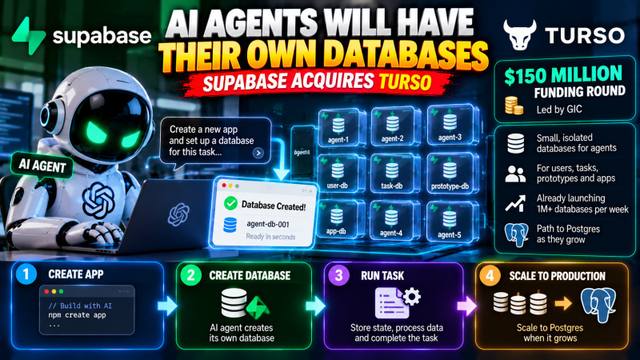
Supabase Acquires Turso to Build AI Agent Databases
Supabase is making a major move in AI infrastructure with its acquisition of Turso, a database company focused on distributed and embedded database technology. At the same time, Supabase announced a $150 million funding round led by GIC. While the funding is significant, the more interesting part of the announcement is Supabase's view that AI agents will increasingly need their own databases.
As AI agents become capable of creating applications, executing tasks and maintaining information over time, they need somewhere to store state and data. Traditionally, developers have created a database for an application and connected users and services to it. The rise of autonomous AI agents could introduce a different model where individual agents, tasks, users or AI-generated applications may require small, isolated databases.
Supabase says it is already launching more than one million databases per week, highlighting how quickly database creation is becoming automated. The company believes this trend will accelerate as AI coding tools and agents increasingly create software without requiring developers to manually configure every part of the infrastructure.
A possible future workflow could look like:
AI agent → creates application → creates database → stores state → performs task → scales infrastructure
This approach could be particularly useful for temporary projects, prototypes, personal AI agents and task-specific applications. An agent could create a small database when it begins a task, store the information it needs, and continue using that database throughout the workflow.
The acquisition of Turso gives Supabase additional technology and expertise for this emerging environment. The broader goal is to make databases easier to create and manage as software development becomes increasingly automated.
Supabase's strategy also connects with the growing popularity of AI coding agents. Developers can already ask AI systems to generate applications, but those applications still need infrastructure such as databases, authentication and storage. Making database provisioning easier could remove another manual step from the AI development process.
An important detail is that reports about 70% of new databases being created by agents or AI tools should not be interpreted as meaning that 70% of all databases are AI-generated. The figure refers specifically to Supabase's reported share of newly created databases associated with agents or AI tools.
The larger trend is nevertheless significant. AI agents may increasingly become software builders rather than simply software assistants. If an agent can create an application, it may also need to create the infrastructure required to run and maintain that application.
Supabase's Turso acquisition therefore points toward a possible shift in cloud architecture: instead of thinking only about one database per application, developers may increasingly work with databases created dynamically for agents, users, tasks and AI-generated applications.
For AI developers, this could make databases a foundational part of autonomous software workflows.