SAP Joule Pushes AI Toward Autonomous Business Workflows
SAP is showcasing Joule agents that can analyze enterprise data and take actions across business workflows, moving enterprise AI beyond simple assistants.
Source: https://www.sap.com/india/events/connect/spend-connect.html
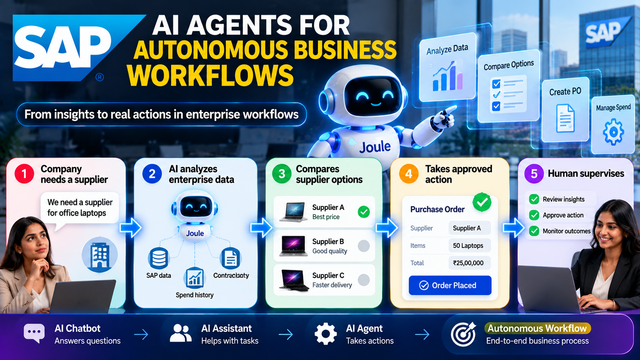
SAP pushes AI from assistants toward autonomous business workflows
Enterprise AI is entering a new stage. Businesses are no longer interested only in chatbots that answer questions. They increasingly want AI systems that can understand company data, make recommendations and take actions inside real business processes.
SAP is showcasing Joule agents and assistants that are designed to work with enterprise information and support more autonomous workflows, particularly in procurement and spend management.
The broader shift can be described simply:
AI chatbot → AI assistant → AI agent → Autonomous business workflow
From answering questions to taking action
A traditional chatbot might answer:
“Which supplier has the lowest price?”
An AI assistant might help compare suppliers.
An AI agent can go further by analyzing business data, comparing available options and taking an approved action.
For example, imagine a company needs new laptops for its employees.
The workflow could look like:
Company needs supplier → AI analyzes enterprise data → compares suppliers → approved action → human supervises
Joule can provide insights from enterprise information and support actions within business workflows. This approach is particularly relevant to procurement and spend processes, where businesses have large amounts of purchasing data and repetitive tasks.
Why autonomous workflows matter
Business processes often involve multiple steps.
A procurement decision may require checking previous spending, supplier information, contracts, pricing and company policies before an action can be taken.
Instead of requiring employees to manually move between different systems, AI agents could increasingly coordinate parts of this process.
The important difference is that the AI is not simply generating text. It is becoming an action layer for enterprise software.
That could eventually help companies automate repetitive work while keeping humans involved in important approvals and decisions.
Human supervision remains important
Autonomous does not necessarily mean completely independent.
For sensitive business operations, companies still need permission controls, audit trails and human oversight.
A practical enterprise workflow could therefore look like:
AI analyzes → AI recommends → human approves → AI executes → human monitors
This approach can allow businesses to benefit from automation without giving an AI agent unlimited authority.
What this means for Indian businesses
Indian enterprises are rapidly adopting AI across customer service, finance, operations and software development.
As these systems become more capable, the focus may shift from using AI as a productivity assistant to connecting AI directly with business processes.
For example, an AI agent could potentially help with supplier discovery, purchasing analysis, invoice workflows, expense management and other repetitive enterprise operations.
The bigger trend is clear:
Enterprise AI is leaving the chatbot stage.
The next generation of business AI may not just tell employees what to do. It could increasingly understand the workflow, perform approved actions and continuously help move the process forward.