OpenAI’s “Automated Research Intern” Is Changing AI Research
OpenAI says AI agents are now performing increasingly complex research tasks inside its own organization, moving AI from coding assistant to research worker.
By singamankitha
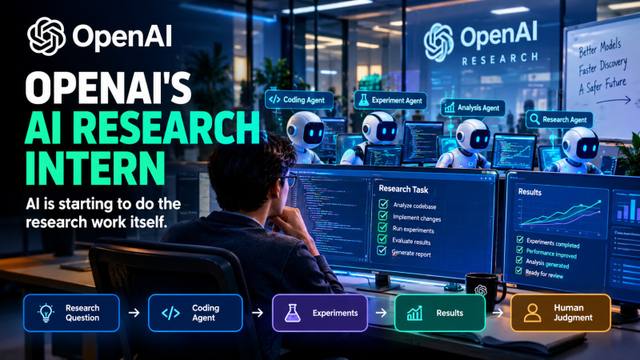
OpenAI Says It Has Built an “Automated Research Intern”
OpenAI says it has reached a milestone it set for itself: an AI system capable of performing meaningful research tasks under human supervision.
That may sound like another announcement about AI getting better at coding.
It is potentially much bigger than that.
In a September 2026 report, OpenAI described how coding agents are increasingly becoming part of the everyday workflow of its research organization. Researchers are using multiple agents concurrently to write code, investigate technical problems, run experiments and analyze results.
OpenAI says it has now reached its goal of having an “automated research intern” by September 2026.
The important detail is what OpenAI means by that term.
The company is not saying it has created a completely autonomous scientist. Instead, it describes an agent capable of completing well-defined research tasks under human direction—including tasks that could otherwise take a skilled researcher several days.
That distinction matters.
The story isn't that human researchers have disappeared.
The story is that AI agents are becoming part of the research workforce itself.
From Coding Assistant to Research Worker
For years, AI coding tools mostly followed a simple pattern:
Human writes code → AI suggests code → Human reviews it.
Agentic systems are changing that workflow.
A modern coding agent can be given a broader objective and then work through multiple steps: inspecting a codebase, writing code, running tests, investigating errors, modifying an implementation, conducting experiments and reporting its findings.
OpenAI says its researchers are increasingly using agents this way internally.
The company reports that researchers were using coding agents throughout the day and frequently running multiple sessions at the same time.
By mid-August 2026, the median researcher in OpenAI's research organization was spending more than $600 per day in inference at API prices, while the 90th-percentile user exceeded $7,000 per day.
These numbers aren't necessarily a measure of research quality. They demonstrate how heavily some researchers are now using AI agents.
OpenAI also reports that, by mid-August, its research organization was using the equivalent of 3.1 agent-workdays for every human workday when agent effort is converted into an eight-hour workday.
That is a remarkable shift.
Agents are no longer simply occasional productivity tools.
They are becoming part of the labor behind AI research.
What Is an “Automated Research Intern”?
The phrase sounds dramatic, but OpenAI's definition is relatively specific.
An automated research intern is a system capable of completing well-defined research tasks under human direction.
Imagine that a researcher wants to test whether a particular change to an AI training system improves performance.
Traditionally, the researcher might:
Develop the idea.
Write the implementation.
Create the experiment.
Run the experiment.
Analyze the results.
Debug problems.
Modify the approach.
Run another experiment.
Decide what to investigate next.
An AI agent can increasingly take over portions of this loop.
The researcher provides the objective and constraints.
The agent can then inspect existing code, implement changes, write supporting code, run tests, execute experiments, investigate failures and summarize the results.
The human researcher still decides whether the experiment is meaningful and what should happen next.
That human judgment remains critical.
The Research Loop Is Getting Faster
One of the biggest implications isn't simply that AI can write code.
It is that AI can increasingly participate in the iterative loop surrounding the code.
AI research is highly experimental.
Researchers develop an idea.
They implement it.
They run an experiment.
The experiment fails.
They diagnose the problem.
They change something.
They run another experiment.
They compare the results.
Then they decide whether the original idea deserves more attention.
This creates a natural bottleneck.
Even if researchers have hundreds of ideas, humans can personally investigate only a limited number of them.
Agents potentially change that equation.
A researcher can have several experiments progressing simultaneously, with different agents handling different pieces of work.
Instead of:
One researcher → one task
the workflow starts looking more like:
One researcher → multiple agents → multiple experiments → multiple results
The researcher increasingly becomes responsible for orchestration, judgment and prioritization rather than manually executing every technical step.
AI Agents Are Moving Up the Research Stack
The interesting part of OpenAI's report is that researchers aren't using agents only for basic programming.
The research process can broadly be thought of as six stages:
1. Decide
What should researchers work on?
Which ideas deserve attention?
2. Design
How should the research idea or experiment be structured?
3. Build
Write code, construct datasets and build systems.
4. Run
Execute training runs, evaluations and infrastructure workloads.
5. Analyze
Interpret experimental results and investigate unexpected behavior.
6. Communicate
Share findings, feedback and research status.
OpenAI says agent usage increased across these areas during 2026.
However, high-level planning remains much less automated than technical execution.
That tells us something important about the current state of AI agents.
They are becoming increasingly good at doing research tasks, but humans still play a much larger role in deciding what research should be done.
Humans Still Handle the Hardest Decisions
It would be easy to interpret OpenAI's announcement as meaning AI researchers are being replaced.
The company's description suggests something more nuanced.
An agent can potentially answer:
“Implement this experiment and tell me what happens.”
A much harder question is:
“What experiment should we run?”
And harder still:
“Why does this result matter?”
As AI systems become better at execution, human researchers may spend more of their time on:
Choosing important problems
Designing meaningful experiments
Interpreting ambiguous results
Identifying promising research directions
Checking unexpected behavior
Managing computing resources
Evaluating risks
Deciding whether an apparent discovery is actually significant
The role could shift from manually executing every experiment toward becoming a research director and evaluator.
Agents Still Need Human Steering
There is an important limitation behind the headline.
OpenAI's agents are improving, but they are not simply given a complex research problem and left alone.
OpenAI reports that human intervention remains significant, particularly as tasks become longer and more difficult.
For complex tasks estimated to take a human several hours, successful completion can still involve human intervention.
This means today's research agents are better understood as highly capable collaborators than completely independent scientists.
They can perform substantial portions of a workflow.
But humans still need to redirect them, correct mistakes, clarify objectives and intervene when the system gets stuck.
The Emerging AI Research Workflow
The new workflow increasingly looks like this:
Research question
↓
Human defines objective
↓
Planning agent
↓
Coding / experiment agent
↓
Implementation
↓
Automated testing
↓
Experiment
↓
Results
↓
Analysis / verification
↓
Human evaluates significance
↓
Next experiment
This is very different from the traditional AI assistant model.
The AI is no longer simply answering:
“How do I write this function?”
It can increasingly be asked:
“Investigate this problem, conduct the experiment and report what you discovered.”
That is a much more powerful interaction model.
Why This Matters for AI Development
The significance becomes clearer when we look at how frontier AI systems are developed.
Researchers need to conduct enormous numbers of experiments involving algorithms, evaluations, infrastructure, training behavior, safety systems and model performance.
If AI agents can automate parts of that process, researchers gain access to something resembling additional digital labor.
That creates a potentially powerful feedback loop:
Better AI agents
↓
More automated research
↓
More experiments
↓
Faster discovery
↓
Better AI systems
↓
More capable research agents
This doesn't mean AI research will accelerate without limits.
There are still constraints involving computing resources, data, experiment design, scientific interpretation, safety and reliability.
But the possibility of AI systems helping humans build the next generation of AI systems is one of the most important developments in the field.
The Safety Question
Greater research automation also makes AI safety more important.
More capable agents can potentially help researchers investigate alignment, security and other safety problems.
But the same capabilities can introduce new risks.
An agent capable of modifying code, executing experiments and interacting with research infrastructure is considerably more powerful than a chatbot that simply produces text.
That means permissions, monitoring, sandboxing and human oversight become increasingly important.
The more authority an agent receives, the more important it becomes to understand exactly what that agent can do.
What Comes Next?
OpenAI's current milestone should not be confused with fully autonomous AI research.
An automated research intern can receive a defined assignment and execute significant portions of it.
A fully automated AI researcher would need to do something considerably harder:
Identify important questions → develop ideas → design experiments → execute them → interpret results → decide what to investigate next.
That requires much more than coding ability.
It requires research judgment.
OpenAI has described an eventual goal of developing increasingly autonomous research capabilities, but the current system still depends heavily on human direction.
From AI Assistant to AI Research Worker
There is a simple way to understand the shift.
Old model:
“AI, help me write this code.”
Emerging model:
“AI, investigate this problem, implement the experiment, run it, analyze what happened and tell me what you found.”
The second instruction treats AI less like an autocomplete system and more like a junior technical worker.
That is why OpenAI's “automated research intern” milestone is significant.
It doesn't mean that AI researchers have been replaced.
It doesn't mean research is now fully autonomous.
And it doesn't mean AI development will accelerate without limits.
It does show that AI agents are beginning to perform substantial pieces of the work involved in building AI itself.
The next major question is therefore not simply:
“Can AI do research?”
It is:
“How much of the research process can AI reliably perform without human intervention?”
Today, the answer is still limited.
But the direction is clear.
AI is moving from coding assistant → technical collaborator → research worker.
And if that transition continues, the next generation of AI may increasingly be developed not only by humans using AI, but by humans working alongside AI systems capable of performing meaningful research work themselves.