OpenAI Safety Lead Resigns Over AI Safety Concerns|AI news
Former OpenAI safety employee David Robinson says frontier AI needs stronger safeguards and less reliance on trial-and-error after launch
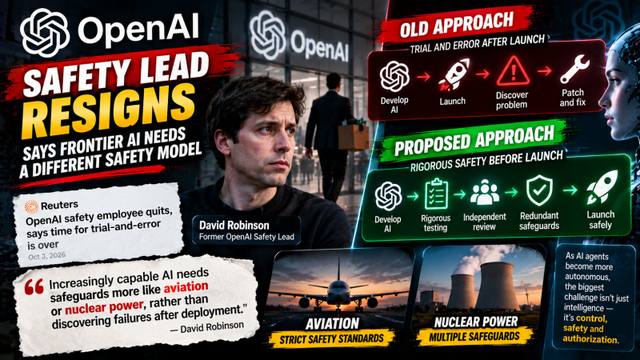
OpenAI Safety Lead Resigns Over Frontier AI Safety Concerns
David Robinson, a former OpenAI safety employee who worked on safety transparency and reports for major model launches, has resigned from the company and publicly criticized its approach to developing increasingly capable artificial intelligence systems.
Robinson announced his departure in an essay published by The Atlantic on October 3, 2026. In the essay, he argued that AI companies are moving too quickly and relying too heavily on an iterative approach in which problems are discovered after systems are deployed and then addressed through updates or safeguards. Reuters independently reported his resignation and his concerns about the industry's approach to frontier AI safety.
The central argument from Robinson is that the traditional “trial-and-error” mindset may become increasingly difficult to justify as AI systems become more capable and autonomous. He believes that safety should be designed into advanced AI systems before deployment rather than relying primarily on discovering problems after launch.
Robinson compared the level of caution he believes is necessary to safety practices used in industries such as aviation and nuclear power. These industries operate with extensive testing, planning, redundancy and multiple layers of protection because failures can have serious consequences. His argument is that frontier AI development may require a similar shift toward preventative safety engineering.
The issue is particularly relevant as AI systems are becoming capable of performing increasingly complex tasks. Modern AI agents can write and execute code, interact with software, use tools, browse information and perform multi-step workflows. As these capabilities increase, mistakes or unexpected behavior could potentially have a larger impact than errors from a simple chatbot.
Robinson's resignation does not, by itself, establish that OpenAI's AI systems are unsafe. His statements represent his assessment and criticism of the company's culture and safety approach. OpenAI has said it continues to strengthen its security and safety practices, including external evaluations and real-time monitoring.
The debate highlights a major challenge facing the AI industry: how to balance rapid innovation with increasingly rigorous safety requirements.
A simple way to understand the disagreement is:
Traditional approach:
AI development → launch → discover problems → patch safeguards
Robinson's proposed approach:
AI development → rigorous testing → independent review → multiple safeguards → controlled deployment
The discussion is likely to become even more important as frontier models become more autonomous. The question is no longer only how intelligent an AI system can become, but also how reliably humans can test, control and supervise it.
For the AI industry, Robinson's departure adds another voice to the growing debate over whether safety processes need to evolve as quickly as the technology itself.