OpenAI Researchers Are Running Multiple cinematic AI Agents at Once
OpenAI researchers are increasingly running coding agents concurrently, changing AI research from one-agent assistance to parallel AI teamwork.
By singamankitha
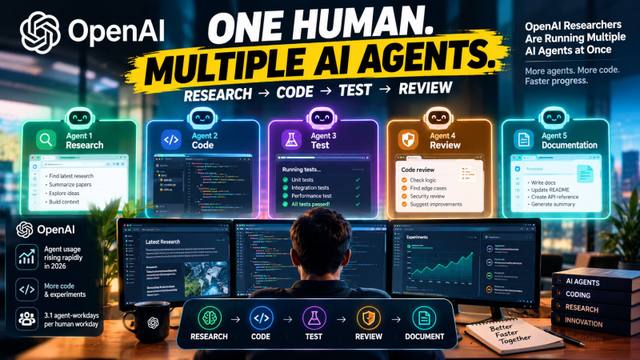
OpenAI Researchers Are Running Multiple AI Agents at Once
The way researchers work with AI is changing.
Instead of asking one AI agent to complete one task, OpenAI says its researchers are increasingly using multiple coding-agent sessions concurrently throughout the day.
The company reports that agent usage inside its research organization has risen rapidly during 2026, while researchers are writing more code, running more experiments and delegating increasingly complex tasks to agents.
This points toward a very different way of working with AI.
Not:
Human → AI → Answer
But:
Human → AI team → Parallel work → Human review
One Researcher. Multiple AI Workers.
Imagine you're working on an AI research project.
Instead of opening one coding agent and waiting for it to finish, you could have several agents working simultaneously:
Agent A → Research
Agent B → Code
Agent C → Run experiments
Agent D → Test
Agent E → Review
Agent F → Documentation
The human remains responsible for the overall direction.
The agents handle different pieces of the workload.
That is the basic idea behind parallel AI workers.
OpenAI Says Concurrent Agent Usage Is Rising
OpenAI's September 6 research update says researchers are using coding agents throughout the day, often in concurrent sessions.
The company also reports that the number of researchers using highly concurrent workflows — including workflows with four or more agents running simultaneously — has been increasing.
OpenAI says the median researcher in its research organization was using agents daily by mid-August, with reported inference usage above $600 per day at API prices for that median researcher. The 90th-percentile user was above $7,000 per day.
Those numbers aren't presented by OpenAI as direct measures of research productivity, but they illustrate how deeply agentic tools have become embedded in some research workflows.
The Bigger Number: 3.1 Agent-Workdays
OpenAI reports another striking measurement.
As of mid-August, its research organization was using approximately:
3.1 agent-workdays
for every:
1 human workday
using a standard eight-hour workday as the comparison.
That does not mean researchers are literally working 3.1 times faster.
Instead, it measures the amount of agent effort being used across the research organization relative to human labor.
But the implication for workflow design is significant.
A single researcher can now initiate many streams of computational work that continue in parallel.
Researchers Are Also Writing More Code
OpenAI says researchers are contributing code faster and running more experiments.
The company reports that the number of experiments per active experimenter increased through 2026, with August reaching the highest level since its tracking began in January 2025. OpenAI notes that this correlates with increased Codex adoption, while also pointing out that available compute has grown significantly.
This distinction matters.
More AI-generated work does not automatically mean more scientific progress.
OpenAI itself says some measurements are easy to collect but harder to interpret because their relationship to research progress is uncertain.
The important development is therefore the workflow transformation, not simply the raw amount of AI usage.
AI Agents Are Taking On Harder Tasks
Another shift is happening at the task level.
OpenAI says researchers are increasingly delegating higher-level and longer-horizon tasks to coding agents.
The company's research workflow can be broken into areas such as:
Decide
What should we work on?
Design
What should we build?
Build
Write code and datasets.
Run
Execute training and evaluation.
Analyze
Study experiments and results.
Communicate
Share findings and decisions.
OpenAI reports increases across all of these research activity categories between January and August 2026, with particularly notable growth in areas such as technical help and monitoring runs.
But Humans Still Matter
This is perhaps the most important part of the story.
More agents do not eliminate human oversight.
OpenAI reports that agents still require significant human steering, especially as task complexity increases.
For tasks estimated to require four to eight hours of human work, OpenAI says more than half of successful tasks in its analyzed period involved at least one human intervention.
So the future workflow isn't:
AI replaces researcher.
It looks more like:
Researcher directs → Agents execute → Researcher verifies → Agents iterate.
The human becomes increasingly responsible for orchestration and verification.
The Three-Agent Workflow Anyone Can Try
You don't need dozens of agents to experiment with this approach.
Start with three.
Agent 1 — Researcher
Give it the job of gathering information.
It can:
Read documentation
Search relevant material
Summarize findings
Identify possible approaches
Produce a research brief
Agent 2 — Builder
Give the second agent the research output.
Its job:
Turn the plan into something working.
It can write:
Code
Scripts
Prototypes
Automations
Data pipelines
Agent 3 — Reviewer
Don't immediately trust the output.
Send it to a separate reviewer.
Ask it to:
Find bugs
Challenge assumptions
Check requirements
Test edge cases
Identify missing pieces
Suggest improvements
Now you have:
Research → Build → Review
That is a much stronger workflow than asking one agent to do everything.
Why Separate Agents?
Because different tasks require different kinds of thinking.
A research agent should focus on:
Information.
A builder should focus on:
Implementation.
A reviewer should focus on:
Verification.
Separating responsibilities can make the workflow easier to understand and audit.
It also gives you a useful principle:
Don't ask one AI to be researcher, programmer and judge of its own work at the same time.
Then Add More Agents
Once the three-agent workflow works, you can expand it.
For example:
Agent 1 — Research
↓
Agent 2 — Architect
↓
Agent 3 — Developer
↓
Agent 4 — Tester
↓
Agent 5 — Security Reviewer
↓
Agent 6 — Documentation
↓
Human Approval
Now you've created something resembling a small digital team.
The important part is that each agent has a specific responsibility.
The Human Becomes the Manager
This creates a new skill.
You are no longer simply learning:
How to prompt AI.
You are learning:
How to manage AI workers.
That means deciding:
What task goes to which agent?
What context does each agent receive?
What tools can it access?
When should it stop?
How is its work evaluated?
Who reviews the output?
What requires human approval?
This is closer to AI orchestration than traditional chatbot usage.
The Bottleneck Moves to Verification
As agents become faster at producing code, another problem becomes more important:
How do you know the output is correct?
OpenAI's research also highlights this issue.
Agents can be effective at well-scoped tasks, but humans still need to determine whether the result is scientifically valid and meets the intended requirements.
That means automated tests, evaluations, benchmarks, reference outputs and human review become increasingly important.
The faster AI gets at building things, the more valuable verification infrastructure becomes.
This Is Already Moving Beyond Coding
The same architecture can work outside software development.
Imagine a marketing workflow:
Agent A → Market research
Agent B → Competitor analysis
Agent C → Content creation
Agent D → SEO review
Agent E → Fact checking
Human → Final approval
Or a business workflow:
Agent A → Customer research
Agent B → Data analysis
Agent C → Report generation
Agent D → Quality control
Human → Decision
The concept is the same.
One person orchestrating multiple specialized AI workers.
OpenAI Is Building Toward Orchestration
OpenAI has also described systems for coordinating multiple coding agents.
Its Symphony project, for example, turns a project-management system into a control plane where tasks can be assigned to agents and humans review their results. OpenAI says this approach was created because managing several interactive coding sessions creates a human context-switching bottleneck.
That reveals an important problem.
The limiting factor may eventually stop being:
“How many agents can AI run?”
and become:
“How many agents can a human effectively supervise?”
The Next Productivity Interface
Today, productivity software is built around:
Apps → Tabs → Documents → Tasks
The emerging AI workflow could look more like:
Goal → Agents → Parallel execution → Review → Result
Instead of opening five applications yourself, you could delegate five streams of work.
Instead of manually switching between them, an orchestration layer could coordinate the work.
And instead of reviewing every intermediate step, you could focus on checkpoints and final outputs.
Start Small
The biggest mistake would be starting with 20 agents.
Start with three.
Researcher
Builder
Reviewer
Give each agent a clear role.
Give each one measurable outputs.
Add automated checks.
Keep humans responsible for important decisions.
Then expand the workflow only when the additional agents actually create value.
The New AI Skill
The next generation of AI users may not be defined by how well they can write prompts.
They may be defined by how well they can design AI systems that work together.
That means learning:
Task decomposition
Agent routing
Context management
Tool access
Evaluation
Human-in-the-loop design
Orchestration
The skill is moving from:
“How do I ask AI?”
to:
“How do I organize AI?”
The Bottom Line
OpenAI's internal research workflow offers a glimpse of a different way of working.
One human doesn't necessarily have to work with one AI session.
A researcher can coordinate multiple agents working on different parts of the same problem.
Research.
Code.
Experiment.
Test.
Review.
Document.
All happening in parallel.
The future of AI productivity may not be about having one incredibly smart assistant.
It may be about building a team of specialized AI workers — and learning how to manage them.
One human. Multiple agents. Parallel work.
That is the workflow to watch.