OpenAI Publishes 722 AI-Generated Math Results
OpenAI has released 722 mathematical manuscripts from an internal frontier model, including many Lean-formalized proofs that can be checked by computers.
Source: https://openai.com/index/sharing-ai-progress-in-mathematics/?utm_source=chatgpt.com
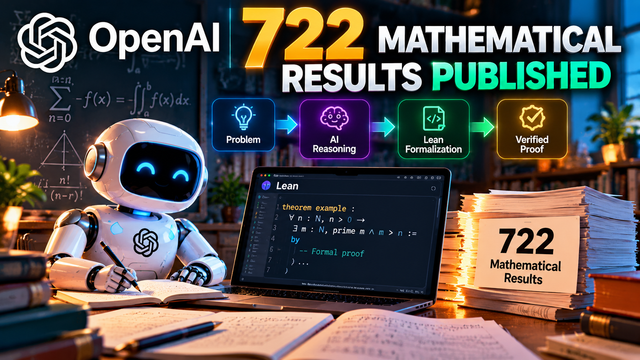
OpenAI releases 722 mathematical results from an internal AI model
OpenAI has published a large collection of mathematical work produced by an internal frontier AI model, marking another significant step in the use of artificial intelligence for mathematical research.
The public collection currently contains 722 mathematical manuscripts organized into 372 related result families. The work covers a broad range of mathematical areas and was produced while OpenAI evaluated its internal model on open research problems. GitHub
What makes this release especially interesting is that OpenAI is not presenting the work simply as a benchmark score. The company has published manuscripts, supporting proof artifacts and Lean formalizations for many of the results. Lean is a programming language and proof system that allows mathematical proofs to be checked computationally. However, OpenAI notes that not every manuscript has been formalized yet, and some unformalized results may still contain issues. OpenAI
The results came from an evaluation in which the internal model was given approximately 4,000 mathematical problems. OpenAI says the average result used computing equivalent to roughly three hours of ChatGPT Pro thinking. The strongest outputs were then organized into the released manuscript collection. GitHub
The release also includes selected summaries of the model's reasoning and additional information about how the results were obtained. OpenAI says it is working with an independent Advisory Group on Mathematics and Artificial Intelligence to improve how major mathematical results from AI systems are communicated to the research community. OpenAI
For students and researchers, the bigger story is the combination of AI reasoning + mathematical research + formal verification. Instead of only asking whether an AI can produce an answer, researchers can increasingly ask whether the generated mathematical argument can be expressed in a formal system and checked by a computer.
This does not mean AI has “solved mathematics.” Instead, it shows that frontier AI systems are beginning to produce mathematical research outputs that can be studied, challenged, corrected and, in many cases, formally verified.