OpenAI Expands AI Data Centres Amid Growing Demand
OpenAI is accelerating its US data-centre expansion as demand for AI services grows, creating new opportunities in GPUs, cloud computing, networking and AI infrastructure.
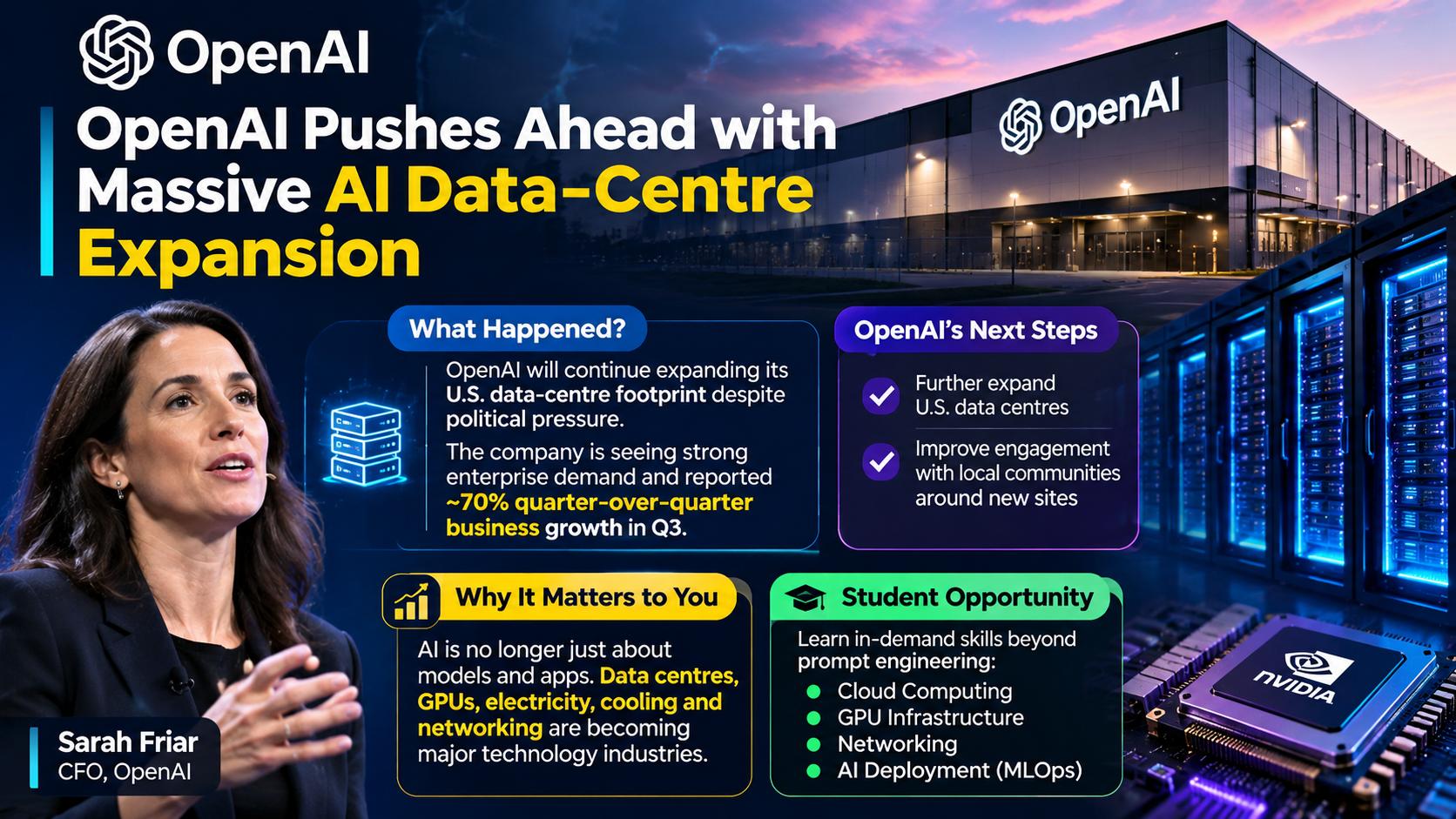
OpenAI Pushes Ahead with Massive AI Data-Centre Expansion Despite Growing Pressure
Introduction: The infrastructure behind the AI revolution
Artificial intelligence is rapidly changing how people work, study, communicate and conduct business. From ChatGPT and AI-powered coding assistants to automated business systems, millions of people now depend on AI tools every day.
However, behind every AI response is a massive technology infrastructure that most users never see.
Powerful computers, advanced GPUs, high-speed networking equipment, cooling systems and enormous data centres make modern AI possible.
OpenAI, the company behind ChatGPT, is continuing to invest in this infrastructure. Despite growing political pressure and concerns about the environmental and economic impact of large data centres, the company says it will continue expanding its United States data-centre footprint.
OpenAI CFO Sarah Friar recently discussed the company's expansion strategy in an interview with CNBC. Her comments highlight an important reality: demand for AI computing power is growing, and technology companies are competing to secure the infrastructure required to support the next generation of AI.
1. What exactly happened?
On November 6, 2026, OpenAI CFO Sarah Friar told CNBC that the company would continue investing in AI data centres despite concerns emerging from the US midterm elections.
The elections increased political pressure around large data-centre developments. Some voters and political candidates expressed concerns about the effects these facilities could have on local communities.
Despite these challenges, OpenAI believes that investment in computing infrastructure remains necessary to serve its growing customer base.
Friar explained that the company needs to keep investing to meet customer demand. She also indicated that OpenAI would continue raising capital and developing relationships with infrastructure partners.
The company is also changing how it communicates with communities where it may develop future facilities.
This signals that AI infrastructure expansion is no longer simply a technology decision. It is also becoming a major economic, political and community issue.
2. OpenAI reports strong business growth
One of the most interesting details from Sarah Friar's interview was the company's reported business growth.
According to Friar:
OpenAI's business grew approximately 70% quarter over quarter in Q3.
Its enterprise business doubled during the same period.
Demand from organisations using AI products has increased.
These figures indicate that AI is becoming increasingly important for businesses, not just individual users.
Companies are exploring AI for customer support, software development, data analysis, cybersecurity, research, marketing and internal automation.
For example, a company can use AI to analyse thousands of customer requests, prepare reports, assist software engineers and automate repetitive business processes.
As more organisations adopt these technologies, they require additional computing capacity.
That is one reason OpenAI is continuing to invest in data-centre infrastructure.
3. Why does OpenAI need massive data centres?
A data centre is a specialised facility containing computer servers, networking equipment, storage systems and supporting infrastructure.
Think of a data centre as a massive digital factory.
Instead of manufacturing physical products, it processes information, runs applications and provides computing power to millions of users.
Modern AI systems require enormous computational resources.
When someone asks ChatGPT a question, the system processes the request using powerful computing infrastructure. When millions of people use AI services simultaneously, the demand for processing power increases significantly.
Data centres help provide the resources needed for:
AI model training
Training advanced AI models requires powerful processors that can perform enormous numbers of mathematical operations.
AI inference
Inference happens when an already-trained AI model generates an answer, creates an image or completes another task.
Cloud computing
Businesses need reliable computing resources to run applications, store information and manage digital services.
Enterprise AI
Large organisations require secure, scalable infrastructure to integrate AI into their existing systems.
Research and development
Researchers need powerful computing resources to experiment with larger models, new architectures and advanced AI capabilities.
Without sufficient computing infrastructure, even the most advanced AI software would struggle to serve users at scale.
4. GPUs are becoming the backbone of artificial intelligence
One of the most important components inside modern AI data centres is the GPU, or Graphics Processing Unit.
Originally designed primarily for graphics processing, GPUs have become essential for many AI workloads because they can perform large numbers of calculations in parallel.
Companies such as NVIDIA supply specialised processors used in AI infrastructure.
A modern AI data centre may contain thousands of powerful processors connected through high-speed networking systems.
These processors work together to train models and deliver AI services.
This creates opportunities across several industries:
GPU hardware manufacturing
Semiconductor engineering
Data-centre construction
High-speed networking
Cloud infrastructure
AI software deployment
Infrastructure security
The growth of AI therefore creates opportunities beyond AI model development.
Students who understand the hardware and infrastructure supporting AI may find additional career pathways.
5. The biggest challenge: Electricity, cooling and water
Building an AI data centre is not as simple as constructing a normal office building.
These facilities require significant amounts of electricity to operate servers and networking equipment.
They also produce heat, which means specialised cooling systems are necessary to maintain safe operating temperatures.
Several important challenges need to be addressed.
Electricity consumption
Large data centres require reliable electricity supplies. As computing demand grows, infrastructure developers must work with energy providers to secure sufficient power.
Cooling systems
Thousands of processors operating together generate considerable heat. Facilities need efficient cooling technologies to protect equipment and maintain performance.
Water management
Some cooling systems consume water. This can create concerns in regions where water resources are already under pressure.
Environmental impact
The construction and operation of data centres can affect local communities through land use, energy demand, water consumption and construction activity.
Grid infrastructure
Electricity networks may need upgrades to support new facilities. These improvements can be expensive and require coordination between technology companies, utilities and governments.
These challenges explain why data-centre expansion has become a major public discussion.
6. Why is there political pressure in the United States?
Although AI companies want to expand their infrastructure, some communities are becoming concerned about the effects of large data-centre projects.
During the 2026 US midterm elections, data-centre development became an important local political issue in several regions.
Some voters supported stronger restrictions or rejected proposals that would encourage additional development.
Concerns included:
Higher electricity bills.
Pressure on local water supplies.
Noise from cooling equipment.
Environmental effects.
Land-use changes.
Whether local residents would receive enough economic benefits.
OpenAI has responded by changing aspects of its approach to community engagement.
According to Reuters, the company said it would stop using nondisclosure agreements with public officials during discussions about potential sites and provide residents with access to construction plans and information about potential impacts.
This approach matters because successful infrastructure projects require more than money and technology. They also need public trust and cooperation.
7. What does this mean for the global AI industry?
OpenAI is not the only company investing heavily in computing infrastructure.
Major technology companies are competing to develop the facilities needed to support AI applications.
Cloud providers, semiconductor companies and infrastructure developers are all becoming important parts of the AI economy.
This competition could influence several areas.
More powerful AI systems
Additional computing capacity can support research, training and deployment of more advanced models.
Expansion of cloud services
Businesses may gain access to more computing resources for AI applications.
Growth of semiconductor demand
AI infrastructure requires specialised processors, memory, storage and networking equipment.
New infrastructure businesses
Companies specialising in cooling, electrical systems, construction and data-centre operations may benefit from industry investment.
Increased competition
Companies with access to reliable computing infrastructure may have an advantage in developing and delivering AI products.
However, expansion also carries financial and operational risks. Large facilities require substantial capital, reliable power supplies and long-term customer demand.
8. Why should Indian students pay attention?
This development is especially interesting for engineering students in India.
Many students focus only on learning how to use AI applications. But the next generation of technology professionals will also need to understand the infrastructure that makes AI possible.
India's technology sector already has opportunities in cloud services, software engineering, networking, cybersecurity and data engineering.
As global AI infrastructure expands, these skills can become increasingly valuable.
Here are five areas worth exploring.
1. Cloud computing
Learn how applications run on cloud platforms, how servers are managed and how organisations deploy scalable services.
Useful topics include virtual machines, cloud storage, networking and cloud security.
2. GPU infrastructure
Understand how GPUs work, how parallel processing supports AI and how computing resources are managed.
Start by learning computer architecture, CUDA fundamentals and GPU computing concepts.
3. Networking
AI data centres depend on high-speed communication between servers.
Study computer networks, routing, switching, network protocols and data-centre networking.
4. Cybersecurity
Large infrastructure facilities need protection against cyberattacks, unauthorised access and data breaches.
Learn Linux, networking fundamentals, security principles and system administration.
5. AI deployment and MLOps
Building an AI model is only one part of the process.
Organisations also need professionals who can deploy models, monitor performance, manage infrastructure and maintain reliable AI applications.
Explore Python, APIs, Docker, Kubernetes and machine-learning deployment.
9. A practical learning roadmap for beginners
Students do not need to master every technology immediately.
A practical approach is to build foundational knowledge first.
Stage 1: Programming fundamentals
Learn Python, basic data structures, algorithms and object-oriented programming.
Stage 2: Linux and computer networks
Understand operating systems, command-line tools, IP addressing, routing and networking fundamentals.
Stage 3: Cloud computing
Explore cloud platforms and learn how to deploy a simple application.
Stage 4: AI and machine learning
Understand model training, inference, APIs and the basic concepts behind machine learning.
Stage 5: Deployment and automation
Build a small AI application and deploy it using containers or cloud services.
Stage 6: Real-world projects
Create practical projects such as an AI chatbot, document analysis application or automated reporting system.
Building projects will help students demonstrate their knowledge more effectively than simply collecting certificates.
10. Opportunities for Indian startups and businesses
The expansion of AI infrastructure can also create opportunities for Indian entrepreneurs.
Startups can develop products and services around AI deployment, infrastructure management, cloud optimisation, cybersecurity and automation.
For example, a startup could build tools that help companies monitor GPU usage and reduce unnecessary computing costs.
Another business could develop AI-powered systems that help organisations manage documents, customer requests or operational data.
Infrastructure-related opportunities may also emerge in cooling technologies, energy management and data-centre maintenance.
India's engineering talent and growing technology ecosystem provide a foundation for participating in this expanding industry.
However, businesses must consider electricity availability, infrastructure costs, data protection and regulatory requirements before investing in large-scale projects.
11. The future of AI: Software is only one part of the story
For many years, discussions about artificial intelligence focused mainly on software, chatbots and machine-learning models.
That is changing.
The AI industry increasingly depends on physical infrastructure: specialised processors, data centres, power systems, cooling technologies and high-speed networks.
This means the future of AI will involve engineers, software developers, electrical specialists, cybersecurity professionals, cloud architects and infrastructure operators.
The companies that can build reliable, efficient and scalable infrastructure will be better positioned to support growing AI demand.
OpenAI's decision to continue expanding its data-centre footprint demonstrates how important computing infrastructure has become to the future of artificial intelligence.
Conclusion
OpenAI's latest comments highlight a major shift in the technology industry.
AI is no longer just a competition between software applications and advanced models. It is also a competition to build the computing infrastructure required to support them.
The company's reported 70% quarter-over-quarter business growth and doubled enterprise business demonstrate the demand driving its investment plans.
At the same time, electricity consumption, cooling requirements, water management, construction costs and community concerns remain important challenges.
For Indian students, the message is clear: learning AI tools is useful, but understanding the technology behind them can open additional career opportunities.
Cloud computing, GPU infrastructure, networking, cybersecurity and AI deployment are valuable areas to explore.
The next big opportunity in AI may not only be building intelligent applications. It may also be building the infrastructure that makes those applications possible.
Reporting based on Reuters coverage and CNBC's interview with OpenAI CFO Sarah Friar, published November 6, 2026.