OpenAI Cuts Trade Validation From 30 Minutes to under 4|midjournry AI news
openAI and Chatham Financial used Codex and GPT-5.6 to reduce an early trade-validation workflow from about 30 minutes to under 4 minutes.b
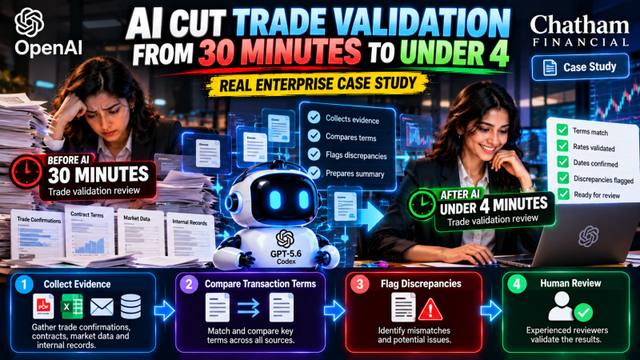
OpenAI and Chatham Financial Cut Trade Validation to Under 4 Minutes
OpenAI has highlighted a new enterprise AI workflow developed with Chatham Financial that shows how AI agents can significantly reduce the time required for complex financial operations. In an early measurement, the company says a trade-validation process that previously took roughly 30 minutes was reduced to under four minutes using OpenAI's Codex and GPT-5.6.
The project focuses on a practical problem faced by financial teams: validating transactions by collecting information from multiple sources and checking whether the details match. These tasks can involve trade confirmations, contracts, transaction terms, market information and internal records. Although the work is important for accuracy and risk management, much of the process involves repetitive evidence gathering and comparison.
The AI workflow is designed around four major stages: collect evidence, compare transaction terms, identify discrepancies and prepare the information for human review. Instead of asking an AI system to make the final financial decision independently, the workflow uses AI to handle much of the time-consuming analysis before an experienced reviewer examines the results.
This distinction is important for enterprise AI adoption. Financial decisions can involve significant consequences, so organizations need systems that provide useful automation while keeping humans responsible for judgment and approval. Chatham is reportedly validating the system against real transactions and experienced reviewers before expanding the automation further.
The project demonstrates how AI agents can become part of existing enterprise processes rather than simply functioning as chatbots. An agent can gather information from different sources, compare documents, identify potential inconsistencies and organize its findings for a person to review.
The reported reduction from approximately 30 minutes to less than four minutes represents a substantial improvement in the early measurement. However, the result should be understood as an initial workflow measurement rather than proof that every financial validation task can be automated to the same level.
The broader lesson is that successful enterprise AI does not necessarily require replacing human expertise. Instead, organizations can focus on automating the repetitive parts of a workflow while keeping experienced employees involved where interpretation, judgment and accountability are required.
Chatham Financial's example also demonstrates a useful blueprint for other industries: collect the evidence automatically, compare information with AI, flag potential problems, and let a human make the final decision.
As AI coding and agent platforms become more capable, workflows like this could become increasingly common across finance, legal operations, compliance, research and other knowledge-intensive industries. The most valuable AI systems may not simply generate answers—they may quietly handle the repetitive work that takes professionals away from higher-value decisions.