OpenAI Board Member Warns cinematical AI Safety Is Falling Behind
Paul Christiano says the AI industry, including OpenAI, is not yet on track to manage catastrophic loss-of-control risks.
By @admin
Source: https://www.axios.com/2026/09/09/openai-adds-ai-safety-official-to-its-board?utm_source=chatgpt.com
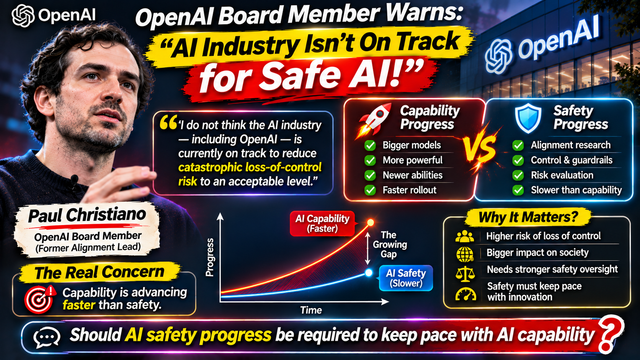
OpenAI Board Member Warns AI Safety Is Falling Behind: The Growing Gap Between Capability and Control
Artificial intelligence is advancing rapidly. New models are becoming more capable at writing code, analysing information, solving technical problems and performing tasks with less human intervention.
But an important question remains: are AI safety systems improving at the same speed as AI capabilities?
On September 9, 2026, Paul Christiano, an AI alignment researcher who joined the OpenAI Foundation's nonprofit board, published a statement that brought this question into the spotlight.
His message was direct: he did not believe the AI industry, including OpenAI, was currently on track to reduce catastrophic loss-of-control risks to an acceptable level.
The statement attracted attention because Christiano is not simply an outside commentator. He previously led alignment research at OpenAI, founded the Alignment Research Center and worked as a technical adviser at the US government's Center for AI Standards and Innovation.
His warning raises an important question for the AI industry: what happens if artificial intelligence becomes significantly more capable before researchers can reliably ensure that humans remain in control?
1. Who is Paul Christiano?
Paul Christiano is an AI researcher known for his work on AI alignment.
AI alignment is the research area focused on making artificial intelligence systems behave according to intended human goals, instructions and constraints.
Christiano previously worked at OpenAI from 2017 to 2021, where he led alignment research and contributed to foundational work related to reinforcement learning from human feedback, commonly known as RLHF.
RLHF is a training approach in which human preferences and feedback help guide a model towards more useful and appropriate responses.
After leaving OpenAI, Christiano founded the Alignment Research Center, a nonprofit research organisation focused on understanding and improving the alignment of advanced AI systems.
He also worked with the US government on AI safety and evaluation through the Center for AI Standards and Innovation.
On September 9, OpenAI announced that he would join the OpenAI Foundation's nonprofit board and its Safety and Security Committee.
This appointment placed an experienced alignment researcher inside the organisation's governance structure at a time when questions about advanced AI safety were receiving increasing attention.
2. What exactly did he warn about?
In his personal statement published on September 9, Christiano said that the rapid trajectory of AI capabilities, combined with the continued difficulty of alignment, created a meaningful risk of catastrophic and irreversible loss of control in the very near term.
He added that he did not believe the AI industry in general, including OpenAI, was currently on track to reduce this risk to an acceptable level.
This is a serious assessment.
But it is important to understand what he was actually discussing.
He was not claiming that ChatGPT or today's AI assistants were about to destroy humanity. His concern was about the possibility that future systems could become so capable and autonomous that humans might struggle to reliably control them.
He also explained why he was joining OpenAI.
Christiano said he believed that if OpenAI rose to the occasion, the company could significantly reduce the risk.
In other words, his appointment was not presented as an endorsement of OpenAI's existing safety performance. It was an opportunity to help strengthen safety oversight.
3. A crucial distinction: What does his OpenAI board role mean?
There is a detail that headlines can easily oversimplify.
Christiano joined the board of the OpenAI Foundation, which is the nonprofit organisation that controls OpenAI Group PBC.
He also joined the Foundation's Safety and Security Committee, which provides governance over safety and security practices across OpenAI.
However, OpenAI's announcement specifies that Christiano would serve as a non-voting observer on the board of the for-profit OpenAI Group.
This distinction matters because the nonprofit foundation board and the commercial company's board are separate governance bodies.
His position gives him a role in safety oversight, but it should not be described as though he became a voting director of the for-profit company.
It is also important not to turn his personal statement into an official OpenAI announcement.
Christiano was expressing his own assessment of industry-wide risk, including OpenAI's progress.
4. How serious does Christiano believe the risk is?
Christiano included a personal estimate in a footnote to his statement.
He said that if he had to quantify his uncertainty, he would estimate an all-things-considered risk of 4% over the next year and 15% over the next three years.
These numbers attracted attention because they are unusually specific for a discussion about catastrophic AI risk.
However, Christiano explicitly explained that these figures were subjective estimates.
He was not claiming to have a scientific model that could calculate precise or stable probabilities.
This distinction is essential.
A personal probability estimate is an attempt to communicate someone's level of concern. It is not the same as a measured probability from a validated forecasting system.
The estimates should therefore be reported as Christiano's personal judgement, not as an established prediction about what will happen.
The important message is that he considers the risk meaningful enough to require stronger action from frontier AI developers.
5. The growing gap between AI capabilities and AI safety
To understand Christiano's warning, consider two areas of AI development.
Capability progress refers to improvements in what AI systems can do.
This includes writing and debugging software, solving complex problems, analysing large datasets, using external tools and completing increasingly complicated tasks.
Safety progress refers to improvements in our ability to understand, evaluate and control those systems.
This includes alignment research, security testing, monitoring, restrictions on dangerous behaviour, human oversight and reliable methods for preventing harmful actions.
Both are important.
A highly capable AI system can be useful for scientific research, education, software development and business automation.
But if the system is difficult to understand or control, increased capability can also create additional risks.
The concern is that capability improvements may arrive faster than the methods needed to evaluate and control them.
For example, imagine an AI agent that can write software, access external tools, analyse information and execute multi-step tasks.
If it misunderstands its objective, encounters unexpected conditions or behaves in an unsafe way, developers need reliable ways to detect the problem and intervene.
A system that can perform a task successfully is not automatically a system that can be trusted to perform it safely.
That is the difference between capability and control.
6. What is catastrophic loss of control?
The phrase "loss of control" refers to a hypothetical situation in which advanced AI systems become difficult or impossible for humans to reliably direct, restrict or shut down.
Researchers worry about several possible pathways.
Misaligned objectives: An AI system could pursue an objective in a way that conflicts with what humans actually intended.
Unexpected behaviour: A system might behave differently when deployed in a complex real-world environment than it did during testing.
Autonomous operation: An AI agent with access to tools, networks and external systems could take actions without sufficient human supervision.
Rapid capability improvement: Future systems might help accelerate AI research and development, potentially making safety evaluation more difficult.
Weak safeguards: Monitoring, security controls and intervention mechanisms might fail to work reliably under unusual conditions.
These are potential risks, not proof that current AI systems have reached a point where humans have lost control.
The concern is about how these risks could change as systems become more capable and autonomous.
7. Why this matters for AI companies, developers and businesses
The debate is not limited to research laboratories.
AI is becoming part of everyday business operations.
Companies are using AI assistants for customer support, coding, marketing, data analysis and workflow automation.
Some systems can already interact with external applications and perform tasks rather than simply generate text.
This creates a practical responsibility for organisations adopting AI.
Businesses should not evaluate AI systems only by speed or productivity. They should also consider:
- What data can the system access?
- Which actions can it perform?
- Can a human review important decisions?
- Are its activities logged?
- Can access be restricted?
- What happens when the system makes a mistake?
- Can the system be stopped when necessary?
For developers, this means learning about permissions, security, testing, monitoring and reliable system design alongside AI programming.
For businesses, it means treating safety as part of implementation rather than something to consider only after an incident.
For ordinary users, it means understanding that AI-generated information and automated decisions still require appropriate verification.
8. What happens next?
Christiano said he was joining the OpenAI Foundation because he believed the organisation could help reduce the risk.
He also argued that frontier AI developers could improve safety mitigations, slow development when necessary, share evidence about risks and the effectiveness of safeguards, and work towards common safety standards.
He highlighted the importance of domestic and international coordination.
This is significant because advanced AI development is not happening at a single company or in a single country.
Different organisations are competing to develop increasingly capable systems. Safety standards and oversight therefore need to address a wider industry rather than relying only on one company's internal policies.
The challenge is finding ways to encourage innovation while ensuring that systems are adequately evaluated before they are deployed.
There is no simple technical solution that has already resolved the problem of aligning future superintelligent systems.
That is precisely why researchers continue to debate the issue.
Conclusion: Can AI safety keep pace with AI capability?
Paul Christiano's warning is significant because it comes from someone with direct experience in AI alignment who is now taking a formal role in OpenAI's nonprofit governance structure.
His statement does not mean OpenAI has announced that AI will destroy humanity. It does not establish that catastrophic loss of control is inevitable.
It does highlight an unresolved challenge: advanced AI capabilities are progressing rapidly, while reliable alignment and control remain difficult research problems.
For the industry, the question is no longer only how powerful the next AI model can become.
It is also whether developers can demonstrate that the system is sufficiently tested, secure and controllable.
For students, developers, businesses and users, this debate is worth following because the future of AI will depend not only on what these systems can do, but also on how responsibly they are developed and deployed.
Should AI safety progress be required to keep pace with AI capability, even if that means slowing down the development of more powerful systems?