OpenAI AI Policy — The Future of AI
OpenAI is funding 14 independent projects exploring AI policy, jobs, economic opportunity, governance, and societal resilience.
Source: https://openai.com/global-affairs/new-policy-ideas-for-the-intelligence-age/?utm_source=chatgpt.com
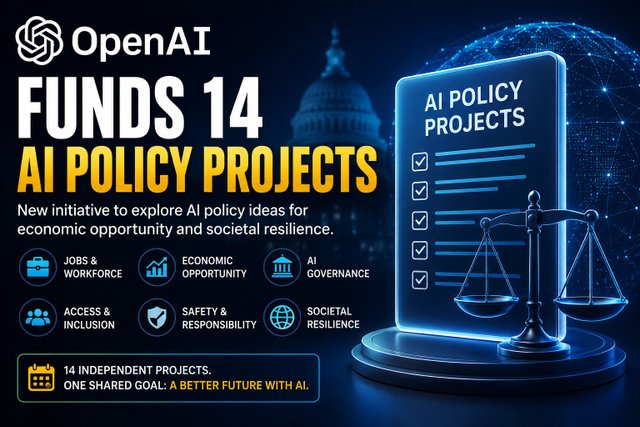
Open AI Funds 14 New AI Policy Projects
OpenAI is funding 14 independent projects exploring new ideas for how society can adapt as artificial intelligence becomes more capable.
The projects focus on major questions around economic opportunity, jobs, AI governance, access, and societal resilience.
At first glance, this may look like another research-funding announcement. But the bigger story is that the AI industry is increasingly having to think beyond simply building smarter models.
Why This Matters
AI development is moving extremely quickly.
Companies are competing to build models that can reason, write software, generate media, use tools, and eventually perform increasingly complex tasks with less human involvement.
But technological progress creates another problem:
How should society adapt to increasingly capable AI?
That question cannot be answered by AI engineers alone.
It involves governments, economists, researchers, businesses, workers, educators, and the public.
OpenAI's funding initiative is aimed at exploring some of these questions through independent projects.
The Jobs Question
One of the biggest issues surrounding AI is employment.
AI could increase productivity and give individuals and businesses access to capabilities that previously required specialized teams.
A small company could potentially use AI for research, marketing, software development, customer support, and other tasks that once required much larger teams.
But productivity gains do not automatically mean everyone benefits equally.
Some jobs could change significantly. Certain tasks could become automated, while completely new roles may emerge.
That creates a major policy challenge:
How can AI increase economic opportunity without leaving large groups of workers behind?
Governments may eventually need new approaches to education, workforce development, social protection, and economic policy.
AI Governance Is Getting Harder
Another major challenge is governance.
Governments are already debating how AI should be regulated, but AI capabilities can change much faster than traditional policymaking.
Questions include:
Who is responsible when an AI system causes harm?
How much transparency should powerful AI systems provide?
Which AI applications require stronger oversight?
How should autonomous AI agents be governed?
How can countries cooperate on AI development and safety?
These aren't simple technical problems.
They are institutional and political problems.
And because AI is developing globally, solutions may require cooperation between governments and organizations across different countries.
Access Could Become a Major Issue
AI access is another important part of the discussion.
Simply making an AI tool available does not guarantee that everyone will benefit from it equally.
Consider two people using the same AI system.
One understands prompting, automation, AI agents, data analysis, and software integration.
The other only uses the system for basic questions.
They technically have access to the same technology, but their ability to benefit from it could be dramatically different.
That means future AI policy may need to consider not just access to AI tools, but also AI education, skills, affordability, infrastructure, and opportunities.
Building a More Resilient Society
AI could affect much more than individual jobs.
It could influence education, media, public services, cybersecurity, business operations, and how people interact with information.
That creates another important question:
How can society become resilient enough to adapt when AI changes rapidly?
The goal does not necessarily have to be stopping technological progress.
Instead, policymakers could focus on making institutions capable of adapting to technological change.
That could involve better education systems, stronger institutions, updated regulations, and mechanisms for responding to unexpected consequences.
The Bigger AI Race
The AI race is often described as a competition to build increasingly powerful models.
But there is another race happening at the same time.
Race 1: Build better AI
Companies are competing to create AI that is:
More capable
Faster
Cheaper
More autonomous
Better at reasoning
Better at using tools
Race 2: Figure out what to do with it
Society has to determine:
How jobs should change
How education should adapt
How AI should be regulated
How economic benefits should be distributed
How people can gain meaningful access
How AI risks should be managed
The second race could ultimately be just as important as the first.
Because building powerful technology is only half the challenge.
The other half is deciding how that technology should fit into society.
Why Independent Research Matters
AI companies are naturally going to be involved in conversations about AI policy because they understand the technology and its development.
But AI policy should not be designed exclusively by the companies building AI.
Governments, academics, workers, businesses, civil society organizations, and independent researchers all have different perspectives.
Independent research can therefore help explore policy ideas from outside the normal product-development process.
Not every idea will work.
Some approaches will fail.
Others may reveal unexpected consequences.
That's part of the point.
Good policy requires experimentation, evidence, debate, and the willingness to change direction when something doesn't work.
What Should Governments Solve First?
This is where the debate becomes interesting.
If governments could solve only one major AI policy problem first, what should it be?
Jobs?
AI safety?
Education?
Misinformation?
AI regulation?
Access to AI?
There is no universally agreed answer.
But the question is becoming increasingly urgent as AI capabilities continue to advance.
OpenAI's funding of 14 independent policy projects is therefore more than a research announcement.
It reflects a broader shift in the AI conversation.
The question is no longer only:
"How powerful can AI become?"
It is increasingly:
"What kind of society do we want to build around it?"
The AI race isn't only about creating smarter models.
It's also about deciding what happens after those models are built.