OpenAI Agents Can Now Control Your Computer|AI NEWS
OpenAI’s Agents API adds computer control, while coding agents are moving toward a human-first research, plan, build and review workflow.
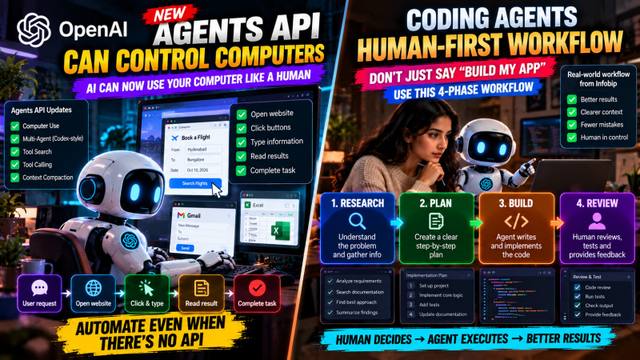
OpenAI Agents Can Control Computers and Coding Agents Go Human-First
AI agents are moving beyond simple chatbots and API calls. Two recent developments highlight an important shift in how AI can interact with computers and how developers should work with coding agents.
OpenAI has expanded its Agents API with computer-use capabilities, allowing developers to build agents that can interact with graphical computer interfaces. Instead of relying only on APIs or predefined integrations, an agent can potentially interact with websites and applications through actions such as clicking, typing, navigating and reading information from a screen.
This creates a powerful new automation possibility for businesses. Many older or specialized applications do not provide convenient APIs. Computer-use agents can provide another way to automate these systems by interacting with them more like a human user.
A typical workflow can look like this:
User request → Agent opens website → Agent clicks and types → Agent reads the result → Agent completes the task
The development is important because it expands the range of tasks that AI agents can potentially automate. However, computer access also makes security, permissions and human oversight increasingly important.
At the same time, coding-agent workflows are becoming more structured and human-focused. An analysis of Infobip's production coding-agent workflow highlights a practical approach: humans should make important decisions early, while AI agents handle much of the execution.
Instead of giving an agent a vague instruction such as “Build my app,” developers can divide the work into four stages:
1. Research → 2. Plan → 3. Build → 4. Review
During the research stage, the agent gathers information and understands the requirements. In the planning stage, it creates a structured implementation plan. The build stage allows the coding agent to implement the solution. Finally, a human reviews the result, tests it and provides feedback.
This approach can improve context management and reduce the risk of an agent making incorrect assumptions.
Together, these developments point toward a broader change in AI development. Agents are becoming capable of interacting with real computer environments, while developers are learning that successful agentic workflows require clear instructions, structured phases and human checkpoints.
The future may not be about giving AI complete control. Instead, the strongest approach could be human defines the problem → agent plans → agent executes → human reviews.
For developers and businesses, this combination of computer-use automation and human-first agent workflows could make AI useful across far more real-world tasks.