NVIDIA RTX Spark Turns PCs Into Local AI Platforms
NVIDIA’s RTX Spark brings powerful local AI models and agents to Windows PCs, while Microsoft adds security infrastructure for running autonomous agents safely on the device.
Source: https://blogs.nvidia.com/blog/local-ai-rtx-spark-microsoft-windows-event/
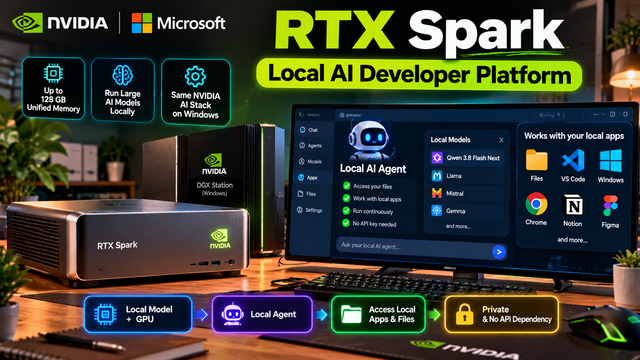
NVIDIA RTX Spark Turns PCs Into Local AI Platforms
Local AI is entering a new phase.
Running a small language model on a laptop is no longer the only goal. NVIDIA and Microsoft are building toward a much bigger idea: Windows PCs that can run powerful AI models and autonomous agents locally, interact with applications and files, and operate with dedicated security controls.
At the center of NVIDIA's latest push is RTX Spark, a new class of Windows hardware designed around local AI workloads.
NVIDIA says RTX Spark can provide up to 128GB of unified memory, up to a petaflop of FP4 AI performance and the full NVIDIA CUDA software stack. The company says the hardware can run large models locally, including models such as Qwen3.8-Flash-Next.
That changes the meaning of an "AI PC."
Instead of thinking about an AI PC as simply a computer with a chatbot built into it, the new idea is closer to:
GPU + local model → AI agent → local files and applications → continuous work
And Microsoft is adding another important piece: an operating-system layer for controlling what those agents are allowed to do.
From local models to local agents
There is a big difference between running an AI model locally and running an AI agent locally.
A local model might answer a question, summarize a document or generate code without sending the request to a cloud service.
An agent can do much more.
It can potentially:
inspect files
run code
use development tools
interact with applications
call services
perform multi-step tasks
continue working toward a goal
That creates a new problem.
If an AI agent can act on your computer, what stops it from accessing something it shouldn't?
This is where Microsoft's work becomes important.
Microsoft Execution Containers
Microsoft has introduced Microsoft Execution Containers (MXC) as part of its Windows platform for agents.
Microsoft describes MXC as a way to provide containment, identity and manageability for AI agents. Developers can define what an agent is allowed to access and do, while Windows applies controls using native isolation technologies.
This is important because an autonomous agent is different from a normal application.
A normal application usually has clearly defined functions.
An agent can dynamically decide what actions to take based on a goal.
For example, imagine a coding agent receives this instruction:
"Fix the bug in my project and run the tests."
The agent might need to:
read files → inspect code → modify files → execute commands → run tests → review results
That's useful.
But it also means the agent needs access to files, processes and tools.
MXC is designed to provide boundaries around that activity.
Microsoft's developer documentation describes controls for agent-driven processes, tokens, tool calls, file access and network access. Human confirmation can also remain part of workflows for sensitive actions.
Why RTX Spark matters
The hardware side of the story is equally important.
Large AI models require significant memory.
Traditional consumer computers often don't have enough memory to comfortably load very large models locally.
RTX Spark addresses this with a unified-memory architecture designed for AI workloads.
NVIDIA says RTX Spark configurations can reach 128GB of unified memory, allowing models of up to around 120B parameters to fit locally, depending on the model and configuration. NVIDIA also highlights support for very large context windows and local agent workloads.
The result is a machine that starts looking less like a conventional laptop and more like a compact personal AI workstation.
NVIDIA describes RTX Spark systems as capable of running personal AI agents continuously at the user's desk.
That's a major change in direction.
No API token for every local task
Cloud AI has one major advantage: the user doesn't need to own expensive hardware.
You send a request to a cloud model and pay according to the service's pricing.
Local AI flips that model.
Once the hardware is purchased, many inference workloads can run directly on the machine without requiring an API request for every interaction.
NVIDIA specifically describes RTX Spark as enabling local AI without sending data to the cloud for supported workloads.
This can be valuable for developers working with private source code, internal documents or sensitive business data.
It can also change the economics of certain workloads.
Instead of paying for every inference request, a developer could run supported models locally and use the hardware repeatedly.
However, this does not mean cloud AI is becoming unnecessary.
High-end cloud systems still provide enormous computing capacity, access to frontier models and easy scalability.
Local AI is more likely to become another layer in the AI stack.
The new architecture
The interesting architecture is therefore becoming:
Local hardware
↓
Local AI model
↓
Agent runtime
↓
Files + applications + tools
↓
Security and containment
↓
Human approval when necessary
This is much more powerful than simply downloading a model and chatting with it offline.
The computer itself becomes the environment where the agent works.
Developers could get a new workflow
Imagine a developer working on a large project.
Today, they might use a cloud coding agent to inspect their repository, generate code and run tests.
With powerful local hardware, some of that work could happen directly on the developer's machine.
The agent could inspect local source files, use development tools, run tests and potentially operate continuously.
Microsoft is already building toward this type of workflow.
Its Windows agent platform documentation specifically describes coding agents that inspect code, call tools, update files and complete development tasks while operating inside controlled boundaries.
Microsoft has also explained that GitHub Copilot can use Microsoft Execution Containers to help sandbox coding-agent activity.
That is a much bigger story than simply "AI runs offline."
What about creators?
The same concept can eventually apply beyond software development.
Imagine a creator with a large collection of videos, images and project files.
A local AI agent could potentially organize files, search a local media library, prepare assets and automate repetitive editing workflows.
A designer could use local models alongside creative applications.
A researcher could work with private documents.
A small business could build an internal agent that operates on company files without sending every piece of information to an external service.
The exact capabilities will depend on the software, permissions and models available.
But the underlying idea is becoming clear:
The PC itself can become the AI workspace.
Why Microsoft Execution Containers may be the bigger story
RTX Spark gets attention because hardware is easy to visualize.
A powerful AI chip, 128GB of memory and large models running locally make an excellent headline.
But Microsoft Execution Containers may have a longer-term impact.
If autonomous agents are going to become normal software components, operating systems need ways to control them.
An agent should not automatically have unlimited access to:
personal files
passwords
company data
financial information
private applications
network resources
An operating system that can identify, contain and govern agent activity becomes increasingly important.
Microsoft describes Windows as an "agent-ready" platform that combines local execution, cloud integration, identity, containment and manageability.
That suggests a future where operating systems are designed not only for humans and traditional applications, but also for AI workers.
The biggest limitation: price
There is an obvious problem.
This technology is not yet mass-market hardware.
High-end local AI machines are expensive.
The new Microsoft Surface RTX Spark Dev Box, for example, has been reported at a starting price of $5,999, while high-end RTX Spark laptops are also positioned toward developers and professional users.
That means most students and everyday users are not going to replace cloud AI with a local AI workstation tomorrow.
For now, the strongest audience is likely to be:
AI developers + professional creators + researchers + businesses + enthusiasts
As hardware becomes cheaper and models become more efficient, the technology could eventually move into more affordable computers.
Local AI versus cloud AI
The future probably isn't going to be completely local or completely cloud-based.
Instead, computers will increasingly choose where a task should run.
Simple or sensitive tasks can run locally.
Heavy tasks can move to the cloud.
An agent could potentially combine both.
Microsoft calls this approach hybrid intelligence: local and cloud AI working together depending on the task.
For example:
Private document → local model
Small coding task → local agent
Huge reasoning task → cloud model
Sensitive file operation → controlled local execution
This could give users a better balance between privacy, performance, cost and capability.
The bigger picture
The AI PC story is changing.
The first generation of AI PCs focused heavily on features such as built-in assistants and neural processing units.
The next generation is increasingly about agents.
And agents need three things:
Compute
They need enough hardware to run capable models.
Tools
They need access to files, applications and software.
Control
They need security boundaries so autonomous actions don't become dangerous.
RTX Spark addresses the first problem.
Microsoft Execution Containers address an important part of the third.
Together, they point toward a future where a personal computer isn't simply a device that runs AI software.
It becomes an AI execution platform.
The most interesting question is no longer:
"Can my laptop run an AI model?"
It is:
"What can my AI agent actually do on my computer?"
That's the shift NVIDIA and Microsoft are now pushing.
For developers, the future could look like a local AI workstation that runs models continuously, works with applications and files, and uses operating-system-level controls to keep autonomous actions inside defined boundaries.
Cloud AI isn't disappearing.
But the PC is becoming a much more serious place to run AI.