NVIDIA Cinematic: The $6B Poolside AI Bet
NVIDIA is paying $6B to license Poolside’s Model Factory and hiring 109 engineers to strengthen its open-weight AI strategy.
By singamankitha
Source: https://thenextweb.com/news/nvidia-poolside-6bn-model-factory-licence?utm_source=chatgpt.com
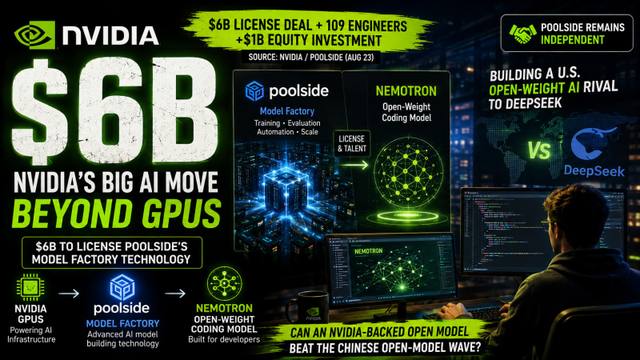
NVIDIA Poolside Deal: The $6B Open-Weight AI Bet
NVIDIA is making a massive move beyond GPUs, reportedly committing $6 billion to license Poolside’s AI model-building technology and bring more than 100 of its engineers into NVIDIA’s open-weight AI efforts.
For years, NVIDIA's biggest role in the AI revolution has been relatively easy to understand.
It makes the chips that power AI.
Companies buy NVIDIA GPUs.
AI labs use those GPUs to train and run increasingly powerful models.
But NVIDIA's latest move shows that the company may want a much bigger role in the AI stack.
According to Reuters reporting, NVIDIA has agreed to pay approximately $6 billion for a non-exclusive license to Poolside's Model Factory technology and plans to hire 109 Poolside engineers for its open-weight Nemotron work. NVIDIA is also separately investing $1 billion in Poolside at a reported $12 billion pre-money valuation.
This isn't a traditional acquisition.
Poolside is expected to remain an independent company.
Instead, NVIDIA is gaining access to Poolside's technology and talent while strengthening its own efforts to build open-weight AI models.
And that could be a very important shift.
NVIDIA Is Moving Up the AI Stack
NVIDIA became one of the most important companies in artificial intelligence because modern AI requires enormous amounts of computing power.
Its GPUs became the infrastructure underneath the AI boom.
But owning the infrastructure isn't necessarily enough forever.
As AI models become more competitive and open-weight models become increasingly important, the companies controlling the models and development systems can capture significant value too.
That's where Poolside comes in.
Poolside specializes in AI models designed for software engineering and has built its own Model Factory, a system for training, evaluating and improving foundation models at scale. Poolside says its Model Factory was created to automate much of the experimentation and infrastructure involved in building foundation models.
NVIDIA is essentially gaining access to that machinery.
The bigger strategy appears to be:
GPUs → AI infrastructure → model training → open-weight models → developers
That is a much larger portion of the AI ecosystem.
What Is Poolside's Model Factory?
The name might sound like another AI model.
It isn't.
The Model Factory is the infrastructure Poolside developed to build and improve AI models.
Poolside describes it as an internal systems framework designed to make foundation-model training faster and more automated.
The system manages areas such as data processing, model training, evaluation, experimentation and code execution.
Poolside has previously explained that its Model Factory runs large-scale workloads across a substantial GPU cluster and uses automation to coordinate experiments.
That matters because building a frontier AI model isn't simply a matter of pressing a button and training a neural network.
Researchers have to constantly experiment.
Which architecture works better?
Which data should be used?
Which training strategy produces better reasoning?
Which model is better at coding?
Which changes actually improve performance?
Each experiment consumes time, computing resources and engineering effort.
A system that makes those experiments faster can become a major competitive advantage.
Why NVIDIA Wants This Technology
NVIDIA already supplies much of the computing infrastructure used by AI companies.
But the AI market is becoming increasingly competitive.
OpenAI has its proprietary models.
Anthropic has Claude.
Google has Gemini.
Chinese companies have produced increasingly capable open-weight models.
DeepSeek became one of the most prominent examples of how open-weight AI can disrupt the market.
Now NVIDIA appears to be putting more resources behind its own open-weight model strategy.
The Poolside technology and engineering talent can help accelerate that effort.
Instead of only providing the hardware used to build AI models, NVIDIA can participate more directly in the process of creating the models themselves.
That is the strategic significance of this deal.
Enter Nemotron
NVIDIA's open-weight model family is called Nemotron.
The Poolside engineers joining NVIDIA are expected to contribute to that effort.
This means the Poolside deal isn't simply about buying a startup.
It is about strengthening NVIDIA's ability to build competitive open-weight AI systems.
That could eventually put NVIDIA in a more direct competitive position against companies developing their own foundation models.
And that is a very different role from the NVIDIA most people knew five years ago.
NVIDIA Isn't Buying Poolside
This distinction is important.
The $6 billion headline can easily create the impression that NVIDIA is acquiring Poolside.
According to the reported deal structure, that isn't what is happening.
NVIDIA is paying approximately $6 billion for a non-exclusive license to Poolside's Model Factory technology.
It is also hiring 109 engineers from Poolside.
Separately, NVIDIA is making a $1 billion equity investment in Poolside.
Poolside continues operating independently, with its leadership and research organization remaining in place.
So the structure is closer to a strategic technology-and-talent partnership than a conventional acquisition.
That distinction matters because Poolside can continue developing its own products and models while NVIDIA gains access to important technology and engineering expertise.
Poolside Already Builds Open-Weight Coding Models
This isn't a random partnership between two companies.
Poolside has been building models specifically around software engineering.
Its current model lineup includes open-weight Laguna models, including Laguna S 2.1 and Laguna XS 2.1. Poolside describes these as agentic coding models designed to perform software-development tasks.
Poolside's models are designed to do more than autocomplete code.
They can operate as coding agents that plan and execute multi-step software tasks.
That expertise is particularly relevant as AI coding agents become one of the fastest-moving categories in the AI industry.
Why Open-Weight Models Matter
There is an important difference between a closed AI model and an open-weight model.
With a closed model, users typically access the model through a company's hosted service or API.
With an open-weight model, the model weights can be made available so organizations can run, customize and deploy the model under the applicable license.
That can provide greater control.
It can also reduce dependence on a single AI provider.
For businesses, governments and developers, that can be extremely attractive.
And the demand for open-weight AI has been growing.
Recent data reported by the South China Morning Post showed open-weight models reaching a record share of token volume on Vercel's AI Gateway, with Chinese models such as DeepSeek contributing heavily to that growth.
That makes the competition around open-weight models increasingly strategic.
The DeepSeek Effect
DeepSeek changed the conversation around AI competition.
Before DeepSeek became a major force, much of the attention was focused on massive proprietary models built by companies such as OpenAI, Anthropic and Google.
Then highly capable open-weight models demonstrated that competitive AI could come from a different direction.
Developers could download or access model weights.
Companies could experiment with them.
Researchers could study them.
Businesses could build their own systems around them.
That created pressure for U.S. companies to remain competitive in the open-model ecosystem.
NVIDIA's Poolside deal can be viewed in that broader context.
The company isn't simply trying to sell more GPUs.
It is also trying to strengthen the software and model ecosystem running on those GPUs.
NVIDIA's Biggest Advantage Is Still Compute
There is one thing NVIDIA already has that most AI model companies don't.
Massive influence over the computing layer.
AI models require enormous amounts of compute.
Training requires GPUs.
Inference requires GPUs.
Large-scale experimentation requires GPUs.
And NVIDIA is one of the dominant suppliers of that infrastructure.
Poolside's Model Factory was itself built around large-scale computing infrastructure. Poolside has previously described operating its training systems across thousands of GPUs and designing software specifically to make large-scale experimentation more efficient.
That creates an interesting combination.
NVIDIA has the compute.
Poolside has model-building infrastructure and talent.
Put those together and NVIDIA can potentially accelerate the development of its open-weight models.
What This Means for Developers
Developers may ultimately be among the biggest beneficiaries of this competition.
If companies compete to create powerful open-weight coding models, developers could gain access to more capable models that can be run in different environments.
That could mean:
More local AI options
More open coding models
Greater model customization
More competition between AI providers
Potentially lower inference costs
More choices for coding agents
Poolside already emphasizes running open-weight coding models in local environments, including on NVIDIA hardware.
If NVIDIA pushes this ecosystem aggressively, developers could see more AI coding capabilities becoming available outside traditional closed AI platforms.
The AI Business Is Becoming a Full-Stack Competition
This may be the biggest takeaway from the deal.
AI companies are no longer competing on just one layer.
There is competition for:
Chips
↓
Data centers
↓
Training infrastructure
↓
Foundation models
↓
AI agents
↓
Applications
NVIDIA already dominates a critical part of the first layer.
Now it is pushing further upward.
The Poolside deal shows how valuable the middle layers of the AI stack have become.
Model training infrastructure and engineering talent can be worth billions.
That tells you something about where the AI industry is heading.
Could NVIDIA Challenge OpenAI and DeepSeek?
It would be too early to say that NVIDIA has suddenly created an OpenAI or DeepSeek competitor.
The deal gives NVIDIA technology and talent.
It does not automatically produce a frontier model.
Building a genuinely competitive AI model requires enormous amounts of research, data, compute, experimentation and engineering.
There is also no guarantee that NVIDIA's future open-weight models will outperform the best models from OpenAI, Anthropic, Google or Chinese AI labs.
But NVIDIA is clearly increasing its ability to compete.
And that's what makes the move interesting.
NVIDIA Is No Longer Just Selling the Shovel
The old description of NVIDIA's AI business was simple:
Everyone needs GPUs, and NVIDIA sells the GPUs.
That is still incredibly important.
But the company is increasingly building an ecosystem around those GPUs.
It has invested in AI infrastructure.
It supports AI software.
It develops its own models.
And now it is paying billions for access to model-building technology and talent.
The strategy looks increasingly like:
Build the infrastructure.
Build the software.
Build the models.
Build the ecosystem.
That is a much bigger ambition.
What Happens Next?
The Poolside deal could be the beginning of a larger push by NVIDIA into open-weight AI.
The company has already been developing its Nemotron family.
Now it has access to Poolside's Model Factory technology and a large group of engineers with experience building coding-focused foundation models.
The next question is simple:
What model will NVIDIA build with it?
If NVIDIA can combine its enormous computing ecosystem with Poolside's model-building expertise, the resulting open-weight models could become important competitors in coding and agentic AI.
For developers, that could mean more choices.
For AI companies, it means more competition.
And for NVIDIA, it could mean something even bigger.
The company that became famous for building the machines that run AI is increasingly interested in building the AI itself.
Final Takeaway
The headline isn't simply:
“NVIDIA spends $6 billion on Poolside.”
The more accurate story is much more interesting.
NVIDIA is paying about $6 billion to license Poolside's Model Factory technology, bringing 109 engineers into its organization, and separately investing $1 billion in Poolside. Poolside remains independent.
That gives NVIDIA access to technology and talent that could strengthen its open-weight Nemotron model strategy.
And in a market increasingly shaped by DeepSeek and other open-weight models, NVIDIA clearly doesn't want to remain only the company supplying the hardware.
It wants a seat at the model-building table.
The GPU giant is becoming an AI-model player.
And that could make the next phase of the AI race very different from the last one.