NPCI Launches New AI and Blockchain Technology Arm in India
NPCI has established NPCI Tech Solutions Ltd to focus on AI, blockchain and digital financial infrastructure, opening new possibilities for India's fintech and technology ecosystem.
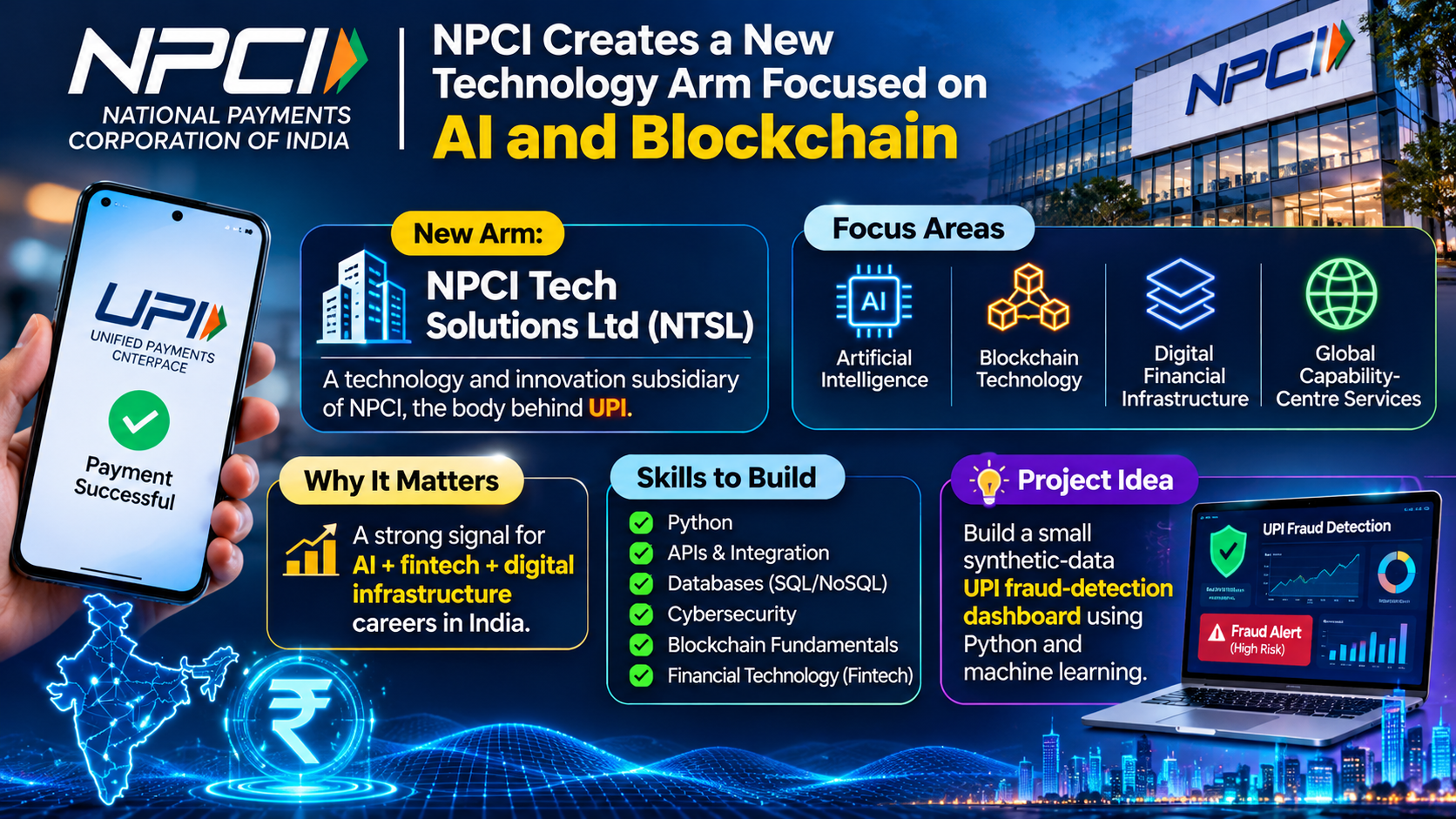
NPCI Launches New Technology Arm Focused on AI and Blockchain: What It Means for India's Fintech Future
India's digital payments ecosystem is entering another important phase. The National Payments Corporation of India (NPCI), the organisation behind popular payment systems such as UPI, has established a new wholly owned technology subsidiary called NPCI Tech Solutions Limited (NTSL).
Announced on November 4, 2026, this development highlights India's growing interest in artificial intelligence, blockchain and advanced digital financial infrastructure.
The new subsidiary will act as the technology and innovation arm of the NPCI Group. Its objective is to build capabilities beyond NPCI's traditional payments operations and support emerging technology initiatives.
1. What Is NPCI Tech Solutions Limited?
NPCI Tech Solutions Limited, also known as NTSL, is a wholly owned subsidiary established to strengthen NPCI's technology capabilities.
The organisation plans to focus on four major areas:
Artificial Intelligence (AI)
Blockchain technology
Digital financial infrastructure
Global Capability Centre (GCC) services
The subsidiary will also provide technology services for initiatives such as eKYC Setu, the Unified Ticketing Platform (UTP) and other Digital Public Infrastructure programmes.
NPCI has appointed Vishal Kanvaty, its former Chief Technology Officer, as the Managing Director and CEO of NTSL.
This appointment is significant because his experience includes developing and commercialising technology platforms within NPCI.
2. Why Is NPCI Investing in AI?
Artificial intelligence is transforming the financial services industry.
Banks, payment companies and financial institutions are increasingly exploring AI to improve customer experiences, automate operations and identify suspicious activities.
Some important applications include:
AI-powered fraud detection: Machine learning systems can analyse transaction patterns and identify potentially suspicious activities.
Customer support automation: AI assistants can answer customer questions and help resolve common banking issues.
Risk assessment: AI systems can analyse financial patterns and help institutions identify potential risks.
Payment automation: Intelligent systems can help simplify payment-related processes while maintaining appropriate security and user authorisation.
These are potential application areas, not a confirmation that NTSL has already deployed all these systems.
3. How Could Blockchain Help India's Financial Infrastructure?
Blockchain is another important technology included in NTSL's focus areas.
Blockchain uses distributed digital records to maintain transaction information across a network.
In financial services, it can potentially support:
Secure record management.
Transparent transaction tracking.
Digital identity verification.
Cross-border financial processes.
Improved auditability.
However, blockchain is not automatically faster or safer for every payment application. Its usefulness depends on the specific problem, architecture and regulatory requirements.
4. What Does This Mean for India's UPI Ecosystem?
UPI has become one of India's most important digital payment systems.
Millions of individuals and businesses use digital payments for shopping, bill payments, money transfers and everyday transactions.
NPCI's new technology subsidiary could help expand its capabilities beyond traditional payment operations.
The organisation has also identified technology services for digital public infrastructure programmes as part of NTSL's work.
This development reflects a broader shift: India's financial technology ecosystem increasingly needs advanced software engineering, cybersecurity, AI research and reliable digital infrastructure.
5. Career Opportunities for Engineering Students
For students pursuing Computer Science, Artificial Intelligence and Machine Learning, this development offers useful signals about emerging technology skills.
Here are six areas worth exploring:
1. Python Programming
Learn Python fundamentals, data structures, libraries and practical application development.
2. Machine Learning
Understand classification, regression, model evaluation and anomaly detection.
3. Database Management
Learn SQL, database design, transaction management and data security.
4. API Development
Understand REST APIs, authentication, integration and backend development.
5. Cybersecurity
Study encryption, authentication, secure coding and payment security fundamentals.
6. Blockchain Fundamentals
Understand distributed ledgers, smart contracts and consensus mechanisms.
These skills can prepare students for fintech and digital infrastructure roles, although NTSL has not announced specific recruitment requirements through this announcement.
6. Practical Project Idea: Build a UPI Fraud Detection Dashboard
Students can turn this news into a useful portfolio project.
Create a small UPI transaction fraud-detection dashboard using Python and machine learning.
Suggested technologies:
Python
Pandas
Scikit-learn
Streamlit
SQL
Matplotlib
Project workflow:
Create or obtain a synthetic transaction dataset.
Clean and prepare the transaction records.
Identify unusual transaction patterns.
Train a basic machine learning classification model.
Evaluate the model using precision, recall and F1-score.
Build a dashboard displaying transaction trends and simulated fraud alerts.
Important: Use synthetic or properly anonymised data. Never collect real UPI PINs, passwords or private banking information.
This project can demonstrate practical knowledge of Python, machine learning, databases and financial technology.
7. What Should We Watch Next?
The establishment of NTSL is an important organisational development, but several questions remain.
For example:
What AI products and platforms will NTSL develop?
How will it approach blockchain applications?
What technology partnerships might emerge?
Will it create new opportunities for Indian technology professionals?
How will its services support India's digital public infrastructure?
The answers will become clearer as the subsidiary develops its operations.
Conclusion
NPCI's creation of NPCI Tech Solutions Limited represents an important step in India's evolving fintech and technology landscape.
AI, blockchain and digital financial infrastructure are becoming increasingly important areas for the future of financial services.
For engineering students, the message is simple: do not focus only on learning how to use AI tools. Develop practical skills in programming, machine learning, databases, cybersecurity and software development.
The combination of AI and fintech could create exciting opportunities for India's next generation of technology professionals.
Source: Reuters, November 4, 2026.