Mistral Raises €3 Billion to Build Europe’s cinematical AI Stack
Mistral’s €3 billion funding round values the French AI company above €21 billion, strengthening Europe’s push for sovereign AI.
By @admin
Source: https://mistral.ai/news/mistral-makes-sovereign-open-weight-ai-to-frontier/?utm_source=chatgpt.com
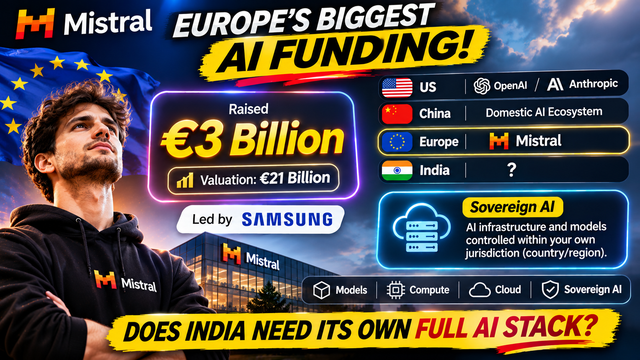
Mistral Raises €3 Billion: Europe’s Big Bet on Sovereign AI
Europe has made a major move in the global artificial intelligence race.
French AI company Mistral has raised €3 billion in a new funding round, taking its post-money valuation to more than €21 billion. The announcement, made on September 8, 2026, marks one of the most significant investments in Europe's technology industry.
But this is not simply another startup raising billions.
The funding reflects a much bigger ambition: Europe wants to build AI technology that it can develop, operate and offer to businesses and governments without depending entirely on platforms controlled elsewhere.
Mistral is positioning itself around frontier AI models, computing infrastructure, enterprise products and cloud services. Its ambition is to become an important part of Europe's AI technology base.
And that makes this funding round relevant far beyond France.
For India, it raises a question worth taking seriously: if Europe is investing billions to strengthen its own AI capabilities, what should India be doing?
1. What exactly happened?
Mistral announced a €3 billion Series D funding round at a post-money valuation of more than €21 billion.
The company described it as the largest equity fundraising round ever completed by a European technology company.
The round was jointly led by three investors:
- Samsung Electronics, the South Korean technology company.
- Scaleup Europe Fund, managed by EQT and backed by the European Union.
- PSG Equity, an existing Mistral investor.
Other investors also participated, including new and existing institutional backers.
The valuation represents a substantial increase from Mistral's previous funding round, when it was valued at approximately €11.7 billion in 2025.
Mistral was founded in 2023 and quickly became one of Europe's most closely watched AI companies.
The reason is straightforward. The company is developing its own AI models and positioning them as alternatives for organisations that want more control over how AI is deployed.
The new investment gives Mistral more financial capacity to compete in a market where building advanced models requires enormous amounts of computing power, specialist talent and infrastructure.
2. Why does an AI company need €3 billion?
Training and operating advanced AI models is expensive.
A modern AI company needs access to specialised processors, large data centres, high-speed networking, storage, electricity and engineering teams.
It also needs enough computing capacity to train models, improve them, test them and serve millions of requests from customers.
This is one of the biggest challenges facing AI startups.
A company might develop a promising model, but if it cannot afford enough computing infrastructure, it may struggle to compete with companies that have access to much larger resources.
Mistral intends to use the new capital to expand its frontier research and computing capacity, develop infrastructure and accelerate commercial growth.
This matters because the AI competition is no longer just about who can build an impressive model.
It is also about who can afford to train it, operate it reliably and deliver it to customers at scale.
The companies that control more of this infrastructure may have an important advantage in the long term.
3. Samsung's involvement makes this round especially interesting
Samsung Electronics is one of the most important companies in the global semiconductor and electronics industry.
Its involvement connects Mistral's AI ambitions with a company that has major expertise in memory chips, electronics manufacturing and advanced technology.
AI systems require enormous amounts of memory and computing resources. As models become larger and AI services expand, demand for specialised chips and memory continues to matter.
Samsung's investment therefore has strategic significance beyond the financial amount.
However, it is important not to misunderstand the deal.
Samsung did not single-handedly lead the entire round. It was one of three joint leads, alongside the Scaleup Europe Fund and PSG Equity.
The investment also does not mean Samsung owns Mistral or that the two companies have merged.
It is a funding relationship that gives Mistral additional capital and brings a major technology investor into its shareholder base.
The wider signal is that established technology companies increasingly see AI model developers as strategically important partners and investment opportunities.
4. What is sovereign AI?
This is the most important concept behind the story.
Sovereign AI refers to a country's ability to develop, control and operate important parts of its artificial intelligence ecosystem according to its own laws, priorities and security requirements.
That can include:
- AI models developed by domestic companies.
- Data centres and computing infrastructure located within the country.
- Control over sensitive data and where it is processed.
- Cloud services that meet local regulatory requirements.
- Skilled researchers, engineers and AI companies.
- The ability to deploy AI systems without relying entirely on foreign providers.
Consider a government department handling sensitive public records.
If every important AI task depends on an external service, the government may have limited control over where data is processed, which rules apply and whether access could change because of commercial or geopolitical decisions.
A sovereign AI strategy aims to give that government more options.
It does not necessarily mean that every component must be manufactured domestically.
A country can use international hardware, open models and global partnerships while still maintaining meaningful control over its data, deployment choices and critical services.
The key is reducing dangerous dependencies and building enough local capability to make independent decisions.
5. Why Europe wants its own AI ecosystem
The United States currently has some of the world's largest AI companies, including OpenAI and Anthropic.
China has developed a strong domestic AI ecosystem with companies building models, applications and infrastructure.
Europe has world-class researchers, technology companies and industrial capabilities, but it has faced criticism for depending heavily on foreign technology platforms.
This creates a strategic concern.
What happens if access to an important AI service changes because of commercial restrictions, regulatory decisions or geopolitical tensions?
What happens if European businesses and governments become deeply dependent on technology they cannot meaningfully control?
These concerns have increased interest in European AI infrastructure and locally developed models.
Mistral is one of the companies trying to address this gap.
Its approach includes developing AI models, providing enterprise solutions and expanding computing infrastructure.
The €3 billion investment gives the company a stronger financial foundation for that ambition.
However, the funding does not automatically make Europe independent.
Building an entire AI ecosystem requires much more than one successful startup. It requires semiconductor supply chains, energy, data centres, software, research institutions, customers and long-term investment.
Mistral can become an important part of the solution, but it cannot solve every dependency on its own.
6. Mistral is trying to build more than models
Many people think of AI companies mainly as model developers.
They release a chatbot, publish benchmarks and compete to produce better answers.
But Mistral's strategy is broader.
It wants to build a business around several connected layers.
Models: The foundation models that understand and generate information, support reasoning and power applications.
Compute: The processors and computing capacity required to train and run those models.
Infrastructure: Data centres, networking and systems that make large-scale AI services possible.
Cloud and enterprise services: Products that allow businesses and organisations to access and deploy AI.
Sovereignty and control: Options for customers that want more control over their data, deployment and technology choices.
Why does this combination matter?
Imagine a company that only develops AI models but depends entirely on another provider for computing and distribution.
It may have a strong product, but it also depends on that provider's pricing, availability and commercial decisions.
A company that develops models while expanding its own infrastructure and enterprise services may have more control over its business.
This is the direction Mistral is pursuing.
Still, it is not a completely self-contained technology stack today. It uses partnerships and external suppliers, including major international technology companies. Sovereignty is a matter of increasing control and options, not claiming that every component is already domestic.
7. The question India should be asking
This is where the story becomes especially relevant for Indian students, developers, entrepreneurs and policymakers.
India has a large technology workforce, a growing digital economy and a substantial market for AI products.
It also has important challenges.
Developing advanced AI requires expensive computing infrastructure, access to specialised chips, reliable electricity, high-quality datasets, research funding and highly skilled teams.
India cannot build a competitive AI ecosystem simply by launching another chatbot.
It needs a broader strategy.
That could include investing in domestic AI research, supporting startups developing models for Indian languages, expanding data-centre capacity, training AI engineers and creating secure infrastructure for government and business use.
India also needs to think carefully about where open models can help.
Open-weight models can allow developers and organisations to download, customise and deploy models in environments they control, subject to the model's licence and technical requirements.
This can create opportunities for Indian startups to build specialised AI systems for healthcare administration, agriculture, education, manufacturing, finance and public services.
But open models are not a complete solution by themselves. They still need computing resources, security testing, maintenance and skilled people.
The challenge is to build a sustainable ecosystem rather than relying on a single headline investment.
8. Does India need its own full AI stack?
The answer depends on what we mean by a full AI stack.
If the expectation is that India must manufacture every advanced chip, build every model, own every data centre and replace every international technology provider, that is an extremely expensive and unrealistic short-term target.
But if the goal is to maintain meaningful control over critical AI capabilities, then the argument is much stronger.
India should aim to have:
1. Domestic AI companies capable of developing competitive models.
2. Reliable computing and data-centre infrastructure.
3. Secure options for processing sensitive data locally.
4. Strong research institutions and AI engineering talent.
5. Open and interoperable systems that reduce dependence on a small number of providers.
6. International partnerships that improve access to technology without creating excessive dependence.
The goal should not be isolation.
AI development is global. India benefits from international research, chips, open-source software and partnerships.
The objective should be to participate in the global AI economy while retaining the ability to make important decisions about critical systems.
That is a more practical definition of technological independence.
9. The bigger message behind Mistral's €3 billion raise
The AI race is entering a new stage.
During the first wave of generative AI, much of the attention focused on chatbots and model capabilities.
Now the competition is increasingly about the infrastructure behind those models.
Who owns the computing capacity?
Who controls the data?
Who can train and deploy models at scale?
Who provides the cloud services?
And who has enough domestic capability to keep important AI systems running when international conditions change?
Mistral's €3 billion funding round is a major European response to those questions.
It does not prove that Europe has caught up with the United States or China. It does not guarantee that Mistral will become a global leader. And it does not mean that Europe is now fully independent in AI.
But it demonstrates that investors and policymakers increasingly view AI infrastructure as a strategic asset.
For India, the lesson is clear: building AI capability is not just about creating an impressive chatbot. It is about developing the models, infrastructure, talent and ecosystem required to support AI over the long term.
Final thought
Europe has made a €3 billion bet on strengthening its AI ecosystem through Mistral.
The bigger question is not whether India should copy Europe's approach exactly.
It is whether India can build enough AI capability to protect its interests, support its industries and compete globally.
Because the next AI race may not be won by the country with the most popular chatbot.
It may be won by the countries and companies that control the infrastructure powering the next generation of AI.