Microsoft MAI Models Upgrade Real-Time AI Voice Agents
Microsoft has launched three MAI models designed for real-time voice experiences, enabling faster transcription, expressive speech and low-latency AI voice agents.
Microsoft MAI Models Upgrade Real-Time AI Voice Agents
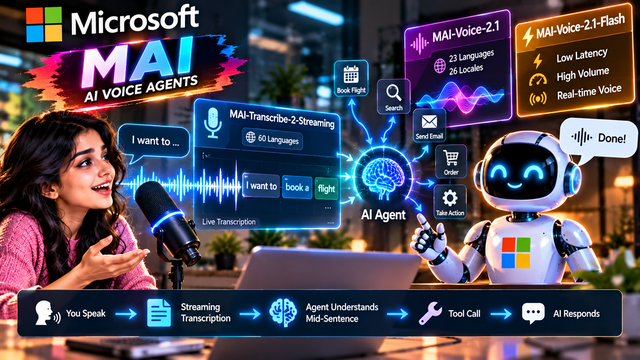
Microsoft has introduced three new MAI models designed to improve real-time AI voice experiences in Microsoft Foundry. The new models are MAI-Transcribe-2-Streaming, MAI-Voice-2.1 and MAI-Voice-2.1-Flash.
The most interesting part of the announcement is the streaming transcription capability. MAI-Transcribe-2-Streaming is designed to process speech continuously rather than waiting for a person to finish an entire sentence before producing a transcript.
That difference can make AI voice agents feel much more responsive.
In a traditional voice workflow, the process often looks like this:
You speak → recording finishes → speech is transcribed → AI understands → tool is called → AI responds.
With streaming transcription, the agent can start receiving partial speech information while the person is still talking:
You speak → streaming transcription → AI starts understanding → tool preparation → response.
Microsoft says MAI-Transcribe-2-Streaming supports 60 languages and is designed to begin producing partial transcripts with very low latency. This makes it useful for conversational applications where response speed matters.
Microsoft's two voice models are designed for generating expressive AI speech. MAI-Voice-2.1 supports 23 languages and 26 locales, while MAI-Voice-2.1-Flash is optimized for lower latency and high-volume scenarios.
This combination gives developers a foundation for building more natural voice agents. Instead of treating speech as a simple input and output layer, developers can build systems where transcription, reasoning, tool use and voice generation work together continuously.
For example, imagine telling an AI assistant, “Book me a flight to Hyderabad tomorrow.” A streaming voice agent could begin recognizing the request before the complete sentence is finished, identify the intent and prepare the necessary tool interaction before generating a spoken response.
The important development is therefore not simply that Microsoft launched three new models. It is that low-latency speech can change how AI agents behave.
For creators and developers, this opens possibilities for customer-support agents, voice assistants, interactive applications, call-center automation, accessibility tools and other real-time conversational experiences.
The broader trend is clear: AI voice agents are moving toward conversations that feel less like sending messages to a chatbot and more like talking to an assistant that can understand, reason and act in real time.