Meta, Walmart and Stripe Build AI Agent Standard
Meta, Walmart, Stripe and other partners are developing an open standard to help AI agents securely identify, authenticate and interact with businesses. Quartz
Source: https://qz.com/meta-walmart-stripe-ai-agent-protocol-open-standard-100626?utm_source=chatgpt.com
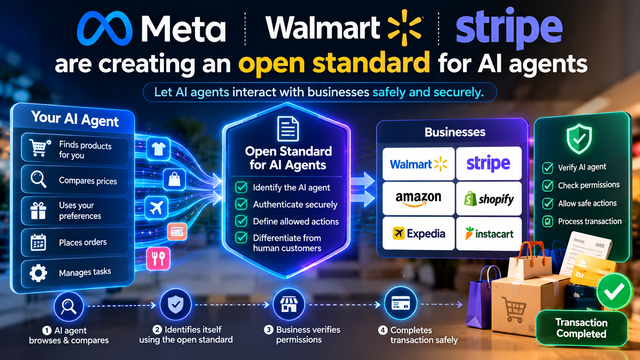
Meta, Walmart and Stripe are working on an open standard for AI agents
AI agents are moving beyond answering questions. They are increasingly being designed to perform actions for people, including finding products, checking information and potentially completing purchases.
To make these interactions safer and easier for businesses, Meta and Sierra are developing the Personal Agent Protocol, an open standard for how personal AI agents interact with businesses. Walmart, Stripe, Shopify, Genesys, Instinct and Rocket are among the partners involved. Quartz
Why do AI agents need a standard?
Today, an AI agent trying to interact with a website can look similar to an ordinary automated bot. A business may not know whether the agent is acting on behalf of a real customer or operating without authorization.
That creates problems around authentication, security, permissions and fraud.
The proposed Personal Agent Protocol aims to give businesses a standard way to recognize an AI agent and understand what it is authorized to do.
The basic idea is:
AI Agent → Identifies Itself → Business Verifies Permissions → Agent Performs Allowed Action
The protocol is designed around OAuth, a widely used authorization technology. An agent could initially interact as a guest, for example to check product availability or a return policy. After a customer signs in, the customer can grant the agent appropriate access, such as read-only or write permissions. Think Facility
What could this mean for online shopping?
Imagine telling your AI agent:
“Find the best laptop under ₹60,000 and order it if you find one with good reviews.”
Instead of simply browsing websites like a human, a future agent could identify itself to participating businesses, receive specific permissions and interact through supported websites or APIs.
This could make agent-to-business transactions much easier to build.
For businesses, the advantage is control. Companies can decide what their systems expose to AI agents and what actions those agents are allowed to perform.
For consumers, the goal is greater visibility and control over what their AI agent can access and do.
The Personal Agent Protocol is still an emerging standard, and its v0.1 specification is expected later in October 2026, so its eventual adoption is not guaranteed. Think Facility
But the direction is significant.
The web could be moving from human → website toward a future where AI agent → business becomes another major way transactions happen.
The bigger picture
This is not just another AI agent framework. It is an attempt to create common infrastructure for agents to interact with businesses securely.
If widely adopted, standards like this could become an important foundation for agentic commerce, AI shopping assistants, automated bookings and business-to-agent interactions.
Your AI agent may not just search the internet for you in the future. It may actually do business for you.