Meta Muse Gadgets Turn AI Agents Into Hardware|AI News
Meta is opening Muse to custom hardware with ESP32 firmware and a Linux SDK, allowing developers to connect AI agents to sensors, displays and devices
Source: https://about.fb.com/news/2026/09/introducing-muse-personal-ai-agent/
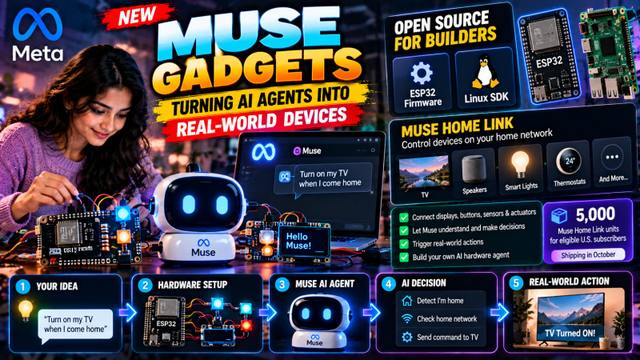
Meta is expanding its Muse personal AI agent beyond software and into the physical world with Muse Gadgets, an initiative that allows developers to connect Muse with custom hardware.
The development is significant because most AI assistants exist primarily inside phones, computers or web applications. Muse Gadgets points toward a different model: an AI agent that can interact with physical devices through sensors, displays, buttons and actuators.
Meta has opened Muse to custom hardware through open-source ESP32 firmware and a Linux SDK. This gives developers a way to experiment with building their own devices around the Muse agent.
The basic concept can be represented as:
Muse → Hardware → Sensor → AI decision → Physical action
For example, a developer could connect Muse to an ESP32 board with sensors and a small display. The hardware could collect information from the environment, send it to the AI system and then trigger an action based on the result.
This could make AI agents much more useful outside traditional chat interfaces. Instead of simply answering a question, an agent could potentially control connected devices, display information, respond to sensor events or interact with other systems.
Meta's Muse Home Link provides an example of this direction. It is designed to allow Muse to communicate with devices on a home network, including devices such as TVs and speakers. Meta produced a limited number of Muse Home Link units for eligible U.S. Muse subscribers, with shipping planned for October.
The broader idea is particularly interesting for developers and hardware enthusiasts. ESP32 boards are inexpensive and widely used in electronics projects, while Linux-based systems can support more complex applications. Combining these platforms with an AI agent could make it easier to build experimental smart devices.
Imagine a simple project where an AI agent receives a command, checks a sensor, makes a decision and then activates a device. The workflow could be:
User request → Muse → AI reasoning → ESP32 → Device action
This changes how people might think about AI assistants. Instead of an assistant that only talks to you through a screen, the assistant could become part of the physical environment.
However, giving AI agents access to physical devices also creates important security considerations. Developers need to carefully control permissions, especially when an agent can operate appliances, access networks or trigger real-world actions.
The most important aspect of Muse Gadgets is therefore not simply the hardware itself. It is the combination of AI agents, open development tools and physical computing.
As these technologies mature, developers may be able to build personalized AI-powered gadgets for homes, education, robotics, accessibility and automation.
The shift is simple but powerful:
Old AI: Ask → AI responds.
New AI hardware: Ask → AI decides → hardware acts.
Meta's Muse Gadgets initiative shows how AI agents could eventually move beyond screens and become active participants in the physical world.