Meta Muse Gadgets Brings AI Agents to DIY Hardware
Meta opens Muse to DIY hardware with ESP32 firmware and a Linux SDK, letting developers connect AI agents to real-world devices
Source: https://about.fb.com/news/2026/09/introducing-muse-personal-ai-agent/
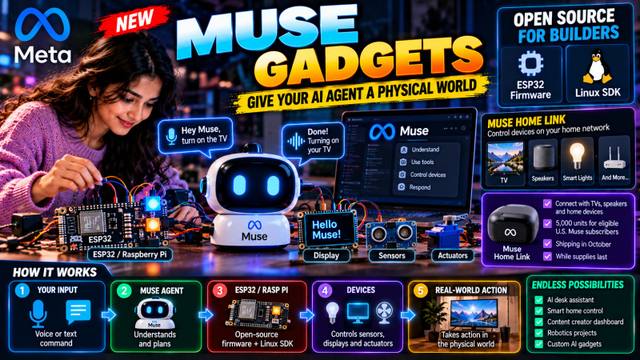
Meta Muse Gadgets Brings AI Agents to DIY Hardware
Meta is taking its Muse AI agent beyond the screen with a new project called Muse Gadgets, giving developers a way to connect AI-powered assistance with custom hardware. The project introduces open-source tools for builders who want to experiment with devices based on platforms such as ESP32 boards and Linux systems.
The idea is significant because AI agents are increasingly moving from simply answering questions to performing actions. With Muse Gadgets, developers can create physical interfaces that allow an AI agent to interact with sensors, displays, buttons, speakers, and other connected devices.
At a high level, the workflow can look like this:
Voice or text → Muse agent → API → ESP32/Raspberry Pi → Sensors, displays or actuators → Real-world action
Meta's approach includes ESP32 firmware and a Linux SDK, giving hardware developers a starting point for building their own Muse-connected gadgets. Instead of requiring users to purchase a dedicated AI device, the project opens the door to custom creations using relatively accessible development hardware.
One example highlighted around the project is Muse Home Link. It is designed to allow Muse to interact with devices on a home network, potentially connecting an AI agent with equipment such as TVs, speakers and other smart-home devices. Meta says Home Link devices are being made available to eligible U.S. Muse subscribers while supplies last.
The bigger opportunity is for developers and makers to experiment with completely new types of AI interfaces. An ESP32 could receive a command from an AI agent and control an LED, motor, relay or display. A Raspberry Pi could act as a more powerful local gateway connecting Muse with multiple devices. Sensors could also provide information back to the system, allowing an agent to respond to changes in the physical environment.
This makes Muse Gadgets particularly interesting for DIY projects, smart homes, robotics, automation and AI-powered creator tools. For example, a developer could build an AI desk assistant that displays notifications, controls lights, monitors environmental sensors or provides information through a small screen.
The project also represents a broader change in how AI agents are being developed. Instead of keeping agents inside websites and mobile applications, developers can increasingly give them access to physical interfaces and connected devices.
For makers, the most interesting part may be the ability to build something unique rather than simply using a standard AI product. A custom AI dashboard, smart-home controller, robotics project or interactive display could all become potential Muse Gadget applications.
Meta's move suggests that the next generation of AI agents may not live only in chat windows. They could interact with the physical world through the hardware developers build themselves.