Meta Executive Dave Wehner Joins AI Startup Fireworks AI
Meta's chief strategy officer Dave Wehner is leaving the technology giant to become CFO of AI startup Fireworks AI. His move highlights the growing opportunities and competition in the artificial intelligence startup ecosystem.
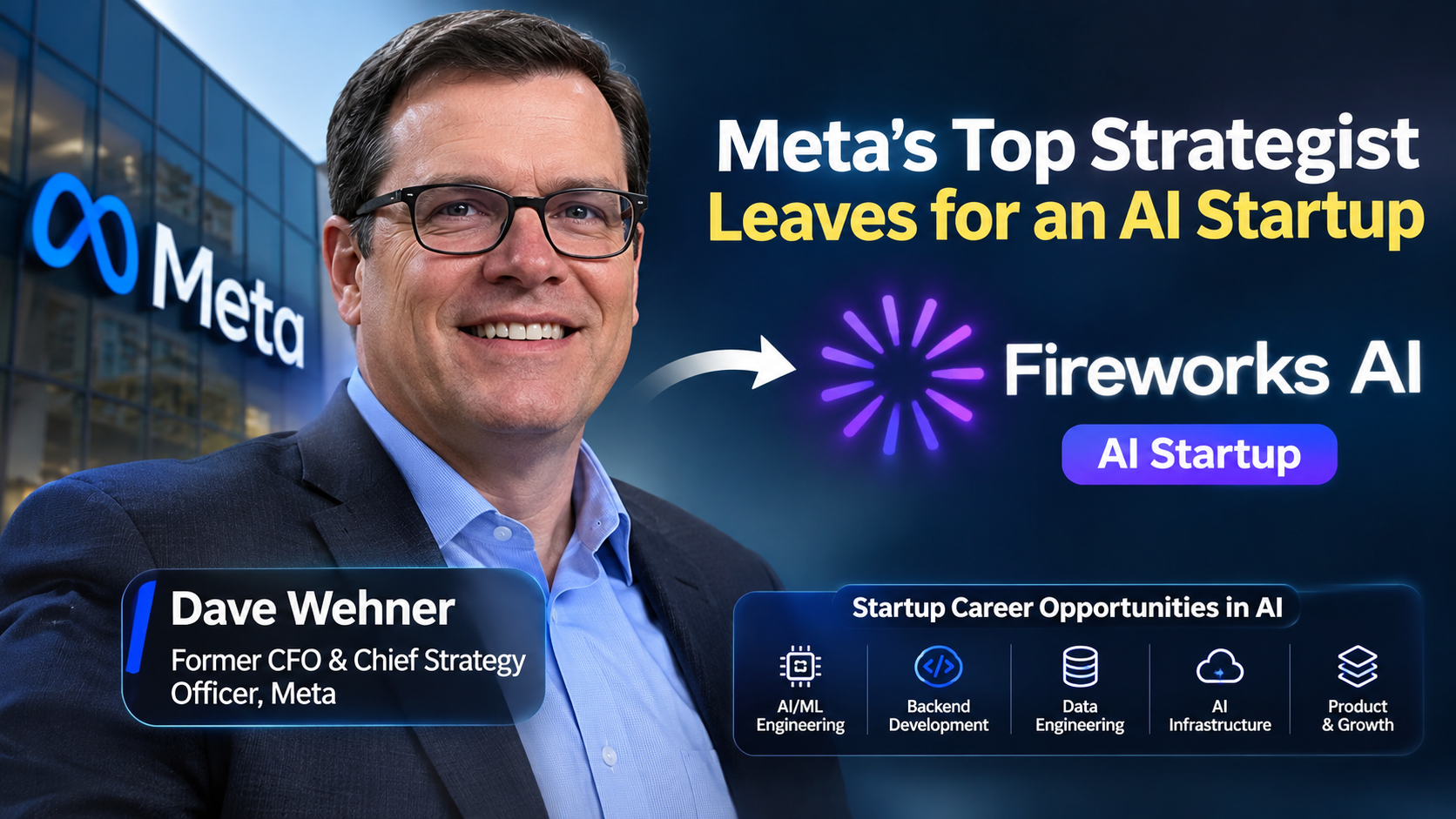
Meta Executive Dave Wehner Leaves Big Tech to Join AI Startup Fireworks
A major leadership move in the artificial intelligence industry
The artificial intelligence industry is attracting more than engineers, researchers and investors. Experienced executives from some of the world's biggest technology companies are also moving into AI startups.
One of the latest examples is Dave Wehner, Meta's chief strategy officer and former chief financial officer, who is leaving the social media giant to join Fireworks AI as its new chief financial officer (CFO).
The move is attracting attention because Wehner spent more than a decade at Meta, helping the company navigate major periods of growth, financial expansion and technological investment.
His decision to join a much younger AI company highlights an important development in the technology industry: AI infrastructure startups are becoming increasingly attractive destinations for experienced business leaders.
Fireworks AI, founded in 2022, focuses on helping developers and businesses customise, train and run open artificial intelligence models.
For the startup, hiring an executive with Wehner's experience could strengthen its financial strategy and prepare the company for its next stage of growth.
1. Who is Dave Wehner?
Dave Wehner is a senior technology and finance executive who has played an important role in Meta's business development.
He joined Facebook, now known as Meta, in 2012. Before joining Facebook, he worked as the chief financial officer of Zynga and held positions in the financial sector.
In 2014, Wehner became Meta's chief financial officer.
He held that position until 2022, overseeing financial operations during an important period in the company's development.
During his time as CFO, Meta experienced significant growth in advertising, expanded its family of applications and invested heavily in new technology initiatives.
In November 2022, Wehner transitioned from the CFO position to become Meta's chief strategy officer.
Susan Li succeeded him as CFO.
As chief strategy officer, Wehner continued working on important company-wide strategic decisions.
His departure therefore represents the exit of a long-serving senior executive who understands the financial and operational challenges of running a major technology company.
2. Why is Dave Wehner joining Fireworks AI?
Wehner announced that he would join Fireworks AI as CFO, explaining that he had become increasingly optimistic about the company's future.
He also expressed confidence in its technical talent and its practical approach to solving customer problems.
In his announcement, Wehner described artificial intelligence as one of the most consequential technology shifts of his lifetime.
He believes businesses will increasingly use AI to build specialised intelligence from their own data, knowledge and expertise.
This is closely connected to Fireworks AI's business strategy.
The company wants to make it easier for businesses to customise and deploy AI models for their specific requirements.
For example, a healthcare company may want an AI system that understands its specialised information.
A financial services company may need AI tools that support document processing and customer operations.
A software company may want to integrate an AI coding assistant into its development platform.
These businesses need more than access to a general-purpose chatbot. They need reliable AI infrastructure that can support their products and workflows.
Fireworks AI is positioning itself in this market.
Wehner's financial experience could help the company manage its expansion, allocate resources and strengthen its business operations.
3. What exactly is Fireworks AI?
Fireworks AI is an artificial intelligence infrastructure company founded in 2022 by former Meta and Google employees.
It focuses on providing infrastructure for running, customising and deploying AI models.
To understand its business, it is important to understand two concepts: AI training and AI inference.
AI training is the process through which an AI model learns patterns from large amounts of data.
During training, models adjust their internal parameters to perform tasks such as understanding language, recognising images or generating content.
AI inference happens when a trained model is used to generate an answer or perform a task.
For example, when a user asks an AI chatbot a question, the model processes the request and generates a response. That process is inference.
Training powerful AI models can be expensive. However, running those models for millions of users also requires significant computing resources.
This is where companies like Fireworks AI become important.
Its platform helps developers and businesses run open AI models efficiently without having to build every part of the infrastructure themselves.
The company also supports model customisation, allowing businesses to adapt models to their particular needs.
4. Why is AI inference becoming such an important industry?
Most people associate artificial intelligence with famous chatbots and image-generation applications.
However, behind every AI application is an infrastructure system that makes the technology work.
When someone generates an image, asks a chatbot a question or uses an AI coding assistant, computing resources are required to process the request.
As AI applications become more popular, the number of these requests increases.
Businesses need infrastructure that can handle large workloads while controlling costs and maintaining performance.
This creates opportunities in the AI inference market.
There are several important reasons for its growth.
Increasing AI adoption: More companies are integrating AI into their products and services.
Higher computing demand: AI applications require computing resources whenever users interact with them.
Cost optimisation: Businesses want to reduce the cost of running AI models.
Open-source models: Developers increasingly have access to models they can customise and deploy.
Enterprise requirements: Companies need AI infrastructure that can work with their own data and applications.
Fireworks AI is targeting this growing infrastructure market.
Its business is not primarily about building another consumer chatbot. Instead, it provides technology that developers and businesses can use to power AI applications.
5. Why are open AI models important?
One of the major areas of focus for Fireworks AI is open AI models.
Open models give developers greater flexibility to customise and deploy AI systems.
Instead of depending entirely on a single closed AI service, businesses can explore different models and select those that best suit their requirements.
For example, a startup developing an AI customer-support application might choose an open model and customise it for its particular industry.
A software development company could use an open model to build coding assistance into its internal tools.
An education platform might explore models for language learning and personalised educational support.
However, open does not always mean completely unrestricted or free. Model licences, computing requirements, hosting costs and usage conditions still matter.
Platforms such as Fireworks AI aim to make working with these models more accessible.
This is important because the future of AI may involve many specialised models rather than a small number of general-purpose systems.
6. Fireworks AI's growth and valuation
Fireworks AI has attracted significant investor interest.
The company was valued at approximately $17.5 billion following its Series D funding round in July 2026, according to reports.
This valuation reflects investor interest in the infrastructure required to develop and deploy AI applications.
AI infrastructure has become an important business category because companies need more than powerful models.
They also need:
Computing infrastructure.
GPU resources.
Model hosting.
Inference optimisation.
Data processing systems.
Developer tools.
Enterprise deployment solutions.
The AI industry is therefore creating opportunities for businesses that provide the technology behind everyday AI applications.
Fireworks AI operates in this infrastructure market.
Its funding and valuation demonstrate the level of attention investors are paying to companies supporting AI deployment.
Reports have also indicated that the company has discussed the possibility of additional fundraising. Any future valuation would depend on the outcome of those discussions and should not be treated as confirmed.
7. What does this move mean for Meta?
Meta is one of the world's largest technology companies and has made substantial investments in artificial intelligence.
Its AI strategy includes developing models, building infrastructure and integrating AI into products such as Facebook, Instagram and WhatsApp.
Wehner's departure is notable because of his long association with the company.
However, it is important to understand that he was no longer Meta's CFO when he announced his departure. He had transitioned to the chief strategy officer role in 2022.
Therefore, Meta is losing an experienced senior strategy executive rather than its current finance chief.
The move also highlights the changing competition for experienced technology leadership.
Large technology companies have traditionally attracted executives through their scale, financial resources and global influence.
Now, fast-growing AI startups are also becoming attractive because they offer opportunities to build businesses around emerging technologies.
For Meta, competition is not limited to AI products and researchers. It also involves attracting and retaining people with the business experience needed to scale technology operations.
8. Why are experienced executives moving towards AI startups?
AI startups are developing products and services that could become important parts of the global technology economy.
This creates opportunities for people with experience in finance, engineering, operations, marketing and business strategy.
There are several reasons why experienced executives may find these companies attractive.
A major technology transition: AI is changing how companies develop products and serve customers.
New business opportunities: AI infrastructure and enterprise AI create markets that did not exist at the same scale a few years ago.
Smaller teams and faster decisions: Startups may offer opportunities to work closely with founders and influence important decisions.
Growth potential: Successful startups can expand rapidly as demand for their technology increases.
Building new products: Executives can participate in developing businesses around technologies that are still evolving.
However, joining a startup also involves risks.
Startups may face competition, changing market conditions, high operating costs and uncertainty about long-term profitability.
A company's valuation does not guarantee future success.
Wehner's move is therefore an interesting example of how experienced leaders are evaluating opportunities in the AI industry.
9. What does this news mean for Indian AI students?
This development is particularly interesting for students pursuing computer science, artificial intelligence and machine learning.
Many students believe that AI careers are available only at companies such as Google, Microsoft, Meta or OpenAI.
However, the AI ecosystem includes thousands of smaller companies working on specialised technologies.
Some develop AI models. Others build infrastructure, developer platforms, data systems, applications and business automation tools.
This creates opportunities for freshers with practical technical skills.
Here are some areas worth exploring.
AI and machine learning engineering
Learn Python, machine learning, deep learning, model evaluation and data processing.
Backend development
Learn Java or Python, REST APIs, databases, authentication and application development.
AI infrastructure
Understand cloud computing, GPUs, Linux, networking, containers and model deployment.
Data engineering
Learn SQL, Python, data pipelines and data management.
MLOps
Understand how machine learning models are deployed, monitored and maintained in real applications.
These skills can help students explore opportunities at AI startups as well as established technology companies.
10. Five practical projects students can build
Instead of learning AI concepts only theoretically, students can create small projects that demonstrate their understanding.
Project 1: AI Chatbot using an Open Model
Build a chatbot that answers questions using an available open AI model.
Technologies: Python, an open model API and Streamlit.
Project 2: AI Model Comparison Dashboard
Create a dashboard that compares different AI models based on response time, output quality and estimated usage cost.
Technologies: Python, APIs, Pandas and Streamlit.
Project 3: Document Question-Answering System
Build an application that allows users to upload documents and ask questions about their contents.
Technologies: Python, embeddings, vector databases and an LLM.
Project 4: AI Model Deployment Application
Deploy a simple machine learning model through an API so that other applications can access it.
Technologies: Python, FastAPI and cloud deployment.
Project 5: AI Usage Monitoring Dashboard
Create a dashboard that tracks API requests, response times and estimated token consumption using sample data.
Technologies: Python, SQL and data visualisation.
These projects can help students develop practical knowledge of the technologies used in AI businesses.
11. The challenges facing AI infrastructure startups
Although AI infrastructure is an attractive market, companies like Fireworks AI must solve several difficult problems.
Infrastructure costs: Running AI models requires computing resources, and GPU infrastructure can be expensive.
Competition: Fireworks competes in a market that includes major cloud providers and specialised AI infrastructure companies.
Performance: Businesses expect models to respond quickly and reliably.
Security: Companies must protect customer data, model configurations, credentials and infrastructure.
Scalability: AI platforms need to handle increasing workloads without significantly reducing performance.
Profitability: Growing revenue is not enough. Companies must also manage infrastructure expenses and build sustainable business models.
Fireworks has also disclosed a security incident involving unauthorised use of internal credentials in October 2026. The company said its investigation found no evidence of unauthorised access to customer models, datasets, training data, personal information or inference traffic.
This highlights why security and operational reliability are important for AI infrastructure businesses.
12. The bigger picture: AI is becoming an infrastructure business
The AI industry is moving beyond the initial excitement surrounding chatbots and image generators.
Companies are increasingly focusing on the systems required to make AI useful at scale.
These include:
AI chips and GPUs.
Cloud computing.
Model training.
AI inference.
Data infrastructure.
Enterprise AI applications.
AI security.
Model deployment and monitoring.
This creates an interconnected industry where different companies provide different parts of the technology stack.
For example, a business might use a cloud provider for computing, an open model for intelligence and an inference platform to serve that model to customers.
This is the type of ecosystem in which Fireworks AI operates.
Wehner's decision to join the company demonstrates the growing importance of the business and financial leadership required to scale these infrastructure providers.
Conclusion: A new opportunity in the AI startup economy
Dave Wehner's move from Meta to Fireworks AI is more than a senior executive changing jobs.
It reflects the growing importance of AI infrastructure companies and the opportunities emerging around open models, enterprise AI and inference technology.
Fireworks AI is positioning itself to support businesses that want to customise and deploy AI models.
Bringing in an experienced executive who previously served as Meta's CFO could help the startup strengthen its financial operations and prepare for its next phase of growth.
For students and aspiring developers, the important lesson is that AI opportunities are not limited to building chatbots.
The industry also needs people who understand Python, backend development, cloud computing, GPUs, databases, machine learning and AI deployment.
The next generation of AI companies will need both strong technology and strong business leadership. That is what makes this development worth watching.