Kore.ai Autoloop: AI Agents That Improve Automatically
Discover how Kore.ai Autoloop evaluates, diagnoses, and improves enterprise AI agents for accuracy, safety, reliability, and cost efficiency.
Source: https://www.expresscomputer.in/news/kore-ai-autoloop-enterprise-ai-agents/139737/
Kore.ai Launches Autoloop to Automatically Improve Enterprise AI Agents
Introduction
Artificial intelligence is moving beyond answering questions and generating content. Businesses are increasingly using AI agents to perform tasks, follow workflows, interact with software, and assist employees and customers. But as these systems become more capable, an important challenge emerges: how can organizations make sure their AI agents continue to work correctly after deployment?
Kore.ai is addressing this challenge with Autoloop, an optimization engine designed to evaluate, diagnose, and continuously improve enterprise AI agents. The company announced its general availability in October 2026 as part of the Kore.ai Agent Platform, Artemis edition.
The idea behind Autoloop is straightforward: instead of depending entirely on developers to identify and repair every problem manually, businesses can use an automated process to evaluate agent performance, identify weaknesses, make targeted improvements, and test the results.
This development reflects a broader trend in enterprise AI: organizations are increasingly focused not only on building AI agents but also on making them reliable, safe, efficient, and ready for real-world operations.
What Is Kore.ai Autoloop?
Autoloop is a continuous optimization capability for enterprise AI agents. It is designed to help organizations manage an agent throughout its lifecycle, from its initial development and testing to its operation in a live environment.
Traditional AI development often involves several separate steps. Developers build an agent, test it with selected examples, deploy it, and monitor its performance. When something goes wrong, engineers investigate the issue and update the system. They then need to test the changes to ensure that the original problem has been fixed without introducing another one.
This process can become difficult when an organization operates many agents across customer service, finance, human resources, healthcare, retail, or other business functions.
Autoloop aims to make this cycle more continuous. According to Kore.ai, the platform can evaluate agents against business-defined objectives, diagnose performance gaps, make targeted adjustments, and validate the proposed changes.
The goal is not simply to make an agent produce more responses. It is to help the agent complete its intended tasks while meeting the organization's requirements for quality, safety, compliance, and cost.
How Does Autoloop Work?
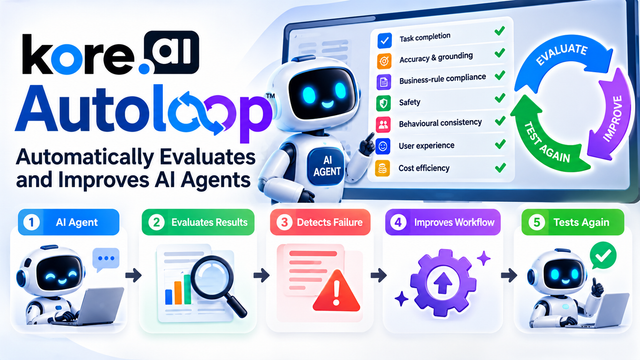
The core concept can be understood through five stages.
1. Build or configure the AI agent
An organization first defines what the agent should accomplish. For example, a customer-support agent might need to answer product questions, retrieve information from approved company sources, follow refund policies, and escalate complicated requests to a human employee.
Clear objectives give the system a basis for evaluating whether the agent is performing correctly.
2. Evaluate the agent's performance
The platform assesses how the agent behaves against the configured objectives. It can examine whether tasks were completed, whether answers were grounded in relevant information, and whether the agent followed the required rules.
This is important because an agent can operate without a technical error while still delivering an incorrect answer or making a poor decision.
3. Identify the source of a failure
When an agent fails to meet an objective, the next step is to determine what happened. The problem might involve a workflow step, a tool call, an incorrect handoff, missing context, or a business rule that was not followed.
Kore.ai describes StateTrace as a technology used to track agent behaviour and execution, helping teams understand where an issue occurred.
4. Make a targeted improvement
After diagnosing the issue, Autoloop is designed to propose or apply a focused change to the relevant part of the agent's workflow. Kore.ai's Agent Blueprint Language (ABL) supports precise changes to the structured logic behind an agent.
Targeted changes matter because modifying an entire workflow to fix one error can create unnecessary risks elsewhere.
5. Test the change again
The updated agent must be evaluated again to check whether the original problem has been resolved. The change should also be checked against other configured requirements.
For example, reducing an agent's operating cost should not cause it to provide less accurate answers or ignore important safety rules.
The overall process is a continuous loop:
AI agent → Evaluate results → Detect failure → Improve workflow → Test again.
Seven Dimensions Used to Evaluate AI Agents
Kore.ai describes Autoloop as evaluating agents across seven dimensions.
1. Task completion
Can the agent finish the task it was assigned? A customer-service agent should resolve an eligible request or correctly escalate it rather than stop halfway through the process.
2. Accuracy and grounding
Are the agent's answers correct and supported by appropriate information? This is especially important when agents work with company documents, product information, or customer records.
3. Business-rule compliance
Does the agent follow the organization's operating procedures and restrictions? For example, it should not approve a refund that violates the applicable policy.
4. Safety
Does the agent remain within its permitted boundaries? Organizations need safeguards to prevent inappropriate actions, unsafe outputs, and unauthorized operations.
5. Behavioural consistency
Does the agent behave consistently across similar situations? A dependable system should not give dramatically different results when the underlying requirements are the same.
6. User experience
Is the interaction useful, clear, and appropriate for the user? An agent may technically complete a task but still frustrate customers with confusing explanations or unnecessary steps.
7. Cost efficiency
Can the agent deliver the required outcome without unnecessary operating expenses? Businesses must consider the cost of running agents as they scale up usage.
These dimensions demonstrate why AI-agent quality involves more than checking whether a system is online. A successful agent needs to deliver the right outcome while respecting business requirements.
Why Continuous AI-Agent Improvement Matters
One of the main difficulties with enterprise AI is that fixing one problem can introduce another. A developer might simplify a workflow to reduce processing time, but the change could accidentally remove a validation step. Another update might improve answer speed while reducing accuracy.
When an organization operates dozens or hundreds of agents, manual troubleshooting can become increasingly demanding.
Autoloop aims to address this challenge by connecting evaluation, diagnosis, optimization, and verification. Instead of treating testing as a one-time activity before launch, the approach makes performance improvement part of the agent lifecycle.
Kore.ai has also highlighted findings from its 2026 Agent Productivity Index concerning enterprise AI-agent failures and reversed actions. These figures reflect the challenges reported in the company's research; they should not be interpreted as independent proof that Autoloop will eliminate such failures.
The broader lesson is that organizations need visibility into what their agents do, reliable methods for evaluating results, and safeguards that help prevent regressions.
What Could This Mean for Indian Businesses?
Indian organizations are exploring AI agents for customer support, document processing, employee assistance, operational workflows, and other business activities.
For a bank, an AI agent might help customers navigate routine service requests. For an online retailer, it might assist with order-related questions. In a large company, agents could help employees locate information or complete repetitive administrative tasks.
As these systems take on more responsibilities, the consequences of errors become more significant. An incorrect customer response may cause inconvenience, while a workflow mistake involving financial transactions or sensitive records may require much more careful handling.
Continuous evaluation can help organizations identify weaknesses earlier and assess whether an agent is meeting its requirements. However, businesses must still implement appropriate access controls, privacy protections, audit procedures, and human approval for sensitive actions.
For Indian companies considering enterprise AI, the important question is not simply whether an agent can perform a task during a demonstration. It is whether that agent can continue to perform reliably under real-world conditions.
Opportunities for Students and AI Creators
Autoloop also provides a useful learning example for students interested in artificial intelligence, machine learning, software engineering, and automation.
Students can explore the difference between building an AI system and evaluating its performance. Useful topics include AI testing, debugging, workflow design, observability, responsible AI, and quality assurance.
Creators can turn this development into educational content explaining how AI agents are tested and improved. A short video could show a fictional customer-support agent making an error, identify the failed workflow step, demonstrate a correction, and finish by testing the updated process.
These examples should be clearly presented as demonstrations rather than actual Autoloop product footage unless genuine product evidence is available.
It is also important to distinguish Autoloop from a general-purpose consumer chatbot. It is an enterprise platform capability, not a claim that every person can automatically improve any AI model or chatbot for free.
Limitations and What to Watch Next
Automated optimization does not guarantee perfect AI behaviour. Results depend on the quality of the evaluation criteria, the information available to the system, and the boundaries defined by the organization.
A system can optimize for the wrong objective if its requirements are incomplete or poorly designed. Similarly, passing a set of tests does not prove that an agent will behave correctly in every possible situation.
Businesses should therefore retain human oversight for high-impact decisions, review important changes, monitor live performance, and test for security and compliance issues.
It will also be worth watching for independently documented customer outcomes, measurable improvements in accuracy, reductions in operating costs, and evidence of how the system handles difficult edge cases.
Autoloop's announced capabilities indicate a move toward more continuous AI-agent management. The practical value will ultimately depend on how effectively those capabilities perform in real deployments.
Conclusion
Kore.ai Autoloop highlights an important direction for enterprise artificial intelligence: AI agents need continuous evaluation and improvement, not just initial development and deployment.
By combining performance assessment, failure diagnosis, targeted optimization, and repeated testing, Autoloop aims to help organizations manage the complexity of AI agents in production.
For businesses, the key takeaway is to measure agents against meaningful outcomes and maintain strong safeguards. For students, it is a reminder that AI testing and responsible automation are valuable skills. For creators, it offers a timely opportunity to explain how the next generation of AI systems may be built, monitored, and improved.
The future of enterprise AI will depend not only on how intelligent agents become, but also on how reliably organizations can operate them.
Source: Express Computer — Kore.ai launches Autoloop to continuously optimise enterprise AI agents.