India Warns: AI Is Automating Financial Cyberattacks
India's CERT-In warns that hackers are using publicly available AI tools to automate cyberattacks against fintech companies, lenders and cryptocurrency exchanges. Discover the risks and cybersecurity skills students should learn.
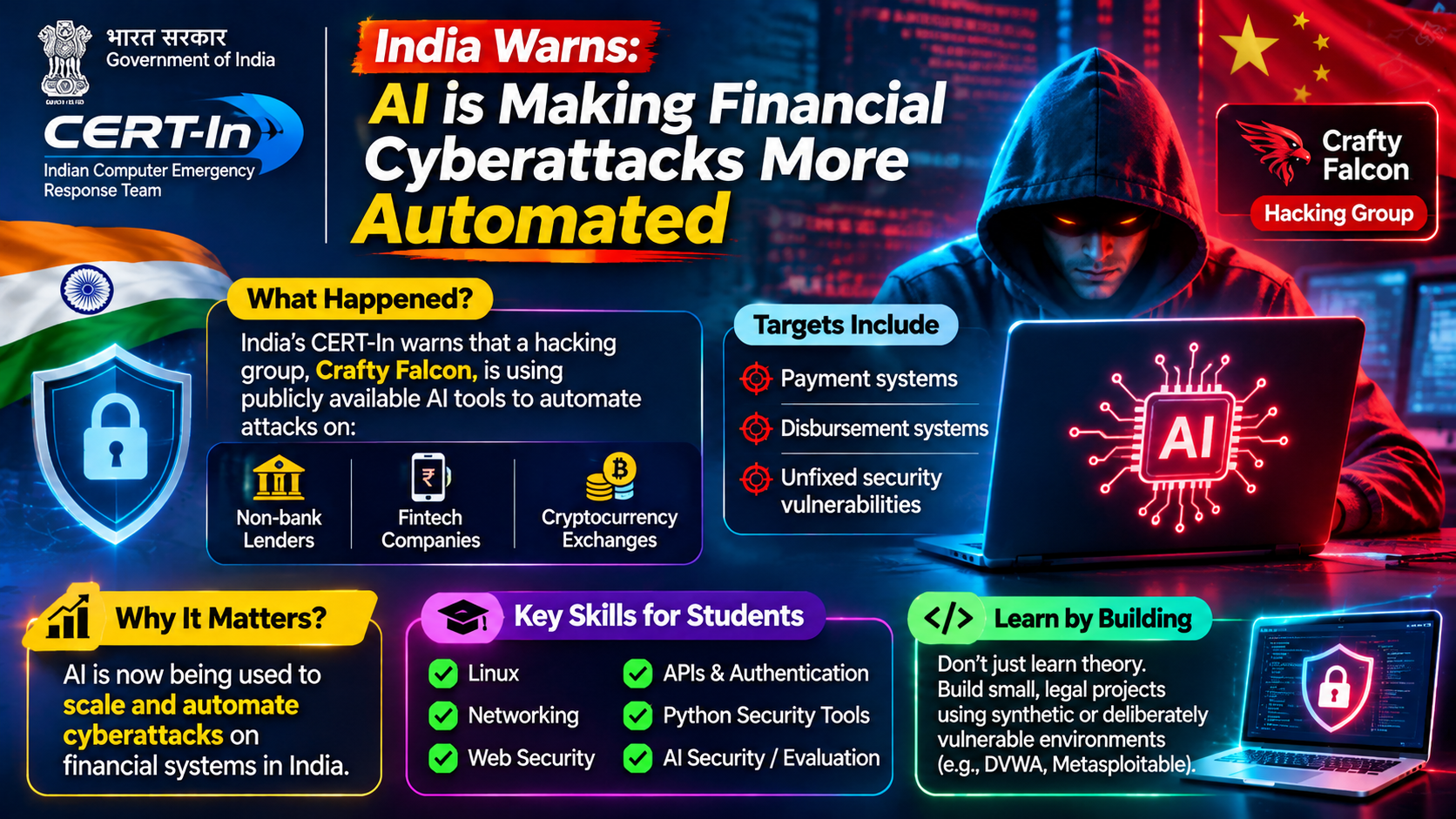
India Warns: AI Is Making Financial Cyberattacks More Automated
Introduction
Artificial Intelligence is transforming industries across the world. From healthcare and education to banking and financial technology, AI is helping businesses work faster and automate complex tasks. However, the same technology is also creating new challenges in cybersecurity.
India's Computer Emergency Response Team (CERT-In) has warned about a hacking campaign in which publicly available AI tools are reportedly being used to automate cyberattacks against financial organisations.
The warning highlights an important concern: cybercriminals are increasingly finding ways to use modern technology to make their attacks more efficient.
What Happened?
According to a Reuters report, India's CERT-In identified a hacking group called Crafty Falcon that reportedly uses publicly available AI tools to support and automate cyberattacks.
The reported targets include:
Non-bank financial companies (NBFCs).
Fintech organisations.
Cryptocurrency exchanges.
Payment processing systems.
Financial disbursement platforms.
The attackers reportedly look for weaknesses in financial systems, including security vulnerabilities that organisations have failed to fix.
This is concerning because financial organisations process sensitive customer information and large volumes of digital transactions.
How Is AI Changing Cybersecurity Threats?
Traditionally, cyberattacks often required considerable technical knowledge, manual investigation and time-consuming processes.
AI tools can potentially help attackers automate certain activities, analyse information and make their operations more efficient.
Some security concerns include:
1. Automated reconnaissance
AI-assisted tools may help analyse publicly available information about an organisation and identify potential security weaknesses.
2. Faster vulnerability discovery
Attackers can use automation to examine systems and search for weaknesses that have not been properly patched.
3. Financial system targeting
Payment platforms, digital lending applications and cryptocurrency exchanges can become attractive targets because they handle valuable financial information.
4. Increased attack efficiency
Automation can reduce the amount of manual work involved in certain stages of an attack, potentially allowing attackers to operate at greater scale.
However, AI does not automatically make every attack successful. Security weaknesses, poor configurations and inadequate protection remain important factors.
Why Are Financial Companies at Risk?
India has experienced rapid growth in digital financial services.
UPI, mobile banking, digital lending applications and online payment platforms have made financial transactions more convenient.
But greater digital connectivity also creates a larger security responsibility.
Financial organisations must protect:
Customer information.
Banking credentials.
Payment APIs.
Transaction databases.
Authentication systems.
Internal business applications.
A security failure can result in financial losses, service disruption, data exposure and reduced customer trust.
What Should Companies Do?
Financial organisations need to strengthen their cybersecurity practices.
Important security measures include:
Regular vulnerability assessments and security testing.
Updating software and fixing known vulnerabilities.
Strong authentication and access controls.
Monitoring suspicious financial transactions.
Securing APIs and payment infrastructure.
Using AI-powered threat detection responsibly.
Conducting regular employee security training.
Cybersecurity should be treated as an ongoing process rather than a one-time activity.
Skills Students Should Learn in 2026
For CSE, AI & ML and IT students, this development creates an opportunity to explore cybersecurity alongside artificial intelligence.
Here are six useful technical skills:
1. Linux
Understand operating systems, terminal commands, permissions and system administration.
2. Computer Networking
Learn IP addresses, DNS, TCP/IP, ports, firewalls and network communication.
3. Web Security
Understand common web vulnerabilities, secure coding and application protection.
4. APIs and Authentication
Learn REST APIs, OAuth, authentication methods, tokens and secure communication.
5. Python Programming
Use Python to develop security automation scripts, analyse logs and process security data.
6. AI Security and Evaluation
Understand how AI systems can be misused, how to evaluate model security and how to build safer AI applications.
Practical Project Ideas for Students
Instead of learning only through theory, students can build small cybersecurity projects in controlled environments.
Here are three beginner-friendly ideas:
Project 1: Suspicious Login Detection
Build a Python application that analyses sample login records and identifies unusual login patterns.
Project 2: UPI Fraud Detection Dashboard
Use synthetic transaction data and machine learning to identify potentially suspicious transaction patterns.
Project 3: Basic Network Monitoring Tool
Create a Python-based dashboard that analyses authorised network traffic and displays unusual activity.
Use only synthetic datasets, systems you own or deliberately vulnerable training environments. Never test against real financial systems without explicit permission.
Career Opportunities
The combination of AI and cybersecurity is becoming increasingly relevant across technology industries.
Students can explore career paths such as:
Cybersecurity Analyst.
Security Operations Centre (SOC) Analyst.
Application Security Engineer.
AI Security Engineer.
Cloud Security Engineer.
Penetration Tester.
Practical projects, programming knowledge and security fundamentals can help students prepare for these opportunities.
Conclusion
India's warning about AI-assisted cyberattacks highlights how quickly the cybersecurity landscape is changing.
Artificial Intelligence can help organisations improve security, but it can also be misused by cybercriminals to automate certain malicious activities.
For students, the lesson is clear: learning AI alone is not enough. Understanding cybersecurity, networking, programming and secure application development will be increasingly valuable.
The future of technology will need professionals who can build intelligent systems and protect them from digital threats.
Learn AI. Understand Cybersecurity. Build a Safer Digital Future.