India Semiconductor Push: 81,755 Jobs Expected
India expands its semiconductor manufacturing programme with ₹77,051 crore in projected investment and 81,755 expected direct jobs, creating new opportunities in chip design, AI hardware and electronics manufacturing
By Gangothri
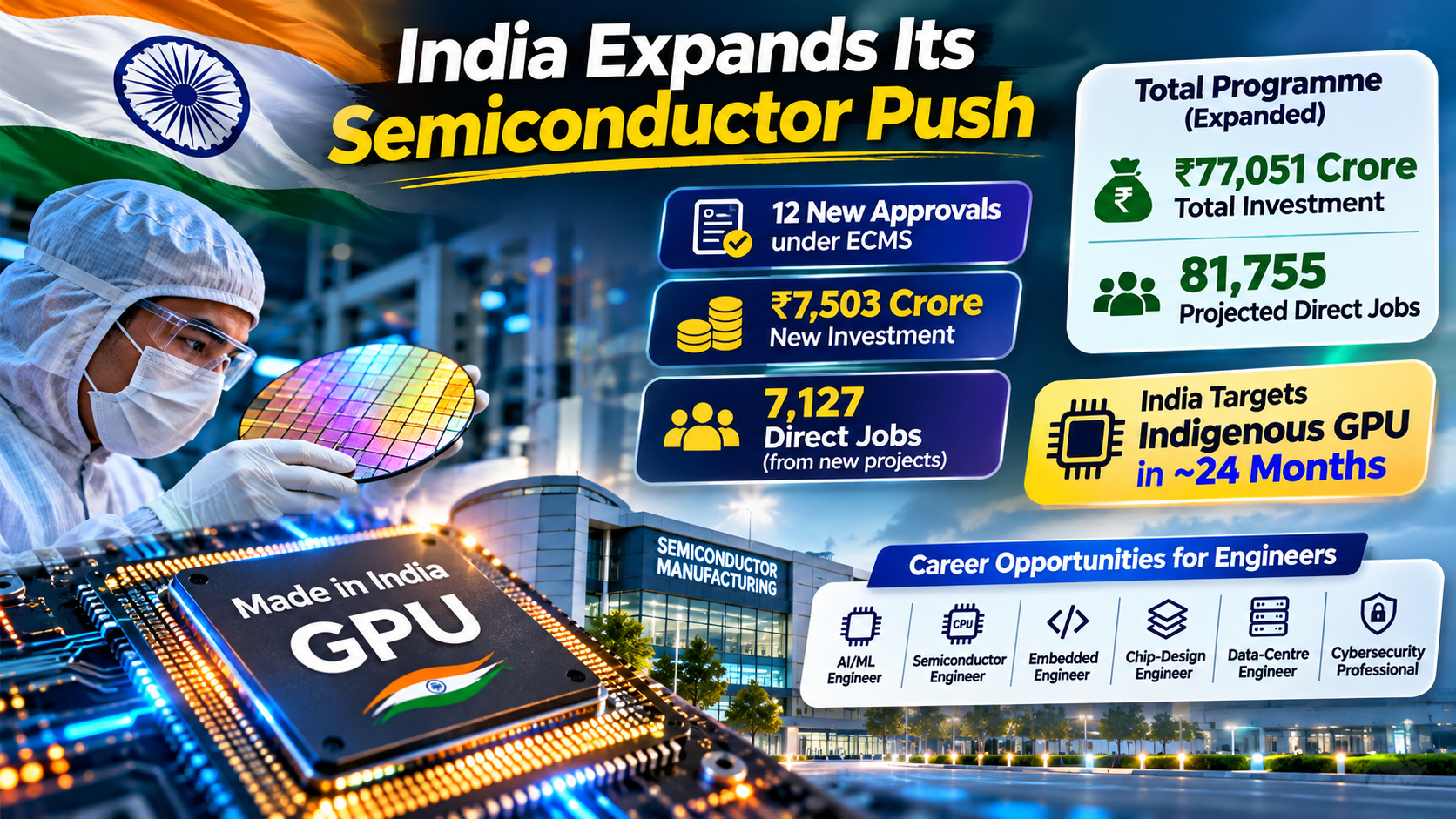
India Expands Its Semiconductor Mission: ₹77,051 Crore Investment and 81,755 Projected Jobs
India is taking another major step towards becoming a global destination for semiconductor manufacturing and advanced electronics production. The country's semiconductor ambitions are expanding beyond chip assembly into a broader ecosystem involving electronic components, chip design, advanced manufacturing and artificial intelligence hardware.
In a significant development, the government announced 12 additional approvals under the Electronics Components Manufacturing Scheme (ECMS). These projects represent a proposed investment of ₹7,503 crore and are expected to generate approximately 7,127 direct jobs.
With these additional approvals, the expanded programme represents approximately ₹77,051 crore in projected investment and 81,755 expected direct jobs across 16 states.
At the same time, India is working towards developing an indigenous GPU within roughly 24 months, according to a separate statement reported by ETGovernment.
Together, these developments highlight India's growing interest in building a stronger domestic electronics and semiconductor industry.
1. What exactly has India announced?
The latest development centres on the Electronics Components Manufacturing Scheme, known as ECMS.
The scheme is designed to strengthen domestic manufacturing of electronic components and reduce dependence on imported parts.
India's electronics industry has grown considerably, but manufacturing advanced components remains an important challenge. Many electronic products assembled in India still depend on components and specialised technologies sourced from international suppliers.
The additional 12 approvals are intended to encourage companies to invest in manufacturing capabilities within India.
The newly approved projects represent:
12 additional project approvals.
₹7,503 crore in proposed investment.
Approximately 7,127 expected direct jobs.
Across the expanded programme, the reported figures stand at approximately ₹77,051 crore in projected investment and 81,755 expected direct jobs.
These figures indicate the scale of the government's manufacturing ambitions. However, projected investment and employment should not be confused with money already spent or jobs already created. Actual outcomes will depend on project implementation, production capacity and hiring.
2. What is the Electronics Components Manufacturing Scheme?
To understand why this announcement matters, it is important to understand ECMS.
Modern electronic devices contain hundreds or thousands of individual components. Smartphones, laptops, servers, communication equipment, electric vehicles and industrial machines all depend on specialised electronic parts.
These include:
Printed circuit boards (PCBs).
Connectors and electronic components.
Display-related components.
Camera and sensor modules.
Power electronics.
Other specialised electronic parts.
When a country depends heavily on imported components, manufacturers can face supply-chain disruptions, higher costs and longer delivery times.
ECMS aims to encourage companies to establish and expand domestic component manufacturing facilities.
The broader objective is to strengthen India's position in global electronics supply chains.
A stronger domestic manufacturing ecosystem could also help Indian companies develop technical expertise, improve production capabilities and become more competitive internationally.
3. Why semiconductor manufacturing is important
Semiconductors are among the most important technologies in the modern world.
A semiconductor chip is a small electronic component that processes information, stores data or controls the operation of electronic devices.
Almost every modern technology depends on semiconductor components.
For example:
Smartphones: Processors, memory chips, image processors and communication chips make smartphones work.
Artificial intelligence: AI systems require specialised computing hardware to train models and run AI applications.
Automobiles: Modern vehicles use chips for engine management, sensors, navigation, safety systems and driver-assistance technologies.
Data centres: Servers depend on processors, memory and networking chips to handle enormous amounts of information.
Healthcare: Medical equipment uses semiconductor technology for imaging, monitoring and diagnostic systems.
As AI adoption increases, the demand for advanced computing hardware is also growing.
This is one reason countries are investing in semiconductor manufacturing and related technologies.
4. India's indigenous GPU ambitions
Another important development is India's reported target of developing an indigenous GPU within approximately 24 months.
GPU stands for Graphics Processing Unit.
Originally designed primarily for graphics processing, GPUs have become essential for artificial intelligence because they can perform many mathematical operations simultaneously.
Modern AI models require enormous computing resources. GPUs are widely used for training and running machine learning models, processing large datasets and supporting generative AI applications.
An indigenous GPU ambition is important because it reflects India's interest in developing more domestic computing capabilities.
However, designing a competitive GPU is a complex engineering challenge.
It requires expertise in:
Processor architecture.
Semiconductor design.
Hardware engineering.
Memory systems.
High-speed interconnects.
Software drivers.
Compiler development.
Testing and validation.
Developing a chip is only one part of the challenge. Building the surrounding software ecosystem, manufacturing arrangements and developer support is equally important.
The reported 24-month target should therefore be understood as an ambition, not a guarantee of a commercially competitive GPU being available by that date.
5. How AI is increasing demand for semiconductor technology
Artificial intelligence is changing the way businesses, governments and individuals use computing systems.
Applications such as ChatGPT, image generators, coding assistants, autonomous systems and AI-powered business tools require significant computing power.
Behind every AI application is a combination of hardware and software.
Consider what happens when someone asks an AI chatbot a question.
First, the application receives the user's request. The system then processes the input using a trained AI model. The model performs calculations using computing hardware and generates a response.
This process is called AI inference.
Training AI models requires even more computational resources because the system processes large datasets and adjusts millions or billions of model parameters.
This creates demand for:
GPUs for parallel processing.
CPUs for general computing.
High-bandwidth memory.
Networking hardware.
Advanced storage systems.
Efficient cooling and power management.
As AI becomes more widely adopted, semiconductor technology becomes increasingly important.
India's semiconductor ambitions could help create opportunities in these connected areas.
6. What opportunities could this create for engineering students?
One of the most interesting aspects of this development is its potential impact on engineering education and employment.
Students often associate technology careers with software development, web development and mobile applications.
However, the semiconductor industry offers several other career paths.
AI and Machine Learning Engineer
AI engineers develop machine learning systems, train models and build intelligent applications. Knowledge of Python, mathematics, algorithms and model optimisation is useful.
VLSI Design Engineer
VLSI stands for Very Large Scale Integration. VLSI engineers work on designing and verifying integrated circuits containing large numbers of electronic components.
Embedded Systems Engineer
Embedded engineers develop software that runs on hardware devices such as sensors, controllers, automobiles and industrial equipment.
Computer Architecture Engineer
Computer architecture professionals study how processors, memory and other hardware components are designed and connected.
Chip Design and Verification Engineer
These professionals work on designing digital circuits, testing chip functionality and identifying hardware design problems.
Data Centre Engineer
Data centre professionals manage computing infrastructure, servers, networking, storage and power systems.
Hardware and Cybersecurity Engineer
These professionals work on protecting hardware systems, embedded devices and computing infrastructure against security threats.
The semiconductor industry requires people with different educational backgrounds and technical specialisations.
7. Skills students should start learning
Students interested in these opportunities can begin with foundational technical skills.
Here are some useful areas to explore.
Programming languages
Python is useful for AI and automation. C and C++ are important for embedded systems, low-level programming and performance-oriented applications.
Digital electronics
Learn binary numbers, logic gates, Boolean algebra, combinational circuits and sequential circuits.
Computer architecture
Understand CPUs, GPUs, memory, instruction sets, registers and parallel processing.
Embedded systems
Explore microcontrollers, sensors, communication protocols and hardware programming.
AI and machine learning
Learn machine learning fundamentals, neural networks, model training and inference.
Cloud computing
Understand how cloud platforms provide access to computing resources and AI infrastructure.
VLSI fundamentals
Explore digital design, RTL concepts, Verilog and hardware verification.
Students do not need to master everything immediately. Building strong fundamentals and choosing one area for deeper study is a practical starting point.
8. What could this mean for India's technology industry?
A stronger semiconductor ecosystem could influence several parts of India's economy.
First, domestic component manufacturing could help electronics companies build more resilient supply chains.
Second, new manufacturing facilities could create demand for engineers, technicians, researchers and specialised service providers.
Third, semiconductor development could encourage collaboration between universities, startups, research institutions and established technology companies.
Fourth, a stronger hardware ecosystem could support India's ambitions in artificial intelligence, telecommunications, electric vehicles and data-centre infrastructure.
There may also be opportunities for startups working on chip design, electronic testing, embedded software, industrial automation and AI hardware solutions.
However, becoming a major semiconductor manufacturing destination will take sustained investment, technical expertise, infrastructure development and long-term industry partnerships.
The announcement is an important development, but the actual impact will become clearer as projects move from approval to implementation and production.
9. Can software students enter the semiconductor industry?
Yes. A computer science student does not necessarily need to study only software development.
Students from Computer Science and AI & ML backgrounds can explore areas connecting software and hardware.
For example, a student interested in AI can study GPU architecture and understand how computing hardware accelerates machine learning workloads.
A student interested in programming can explore embedded C and microcontroller development.
Someone interested in mathematics and algorithms can investigate processor optimisation and parallel computing.
There are also opportunities in software tools used for chip design, hardware simulation, verification and testing.
The important point is to understand the connection between software, computing systems and physical hardware.
This combination can help students build a broader technical profile.
10. What should students do next?
For students who want to prepare for India's expanding semiconductor ecosystem, a simple learning roadmap can help.
Step 1: Strengthen programming fundamentals.
Learn Python, C and basic problem-solving.
Step 2: Understand computer organisation.
Study CPU architecture, memory, processors and operating systems.
Step 3: Learn digital electronics.
Understand logic gates, circuits and basic digital design.
Step 4: Explore AI hardware.
Learn the differences between CPUs, GPUs and specialised AI accelerators.
Step 5: Build practical projects.
Experiment with microcontrollers, sensors, embedded programming and basic AI applications.
Step 6: Explore a specialisation.
Choose an area such as VLSI, embedded systems, AI hardware, computer architecture or semiconductor verification.
Practical projects and a clear understanding of fundamentals can help students demonstrate their skills to potential employers.
Conclusion
India's semiconductor expansion represents an important development in the country's technology ambitions.
The additional 12 ECMS approvals, projected investment of ₹7,503 crore and estimated 7,127 direct jobs highlight the scale of the latest manufacturing push.
Across the expanded programme, the reported figures of ₹77,051 crore in investment and 81,755 projected direct jobs show the potential size of the opportunity.
India's ambition to develop an indigenous GPU adds another important dimension to this story: the country wants to strengthen not only electronics manufacturing but also its future computing capabilities.
For engineering students, the message is clear. Technology careers are becoming broader than traditional software development.
AI, semiconductor engineering, chip design, embedded systems and computer architecture are areas worth exploring.
The next generation of technology professionals may work not only on the applications people use but also on the hardware that makes those applications possible.