IBM Bob Goes Self-Hosted for Enterprise AI
IBM Bob can now run in customer-controlled infrastructure, including on-premises, private cloud, sovereign cloud and air-gapped environments.
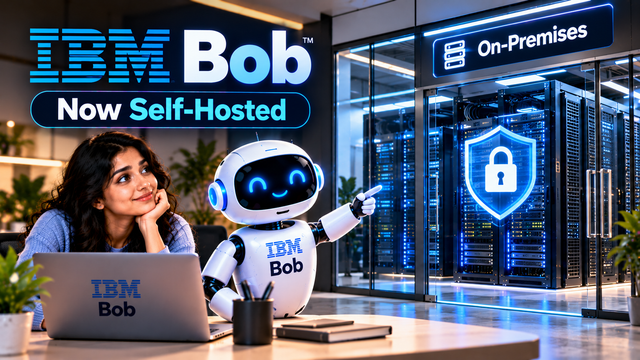
IBM is making its AI-powered software development platform more suitable for organizations that cannot send sensitive code and data to external AI services.
IBM Bob is now generally available as a self-hosted deployment, allowing enterprises to run the agentic software development platform in infrastructure they control. Supported deployment environments include on-premises infrastructure, private cloud, sovereign cloud and air-gapped environments.
The important idea is simple:
Traditional cloud AI:
Data → External AI service
Self-hosted AI:
AI → Comes to the company's infrastructure
IBM Bob is designed to help teams across the software development lifecycle, including software development and modernization. With the self-hosted option, organizations can keep source code, application context and development workflows within environments that they control.
The deployment is built for Red Hat OpenShift. IBM says the self-hosted package includes components such as identity, an inference gateway, audit logging and usage metering. Developers can continue using Bob IDE and Bob Shell while the backend runs inside the organization's controlled environment.
Air-gapped deployment is particularly interesting. In an environment with no internet connection, IBM Bob can use an open-weight model running on the organization's own GPUs. In other controlled environments, organizations can connect Bob to supported external model services through hybrid configurations.
This approach is aimed at enterprises with strict security, regulatory or data-sovereignty requirements. Banks may need tighter control over financial systems and source code. Healthcare organizations may have sensitive applications and data. Government agencies and other critical infrastructure operators can also have requirements around where software and AI systems operate.
That makes IBM Bob's self-hosted deployment different from simply launching another AI coding assistant. The important change is where the AI can operate.
For enterprise AI, the question is increasingly becoming:
“Which AI model should we use?”
and also:
“Where can that AI safely run?”
IBM's move reflects the growing importance of AI sovereignty. Organizations want the productivity benefits of agentic development while maintaining control over infrastructure, data, models and governance.
For developers, this could mean AI coding agents becoming part of highly controlled enterprise development environments rather than being limited to public cloud services.
The larger trend is clear: enterprise AI is moving closer to the data. Instead of forcing sensitive workloads to move to AI platforms, companies increasingly want AI capabilities that can run within their own infrastructure.