HCLTech Launches 20 Industry-Specific AI Solutions
HCLTech launches 20 industry-specific AI solutions for sectors including banking, healthcare, manufacturing and retail. Explore examples and business impact.
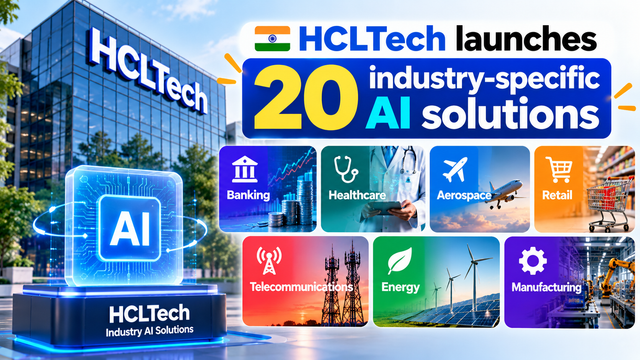
HCLTech Launches 20 Industry AI Solutions: How AI Is Moving Into Real Business Workflows
Artificial intelligence is moving beyond chatbots and content generation into the everyday operations of businesses. From manufacturing plants and hospitals to banks, retailers and energy companies, organisations are exploring how AI can help solve specific operational problems.
On October 8, 2026, HCLTech announced the launch of 20 Industry AI Solutions, a portfolio designed to apply artificial intelligence to business challenges across different industries. The solutions combine AI capabilities with specialised industry knowledge and are intended to support processes across business value chains.
The announcement covers sectors including banking, healthcare and life sciences, aerospace, retail, telecommunications, mobility, energy and manufacturing. HCLTech says some solutions are already deployed at scale in client operations around the world, while others are in earlier stages of deployment.
This development reflects a wider change in enterprise AI. Businesses are increasingly interested in systems that can help improve a specific process, reduce repetitive work or support decisions, rather than simply answer general questions.
For Indian students, developers, startups and business owners, the launch offers a useful look at where enterprise AI is heading—and why understanding an industry's actual needs may be just as important as understanding the technology itself.
1. What are HCLTech's Industry AI Solutions?
HCLTech is a global technology company that provides digital, engineering, cloud, software and AI-related services. Its new portfolio focuses on purpose-built solutions for industry-specific problems.
The idea is to combine knowledge of a business sector with AI technology that can be integrated into real operational workflows.
Consider the difference between a general chatbot and an industry-focused AI solution.
A general chatbot can explain what an invoice is, summarise a manufacturing process or describe how a hospital manages patient records. An industry solution, by contrast, may be designed to assist with a defined workflow within an organisation's existing systems.
Depending on the solution, that could involve analysing visual information in a factory, helping manage invoices or supporting specialised regulatory processes.
These applications are different from simply asking an AI assistant to write a paragraph. They must operate within business requirements, existing software, security policies and performance expectations.
HCLTech says its solutions are developed in-house by a dedicated global team of engineers and industry specialists. The portfolio is part of the company's strategy to build differentiated AI intellectual property rather than relying exclusively on general-purpose models.
2. Why are companies moving beyond general-purpose chatbots?
General-purpose AI assistants have made it easier for people to write, research, summarise information and generate code. But many business problems require more than a conversational interface.
A bank may need to process financial documents consistently. A manufacturer may need to detect defects on a production line. A healthcare organisation may need to manage regulatory information. A retailer may want to improve inventory visibility.
Each problem has its own data, rules, risks and definition of success.
For example, a chatbot that explains invoice processing is not the same as a system integrated into an accounts-payable workflow. The latter must work with business documents, follow approval rules, interact with existing systems and maintain an auditable record of important actions.
Industry-specific AI solutions aim to close this gap between AI experimentation and practical deployment.
However, specialised AI is not automatically better in every situation. Some tasks can be handled by simple automation or conventional software. Others may benefit from a general-purpose model. Businesses need to compare options based on their requirements, costs and measurable results.
The important shift is from asking, "Can we use AI?" to asking, "Which business problem should AI solve, and how will we measure the outcome?"
3. Manufacturing: using AI in factories and warehouses
Manufacturing is one of the areas where AI can connect digital intelligence with physical operations.
Factories and warehouses generate large amounts of information through cameras, sensors, machines, logistics systems and production records. Analysing this information can help teams identify issues, improve processes and understand what is happening across their operations.
HCLTech's announcement highlights two examples: VisionX and SmartTwin.
VisionX: computer vision for industrial environments
VisionX is described as a computer-vision AI platform for factory and warehouse environments.
Computer vision enables software to analyse images and video. In industrial settings, potential uses include identifying visual defects, observing processes and helping operators detect conditions that need attention.
HCLTech reports that VisionX has improved response times by more than 90% and reduced operational costs by 70% across factory and warehouse environments. These are company-reported results, not a guarantee that every deployment will achieve the same outcomes.
The broader lesson is that AI can be valuable when it helps people identify problems faster and respond more efficiently.
SmartTwin: simulating products and plants
SmartTwin is designed to help manufacturers simulate products and plants before physical deployment.
Simulation can let teams explore designs, assess scenarios and identify potential problems before committing to expensive physical changes. AI-enabled capabilities may help make these workflows more useful, depending on the implementation.
HCLTech says SmartTwin can help deliver up to 44% faster time-to-market for new products. The actual benefit will depend on the process being improved and the conditions of the deployment.
For manufacturers, the appeal is straightforward: finding problems earlier may save time and reduce costly rework.
4. Healthcare and life sciences: supporting complex processes
Healthcare and life sciences involve demanding requirements for accuracy, documentation, privacy and regulatory compliance. AI applications in these areas must be evaluated carefully because errors can have serious consequences.
HCLTech's announcement describes solutions aimed at regulatory intelligence and pharmacovigilance.
Regulatory intelligence involves understanding and managing information about rules, requirements and changes relevant to medical products and life-sciences businesses. AI may help teams find information, organise documents and support research, but expert review remains essential.
Pharmacovigilance is the monitoring and assessment of the safety of medicines. It involves collecting and reviewing information about potential adverse effects and managing associated reporting processes.
HCLTech says its Intelligent Safety Platform has reduced pharmacovigilance case-processing time by 40–50%. This is a reported result associated with the company's platform; it should not be interpreted as a universal outcome for every organisation.
Faster processing can be useful, but speed alone is not enough. Healthcare and life-sciences businesses must also evaluate quality, consistency, auditability and compliance with applicable requirements.
The larger opportunity is to use AI to assist professionals with information-heavy work while retaining appropriate human responsibility for important decisions.
5. Finance and procurement: reducing repetitive work
Finance departments handle invoices, payments, reconciliations, approvals and many other document-heavy processes. Some tasks follow predictable rules but still require significant manual effort.
HCLTech's announcement highlights Autonomous Accounts Payable, an AI-led invoice-management platform.
Accounts payable refers to money an organisation owes its suppliers. Processing an invoice may involve extracting information, matching it against purchase orders, checking supporting documents, resolving discrepancies and obtaining approval.
Automation can help reduce repetitive data entry and route exceptions to the appropriate employees. But a reliable system must also handle incorrect information, duplicate invoices, unusual transactions and approval controls.
HCLTech reports that its Autonomous Accounts Payable platform is live at a major global manufacturer of motorbikes and tools, where it has cut processing cycle time by 60%.
That figure is a company-reported result from a particular deployment, not proof that every organisation can achieve the same reduction.
For finance teams, the most important questions include whether the system processes documents accurately, identifies exceptions, protects sensitive information and maintains the controls required by the business.
AI should help employees work more effectively, not remove essential financial checks.
6. What do the other industry areas mean?
The 20-solution portfolio also covers sectors such as banking, aerospace, retail, telecommunications, mobility and energy.
The company has not described every solution in equal detail in the launch announcement, so it is important not to assume that all 20 offerings have the same capabilities or deployment status.
Nevertheless, each sector illustrates why specialised AI can matter.
Banking: Financial institutions manage complex workflows involving customer information, risk, compliance and transactions. AI applications must operate with strong controls, traceability and privacy protections.
Aerospace: Aerospace organisations work with detailed engineering documentation, maintenance processes, complex supply chains and demanding safety requirements. Any AI system used in these environments needs rigorous validation and appropriate expert oversight.
Retail: Retailers handle product information, inventory, pricing, customer service and supply-chain operations. AI may support analysis and automation across these processes, but outcomes depend on data quality and integration with existing systems.
Telecommunications: Telecom companies manage networks, customer services, infrastructure and large volumes of operational data. Specialised AI can help teams analyse information and support network-related workflows, subject to technical and reliability requirements.
Mobility: Mobility businesses operate across vehicles, transportation, engineering and connected services. AI applications must account for safety, operational constraints and the specific context in which they are deployed.
Energy: Energy organisations manage assets, infrastructure, demand and operational risks. AI can help analyse information and support decisions, but critical infrastructure requires robust safety and security controls.
Manufacturing and logistics: Production and supply-chain operations involve many connected processes. AI solutions may help teams understand operations, identify inefficiencies and manage repetitive tasks.
These are broad examples of where industry AI may be useful. They should not be interpreted as a list of verified features offered by every HCLTech solution.
7. What does "deployed at scale" mean?
One detail in HCLTech's announcement is that some solutions are already deployed at scale, while others are in early-stage deployments.
This distinction matters because an AI demonstration is not the same as an operational system used regularly by a business.
A pilot project typically tests whether a solution works for a limited use case or group of users. A scaled deployment involves putting the technology into broader operational use, with the associated requirements for integration, support, governance and performance.
Enterprise deployment often requires more than selecting a model. Teams may need to connect data sources, integrate existing software, set access permissions, test reliability, train users and establish processes for monitoring results.
A solution may perform well in a demonstration but encounter challenges when faced with inconsistent data, legacy systems or unusual real-world cases.
Businesses should therefore ask which workflows are live, what evidence supports the reported benefits, how performance is measured and what ongoing support is available.
The distinction between early deployments and scaled use helps readers understand that enterprise AI adoption happens in stages.
8. What does this mean for Indian startups?
HCLTech's announcement offers a useful lesson for Indian entrepreneurs building AI products.
The market opportunity is not limited to creating another general chatbot. Many businesses have specific operational problems that are expensive, repetitive or difficult to manage with existing software.
A startup could investigate problems such as document processing, quality inspection, inventory management, customer-support workflows or specialised research. The right opportunity depends on the needs of a particular customer group.
However, building an AI product requires more than attaching a model to an interface.
Founders need to understand the workflow, obtain suitable data, define acceptable error rates, protect confidential information and integrate with the tools customers already use. They must also decide when human approval is necessary.
A focused solution that reliably improves one measurable process may be more useful than a broad product that promises to automate everything.
Startups should begin with a clearly defined problem, test the product with representative users and measure the difference between the old and new workflow. Useful measures might include processing time, error rates, customer satisfaction or the cost of completing a task.
HCLTech's portfolio illustrates the strategic importance of combining technology with domain knowledge. It does not mean smaller businesses need to copy an enterprise-scale approach exactly; they should choose an approach suited to their resources and customers.
9. What should students and developers learn?
For Indian students studying computer science, artificial intelligence, data science or information technology, industry AI creates opportunities to develop both technical and business skills.
Learning how to use language models is useful, but it is only one part of the picture. Developers also need to understand APIs, databases, software integration, data quality, testing, security and deployment.
For example, a student building an AI invoice assistant could start with document extraction and classification. The next step might be to connect the system to a test database, check whether the extracted fields are correct and route uncertain cases for human review.
A student interested in manufacturing could explore computer vision using a properly licensed dataset or a controlled demonstration. Someone interested in healthcare could build a document-search prototype using public, approved information rather than private patient records.
These projects can help students learn how AI systems behave outside simple chat interfaces.
It is also important to understand evaluation. A model that produces impressive answers in a few examples may still fail on unusual inputs. Developers should test edge cases, measure accuracy, document limitations and consider how the system behaves when information is missing.
Students who combine AI knowledge with an understanding of real industry workflows may be better prepared to build useful applications.
10. Risks, costs and responsible deployment
Industry AI can create value, but organisations should not assume that every AI project will deliver savings automatically.
The quality of the underlying data is critical. Incomplete records, inconsistent formats and outdated information can reduce reliability.
Integration can also be challenging. Businesses may rely on older software that was not designed to work with modern AI systems. Connecting new capabilities safely can require substantial engineering effort.
Privacy and security are equally important. Organisations must decide which data an AI solution can access, how information is protected and whether the system's actions need approval.
Human oversight remains necessary for high-impact decisions. An AI system may help prepare a recommendation, but a qualified employee may need to review it before action is taken.
Businesses should also establish measurable success criteria before deployment. These might include fewer processing errors, faster turnaround times, lower operational costs or improved service quality.
Finally, organisations should compare AI with simpler alternatives. Sometimes a better workflow, a traditional rules-based system or cleaner data can solve the problem more cheaply and reliably.
Responsible deployment means choosing the right technology for the task and checking whether it actually improves outcomes.
Final takeaway: AI is becoming industry-specific
HCLTech's launch of 20 Industry AI Solutions reflects a broader move towards AI designed for particular business processes rather than general conversations alone.
The company's announcement highlights examples in manufacturing, healthcare and finance operations, alongside a wider portfolio spanning multiple industries. Its reported deployment results provide examples of the kinds of outcomes enterprises are pursuing, although results will vary by implementation.
For Indian businesses, the key lesson is to start with a real operational problem and measure whether AI solves it. For students and developers, it is an opportunity to learn how AI connects with data, software, industry knowledge and responsible deployment.
The next phase of enterprise AI will not be measured only by how naturally a model can talk. It will also be measured by whether the technology can be integrated safely into real workflows and deliver reliable, demonstrable value.
Official source: HCLTech, HCLTech introduces 20 Industry AI Solutions to transform vertical value chains with AI, October 8, 2026.
Note: Performance figures in this article are attributed to HCLTech's announcement. They are company-reported results and should not be treated as guaranteed outcomes for all deployments.