GPT-5: OpenAI Leadership Shake-Up
Open AI is reshuffling its leadership as it expands enterprise AI and prepares for its next major growth phase.
Source: https://www.axios.com/2026/08/14/openai-executive-greg-brockman-ipo
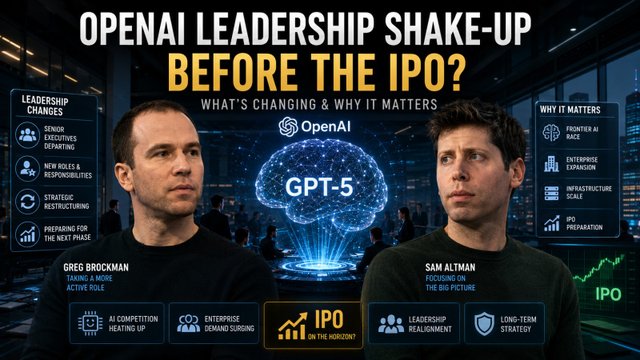
Open AI Is Reshaping Its Leadership
Open AI is going through a significant leadership reshuffle at a critical point in the company's growth.
Several senior executives have recently departed, while co-founder Greg Brockman is becoming more involved across the company. Axios reports that the changes are being driven primarily by strategy as Open AI focuses on strengthening its enterprise business and preparing for a possible IPO.
This matters because Open AI is no longer operating like a small research-focused AI company.
The company is competing on several fronts at the same time:
Frontier AI
↓
Developing increasingly capable models and competing with companies such as Anthropic.
Enterprise AI
↓
Convincing businesses to use Open AI products across their organizations.
AI Infrastructure
↓
Scaling the computing, products and systems required to support massive AI demand.
Public-Market Preparation
↓
Building a business structure capable of supporting the expectations that come with a potential IPO.
As the company grows, its leadership requirements also change.
A startup can sometimes operate around a small group of technical founders and researchers. A company operating at enormous scale needs executives focused on enterprise sales, operations, finance, partnerships, governance, infrastructure and long-term strategy.
That makes the current reshuffle more interesting than simply asking:
"Why are executives leaving Open AI?"
The bigger question is:
"What kind of company is Open AI trying to become?"
Greg Brockman's increased involvement is particularly notable. Axios reports that he is working more directly with customers and internal teams as Open AI attempts to accelerate enterprise adoption and strengthen its competitive position.
At the same time, reports of departures from safety and alignment teams add another dimension to the story. However, those developments should not automatically be interpreted as evidence that Open AI is "collapsing." The available reporting points to a broader organizational transition rather than proving that conclusion.
The AI industry is entering a phase where technical leadership alone isn't enough.
The companies building frontier models now also need to solve a much larger business problem:
How do you turn extremely expensive AI research into a scalable global business?
That's why leadership changes at Open AI matter.
They may signal a transition from:
AI research company → AI technology company → global enterprise platform
And if Open AI eventually goes public, investors will judge the company not only by how powerful its models are, but also by revenue, enterprise adoption, infrastructure costs, governance and its ability to compete in an increasingly crowded AI market.
The important story isn't:
"Open AI is doomed."
There isn't enough evidence to make that claim.
The more interesting question is:
What does Open AI need to change to become a company capable of operating at the scale of the AI industry it helped create?