Gemini & GPT-5: The AI Cost Optimization Race
Companies are rethinking AI spending as expensive frontier models drive higher inference costs, pushing businesses toward smarter model routing.
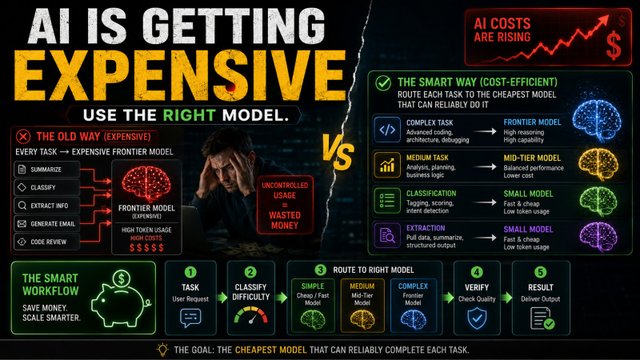
AI is becoming more powerful—but it is also becoming more expensive to operate at scale.
Companies initially focused on getting employees access to the best AI models. But as AI agents, coding assistants and long-context workflows become part of everyday work, the amount of compute and tokens consumed can grow quickly.
A developer asking an AI to analyze an entire codebase, repeatedly run agents, or process large amounts of context can generate significantly more usage than a simple chatbot request.
That creates a new business problem:
AI adoption can increase productivity—but uncontrolled AI usage can also increase costs.
The old strategy was:
Every task → Most powerful model
The smarter strategy is:
Task → Assess difficulty → Choose model → Run → Verify
For example:
Simple task
Caption generation → Efficient model
Classification
Lead scoring → Small model
Extraction
Pulling information from documents → Efficient model
Medium reasoning
Business analysis → Mid-tier model
Complex task
Advanced coding → Frontier model
This approach is called model routing.
Instead of paying for frontier-level intelligence when it isn't necessary, companies can reserve expensive models for tasks where their additional capability actually matters.
The goal isn't simply to use cheaper AI.
The goal is to find the cheapest model that can reliably complete each task.
This can improve:
AI cost efficiency
Inference spending
Response speed
Scalability
Automation profitability
The bigger shift is happening in how companies think about AI budgets.
Before:
"How many employees can we give AI to?"
Now:
"How much AI usage can we afford—and which model should handle each task?"
For companies building AI agents, this could become an important part of their architecture:
User Request → Task Classifier → Model Router → AI Model → Verification → Result
And that means the future AI advantage may not belong only to companies with access to the smartest model.
It could belong to companies that know when to use it—and when not to.