EU Tests GPT-6 Astra and Anthropic's cinematical Mythos 5
The EU's cybersecurity agency ENISA is testing two advanced AI models to examine their cybersecurity capabilities and risks.
By @admin
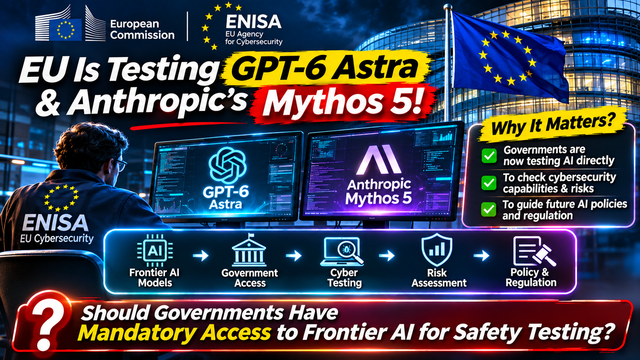
EU Tests GPT-6 Astra and Anthropic's Mythos 5: Governments Are Starting to Examine Frontier AI Directly
Artificial intelligence is becoming an important part of cybersecurity. Advanced AI systems can analyse software, identify vulnerabilities, assist security researchers and potentially automate complex cyber operations.
But as these capabilities improve, governments face a difficult question: how can they understand the risks of powerful AI systems before those systems become widely available?
In September 2026, the European Union took an important step towards answering that question.
The European Commission confirmed that the EU's cybersecurity agency, ENISA, had received access to Anthropic's Mythos 5 and was testing the model. The agency had also received access to OpenAI's latest model, GPT-6 Astra.
The development is significant because governments are not relying entirely on public demonstrations, company announcements or documentation. They are increasingly seeking opportunities to examine advanced AI systems directly.
This could influence how future AI models are tested, evaluated and regulated.
1. What exactly happened?
On September 10, 2026, a European Commission spokesperson confirmed that ENISA had been granted access to Anthropic's Mythos 5 and was testing it.
The spokesperson also confirmed that the agency had access to OpenAI's GPT-6 Astra.
The announcement followed discussions between European authorities and the companies developing these systems.
The two models attracted attention because of their advanced capabilities, particularly in cybersecurity-related tasks.
Mythos 5 was developed by Anthropic and is associated with advanced software vulnerability discovery and cybersecurity capabilities.
GPT-6 Astra is OpenAI's latest frontier model, designed to perform complex tasks and work with software and external tools.
The EU wants to understand the implications of these technologies for cybersecurity and the wider digital environment.
However, an important distinction is necessary: the announcement confirmed access and testing. It did not publish the detailed testing methodology, final results or a formal safety certification.
The development should therefore be understood as an important evaluation step, not proof that the EU has already established that both models are safe or unsafe.
2. What is ENISA, and why is it involved?
ENISA stands for the European Union Agency for Cybersecurity.
It is the EU's specialised agency supporting cybersecurity across European member states.
Its work includes helping organisations understand cyber threats, improving cybersecurity preparedness, supporting cooperation between countries and contributing technical expertise to European cybersecurity policy.
As AI systems become more capable of analysing and interacting with software, they create new opportunities as well as new security concerns.
For example, an advanced AI model may help a security researcher identify weaknesses in a software application.
The same capability could potentially be misused by someone trying to discover vulnerabilities for malicious purposes.
ENISA's involvement is important because the agency can help evaluate these cybersecurity implications from a public-interest and technical perspective.
Instead of relying exclusively on a model developer's description of its capabilities, independent technical examination can help authorities understand what the system can actually do.
That information can support future risk assessments and policy decisions.
3. Why are GPT-6 Astra and Mythos 5 important?
The models attracted attention because they are associated with advanced capabilities that go beyond ordinary chatbot interactions.
A conventional chatbot mainly responds to user instructions.
More capable systems can assist with multi-step tasks, analyse complex codebases, use tools and support technical workflows.
In cybersecurity, these capabilities matter in several areas.
Vulnerability discovery: AI can help examine software and identify possible security weaknesses.
Code analysis: Models can review code, explain suspicious behaviour and help developers understand potential problems.
Security research: AI can assist authorised researchers in investigating software and testing defensive systems.
Incident analysis: Models can help security teams organise information, examine logs and investigate suspicious activity.
Automation: AI agents can support repetitive security tasks and help analysts process large amounts of information.
These capabilities can make security work more efficient.
But they also introduce risks. If powerful models are misused, they could potentially make certain cyber operations easier to automate.
That is one reason governments want to understand the capabilities and limitations of frontier AI systems.
4. Why did Anthropic's Mythos 5 attract attention?
Anthropic's Mythos models have been associated with advanced cybersecurity capabilities.
The company has restricted access to the technology through controlled programmes rather than making it broadly available to everyone.
The concern is that models capable of finding and exploiting software vulnerabilities could create significant risks if placed in the wrong hands.
At the same time, the same capabilities could help defenders identify weaknesses before attackers discover them.
This creates a difficult balance.
A model that is useful for authorised security research may also possess capabilities that require careful access restrictions.
For European authorities, testing Mythos 5 provides an opportunity to understand these risks more directly.
The access followed months of discussions between Anthropic and European officials.
The delay also raised broader questions about how quickly public authorities should be able to evaluate powerful AI systems that could affect critical infrastructure.
However, the Commission has not publicly explained the complete testing arrangement or specified every configuration available to ENISA.
It would therefore be premature to claim that the agency has unrestricted access to every capability of Mythos 5.
5. OpenAI's GPT-6 Astra is also part of the evaluation
Anthropic is not the only company involved.
OpenAI's GPT-6 Astra has also been made available to ENISA for testing.
This is important because evaluating models from different developers can help authorities understand how their capabilities and limitations compare.
The EU had previously received access to OpenAI's GPT-5.6-Cyber, according to reporting on the September announcement.
The newer GPT-6 Astra access adds another advanced model to the agency's evaluation efforts.
The models should not automatically be treated as identical.
They may differ in their training, cybersecurity capabilities, restrictions, tool access and behaviour during testing.
That is why evaluation needs to consider the specific model version and configuration.
A model's performance in a controlled test does not necessarily predict how it will behave in every real-world environment.
6. From AI regulation to direct technical evaluation
One of the most important aspects of this story is the relationship between AI regulation and technical testing.
Regulation establishes obligations, rules and accountability requirements.
But understanding the real capabilities of an advanced AI system can require technical examination.
For example, authorities may want to understand:
- How effectively can the model identify software vulnerabilities?
- Can it help security researchers detect weaknesses in important systems?
- What happens when it is given access to external tools?
- Can safeguards prevent unauthorised or harmful actions?
- How reliably does it follow restrictions?
- What happens when the model encounters unexpected conditions?
- Can its behaviour be monitored and evaluated?
These are questions that cannot always be answered through marketing materials or general product descriptions.
Direct testing can provide additional evidence.
The EU AI Act also establishes a framework for general-purpose AI models, including additional obligations for models classified as having systemic risk.
The broader policy challenge is ensuring that regulators have enough technical knowledge and capacity to evaluate increasingly capable systems.
This is particularly important when those systems may affect cybersecurity, critical infrastructure and public services.
7. Why this matters beyond Europe
The development could have implications for AI regulation around the world.
Countries are increasingly considering how to evaluate advanced AI systems before or after deployment.
India, the United States, the United Kingdom and other jurisdictions are also discussing AI safety, cybersecurity and responsible deployment.
For India, this issue is relevant because financial services, digital payments, healthcare, government platforms and businesses depend heavily on connected software systems.
As AI becomes more capable of analysing software and assisting with cybersecurity operations, organisations will need to understand both the benefits and the risks.
There are several practical lessons.
For developers: Security testing should become part of the development process, especially when applications use AI agents or external tools.
For businesses: AI systems should receive only the permissions necessary for their tasks. Sensitive actions need monitoring and appropriate approval.
For cybersecurity professionals: Understanding AI capabilities will become increasingly useful alongside traditional security knowledge.
For policymakers: Technical expertise and independent evaluation are important when creating rules for powerful AI systems.
The goal should not be to block every advanced model. It should be to understand what the systems can do and establish appropriate safeguards for their use.
8. What happens after the testing?
This is one of the most important unanswered questions.
The European Commission confirmed that ENISA had access to the models and was testing them.
However, detailed public results were not included in the announcement.
It is not yet clear from the announcement what specific tests will be conducted, how the results will be published or whether the findings will directly lead to additional regulatory requirements.
These details matter.
Testing a model is only the beginning. Authorities need to understand the results, compare them with existing safety requirements and determine whether additional safeguards are necessary.
They also need to consider how frequently evaluations should be repeated.
AI systems are updated regularly. A model's capabilities, restrictions and behaviour can change between versions.
A single evaluation cannot guarantee that every future version will behave in the same way.
The wider challenge is building an ongoing process for evaluating powerful AI systems rather than treating safety testing as a one-time activity.
Conclusion: Governments want a closer look at frontier AI
The EU's decision to test Anthropic's Mythos 5 and OpenAI's GPT-6 Astra highlights an important development in AI governance.
Governments are increasingly interested in understanding advanced AI systems directly, especially when those systems have capabilities that could affect cybersecurity.
ENISA's access does not mean the EU has completed a full safety certification, and the detailed results of its testing have not yet been publicly established.
But it does demonstrate why technical evaluation matters.
As AI becomes more capable, governments need more than promises and product demonstrations. They need evidence about what systems can do, how they behave under testing and what safeguards are effective.
The future of AI regulation may therefore involve a closer relationship between policymakers, cybersecurity agencies and the companies building frontier models.
The big question is: should governments have guaranteed access to powerful AI models for independent safety and cybersecurity testing before those models are widely deployed?