ElevenLabs AI Campaigns: Cinematic AI Video & Voice Workflow
ElevenLabs shows how brands can turn one campaign brief into videos, voiceovers, music and localized versions for multiple channels.
By singamankitha
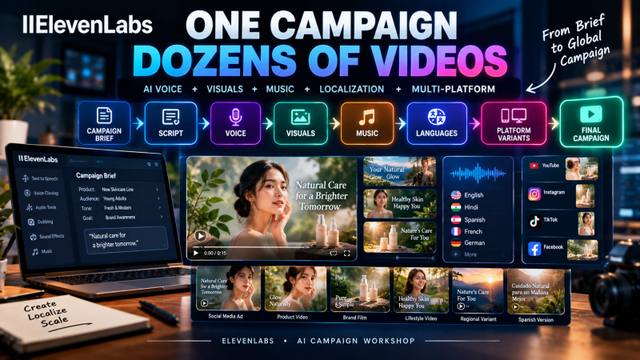
ElevenLabs AI Campaigns: Create Dozens of Videos
Published: September 9, 2026
Category: Tools & Apps
Reading time: ~8 minutes
One Campaign Could Become Dozens of AI-Generated Assets
Imagine a company has one new product to promote.
Traditionally, creating a complete marketing campaign can involve many different people and tools.
A marketing team creates the brief.
A copywriter develops the script.
A designer creates the visuals.
A voice artist records the voiceover.
An editor combines the footage.
A sound designer adds music and effects.
Then another team may need to translate and adapt everything for different countries and social-media platforms.
By the time the campaign is finished, the original idea may have gone through several handoffs.
ElevenLabs is showing a different approach.
On September 9, 2026, ElevenLabs hosted a live workshop demonstrating how marketing teams can use AI voice, music, image and video models to take a campaign from an initial brief to a finished video while maintaining consistency across different assets.
The interesting part is not simply that AI can generate a video.
The bigger idea is that one campaign can become many different pieces of content.
From Brief to Finished Video
The workshop demonstrated an end-to-end campaign workflow.
Instead of treating voice generation, image generation, music and video production as completely separate activities, the workflow connects them.
The basic process looks like this:
Brief → Script → Visuals → Voice → Music → Video → Localization → Variants
This means the original campaign idea becomes the foundation for multiple assets.
For example, a company might start with one campaign promoting a new product.
From that campaign, the team could create:
A vertical Instagram video
A TikTok version
A YouTube Short
A product advertisement
A different-language version
A different voice version
A different visual version
A shorter advertisement
A longer product video
Regional versions for different markets
ElevenLabs says its workshop showed how dozens of variants can be created from a single campaign by changing copy, voice, visuals or language for different channels and markets.
That is where the workflow becomes especially interesting for businesses.
Why This Matters for Marketing Teams
Marketing teams are under pressure to create more content for more platforms.
One campaign is no longer enough.
A business may need different versions for Instagram, Facebook, YouTube, TikTok, websites, advertisements and other channels.
Each platform can also require a different format.
A vertical video might work for Reels.
A different version might be needed for YouTube.
A square image could be used for another advertising placement.
The traditional approach is to create these assets individually.
AI allows teams to start from a common creative direction and generate variations much faster.
Instead of thinking:
One campaign = one advertisement
the new workflow is closer to:
One campaign = a content system.
The First Step: Campaign Brief
Everything starts with the campaign brief.
The brief defines the basic idea.
For example:
Product: New skincare product
Audience: Young adults
Tone: Premium and modern
Message: Simple skincare for everyday life
Platform: Social media
Market: Multiple countries
The brief becomes the source of truth for the rest of the campaign.
The goal is not to let AI randomly create content.
The goal is to give AI a clear creative direction.
This is important because consistency becomes more difficult when a campaign produces many different assets.
If every asset looks completely different, customers may not recognize that the content belongs to the same brand.
Step Two: Create the Master Script
Once the campaign direction is established, the team can develop a master script.
The master script contains the main message that should remain consistent.
For example:
“Meet the simple skincare routine designed for everyday confidence.”
From that master message, different versions can be created.
A short version might be used for a six-second advertisement.
A longer version could become a 30-second Reel.
Another version could focus on a specific product benefit.
Another could be translated for a different market.
The important idea is that the campaign has a central message while individual assets can still be adapted.
Step Three: Generate the Voice
Voice is one of the areas where ElevenLabs has built its reputation.
In the September 9 workshop, ElevenLabs showed how AI voice can become part of a complete campaign workflow alongside image, video and music generation.
A brand can define the desired voice identity.
It could be:
Friendly
Professional
Energetic
Calm
Premium
Young
Educational
The voice becomes another part of the brand identity.
This matters because a recognizable voice can help different advertisements feel connected.
Instead of finding a different voice for every advertisement, a company can establish a consistent voice direction and reuse it across campaign assets.
Step Four: Create the Visuals
Next comes the visual layer.
AI image and video models can help create the scenes required for the campaign.
For example, a product advertisement might require:
Scene 1: Product introduction
Scene 2: Product close-up
Scene 3: Person using the product
Scene 4: Lifestyle environment
Scene 5: Product benefit
Scene 6: Final brand message
Instead of building every visual from scratch, the team can use the campaign's visual direction as a consistent foundation.
The goal is not just to create attractive images.
The goal is to make the images look like they belong to the same campaign.
Step Five: Add Music
Music is another important part of advertising.
The wrong music can completely change the feeling of a video.
A luxury advertisement may need something subtle and sophisticated.
A fitness advertisement may need something energetic.
A technology advertisement might use a futuristic sound.
AI can help generate or select music that matches the intended mood.
In ElevenLabs' broader campaign workflows, the company has demonstrated combining generated visuals, voiceover and music into finished video content.
That means the creative process can happen inside a connected workflow rather than requiring constant movement between unrelated tools.
Step Six: Build the Finished Video
Now the individual pieces come together.
The campaign has:
Script
Voice
Visuals
Music
The final step is assembling these components into a finished advertisement.
This is where the workflow starts looking less like individual AI tools and more like an AI-powered production pipeline.
The finished video can then be reviewed.
If the voice needs to change, it can be changed.
If the product image needs to change, it can be changed.
If the script needs another version, it can be rewritten.
The campaign becomes editable rather than being a single fixed output.
The Real Power: Localization
Now comes one of the most important parts.
Different markets speak different languages.
Traditionally, localization can require translation, new voice recordings, editing and sometimes completely different creative assets.
AI can reduce some of this work.
ElevenLabs' September 9 workshop specifically highlighted creating different versions by changing language, voice, visuals or copy for different channels and markets.
Imagine a campaign originally created in English.
The same campaign could potentially be adapted for:
English
Hindi
Telugu
Spanish
French
German
and other languages.
The message can remain connected to the original campaign while the language and other creative elements change.
This is particularly important for companies that operate across multiple markets.
One Campaign, Multiple Languages
Let's imagine a fictional company launching a new AI productivity application.
The master campaign is created in English.
The company then needs versions for India, Europe and Latin America.
Instead of producing every version completely independently, the team can use the original campaign as a foundation.
The workflow becomes:
Master Campaign
↓
English Version
↓
Hindi Version
↓
Spanish Version
↓
French Version
↓
Regional Visual Variants
↓
Platform Variants
This does not mean every version should be published automatically.
Human review remains important, especially for advertising claims, cultural context, pronunciation and brand guidelines.
But AI can significantly reduce repetitive production work.
Brand Consistency Becomes Critical
When a company produces dozens of assets, consistency becomes a challenge.
Imagine an advertisement where the brand uses one visual style.
Then another advertisement suddenly uses completely different colors.
The voice sounds different.
The product looks different.
The messaging changes.
The campaign may start feeling disconnected.
ElevenLabs says its workshop focused on maintaining voice, visual style and brand assets consistently across campaign outputs.
This is one of the most important ideas in AI marketing.
Generation is easy. Consistent generation is harder.
A professional campaign needs rules.
The brand may define:
Logo usage
Colors
Typography
Voice
Tone
Visual style
Product appearance
Messaging
Target audience
AI can then operate within those creative boundaries.
Platform Variants
Different platforms require different formats.
For example:
Instagram Reels: Vertical 9:16
YouTube Shorts: Vertical 9:16
Instagram Feed: Multiple possible formats
Website: Landscape or responsive
Digital advertising: Different placements
Instead of manually rebuilding every advertisement, an AI-powered campaign workflow can generate variations based on the platform requirements.
The core campaign remains the same.
The presentation changes.
This is why the future of AI content creation may not simply be about making one impressive video.
It may be about creating a system that can produce many versions efficiently.
From One Idea to 20 Pieces of Content
Let's take a simple campaign idea:
“A new coffee brand for busy professionals.”
One campaign could become:
30-second Reel
15-second Reel
YouTube Short
Product teaser
Founder video
Product close-up
Customer testimonial format
Instagram Story
Website hero video
Hindi advertisement
Telugu advertisement
Tamil advertisement
Spanish advertisement
Short product animation
Promotional poster
Voiceover-only advertisement
Seasonal version
Discount version
Retargeting advertisement
Brand awareness video
The creative idea remains connected.
The individual assets change.
This is the concept behind scalable AI content production.
AI Is Moving From Tool to Workflow
This may be the most important lesson from the ElevenLabs workshop.
AI is no longer only being used as a single tool.
Businesses are beginning to connect multiple AI capabilities together.
Instead of:
“Use AI to create a voice.”
the question becomes:
“How can AI help us create the entire campaign?”
Instead of:
“Generate one image.”
the question becomes:
“How can we create all the visual assets needed for this campaign?”
Instead of:
“Translate this video.”
the question becomes:
“How can we localize this entire campaign for multiple markets?”
That change in thinking is significant.
What This Means for Small Businesses
This technology is not only relevant to large companies.
Small businesses also need content.
A local restaurant might need:
Food advertisements
Festival promotions
Instagram Reels
Product videos
Menu promotions
Local-language content
A clothing store might need:
New collection videos
Product advertisements
Model videos
Festival campaigns
Regional-language versions
A real-estate company might need:
Property walkthroughs
Location videos
Short advertisements
Voiceovers
Multiple-language versions
Instead of creating every piece manually, businesses can build a repeatable AI workflow.
The New Content Production Formula
The workflow can be summarized as:
ONE IDEA
↓
MASTER CAMPAIGN
↓
MASTER SCRIPT
↓
VOICE
↓
VISUALS
↓
MUSIC
↓
VIDEO
↓
LOCALIZATION
↓
PLATFORM VARIANTS
↓
HUMAN REVIEW
↓
PUBLISH
This is more powerful than simply asking an AI tool:
“Make me an advertisement.”
The workflow gives every stage a purpose.
But Human Creativity Still Matters
AI can accelerate production, but it does not eliminate the need for creative direction.
Someone still needs to decide:
What is the campaign about?
Who is the audience?
What should people remember?
What emotion should the advertisement create?
What makes the brand different?
What should the final call-to-action be?
AI can help execute these ideas, but the campaign still needs a clear creative strategy.
That is why the most useful approach is not necessarily:
Human vs AI.
It is:
Human creativity + AI production.
The Future of AI Advertising
The direction demonstrated by ElevenLabs points toward a future where creating marketing content becomes much more scalable.
A company could develop one strong campaign concept and then generate many adaptations from that foundation.
The biggest advantage may not be that AI makes one advertisement faster.
It is that AI can help businesses produce more variations without rebuilding the entire campaign from zero every time.
This could change how businesses approach social-media content, advertising and localization.
Final Takeaway
ElevenLabs' September 9 workshop demonstrated an important direction for AI-powered marketing.
The focus is moving from individual AI tools toward complete production workflows.
A campaign can begin with a simple brief.
Then AI can assist with:
Script
→ Voice
→ Visuals
→ Music
→ Video
→ Languages
→ Channel Variants
→ Market Variants
The result is not just one video.
It is a campaign system capable of producing many connected assets.
For creators and businesses, the most interesting question may no longer be:
“Can AI make a video?”
The more important question is:
“How many pieces of content can we create from one strong idea?”
That is where AI-powered marketing is heading.