Cua Driver Gives AI Agents Human-Like Cursor Motion
Open-source Cua Driver has added six configurable cursor-motion styles for AI computer-use agents, making automated mouse movements easier for people to follow while an agent operates a desktop or browser.
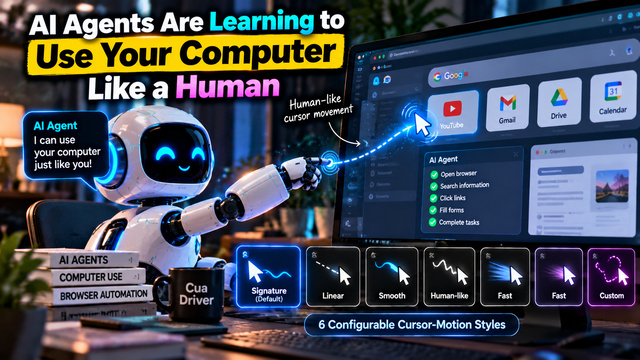
AI Agents Are Getting More Human-Like Cursor Movement
AI agents are increasingly learning how to operate computers instead of simply responding to text. They can open applications, navigate websites, click buttons, fill forms and complete multi-step tasks. But there is another part of computer-use agents that matters when humans are watching them: how their actions are visually communicated.
Open-source project Cua Driver has added six configurable cursor-motion styles designed for AI agents that operate computers. The new release includes different ways for an agent cursor to move across a screen, with Signature becoming the new default motion. GitHub
The six styles include Comet Swoop, Signature Arc, Spring Settle, Magnetic, Adaptive and Classic. According to the project's developers, the motions were designed after studying how people aim a mouse and testing 82 different motion patterns before selecting the final six. LinkedIn
The Signature motion is particularly interesting because it includes visual feedback during movement and clicking. Other styles can use different trajectories, settling behavior and visual effects.
At first, this might sound like a cosmetic change. It doesn't make an AI model smarter or give an agent a new reasoning capability.
But there is a useful idea underneath it: computer-use agents need to be understandable to humans.
When an AI agent operates a browser or desktop, the cursor becomes a visual indicator of what the system is doing. A cursor that instantly jumps between locations can make an automated process difficult to follow. More deliberate movement can make it easier to see which button the agent is targeting and when an action is taking place.
Cua says the motion system also considers factors such as movement distance and target size, following principles associated with Fitts' law. The project supports the cursor styles across macOS, Windows and Linux, while the agent's displayed cursor does not have to move the user's physical pointer. LinkedIn
This is becoming increasingly relevant as computer-use agents become more common. Developers need to build systems that humans can monitor, understand and interrupt when necessary.
For Indian developers and AI startups, the update is another example of how agent development is moving beyond model intelligence. The user experience around agents also matters.
The emerging workflow looks like:
AI Agent → Sees Computer → Moves Cursor → Clicks → Completes Task
The interesting shift is that AI agents are not just learning what to click. Their computer interactions are also becoming easier for humans to see and understand.