CodeWithHarry Updates cinematical Python and Data Science Courses
CodeWithHarry’s updated Python and Data Science courses highlight why programming and data skills still matter in 2026.
By @admin
Source: https://www.codewithharry.com/courses?utm_source=chatgpt.com
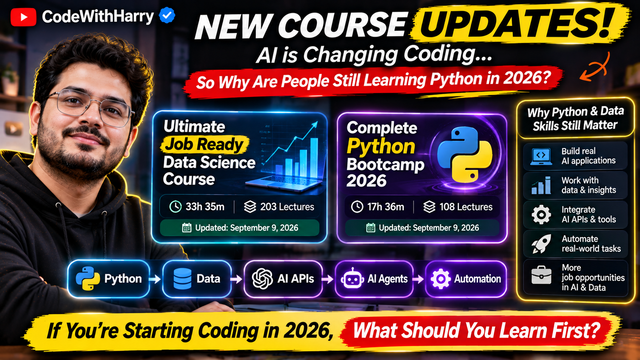
CodeWithHarry Updates Python and Data Science Courses: Why Coding Still Matters in 2026
Artificial intelligence can now generate code, explain programming concepts, find errors and help developers build applications faster than before.
That has created a question among students who are planning to enter the technology industry:
If AI can write code, is learning programming still worth it?
The answer is yes.
Understanding code is still important because building useful software involves much more than generating lines of code. Developers need to understand problems, choose the right tools, work with data, test systems, fix errors and make sure applications behave correctly.
A recent update to CodeWithHarry's course catalogue brings this discussion back into focus.
The Indian educator has two relevant courses listed on his official website:
- The Ultimate Job Ready Data Science Course.
- Complete 2026 Python Bootcamp: Learn Python from Scratch.
The official course pages currently list 203 lectures and 33 hours 35 minutes for the Data Science course, and 108 lectures and 17 hours 36 minutes for the Python Bootcamp. Both course pages show November 1, 2026 as their latest update date.
These are not just two course announcements. They offer a useful opportunity to examine what beginners should learn if they want to build a career in software, data or artificial intelligence.
1. What has CodeWithHarry updated?
The first course is called The Ultimate Job Ready Data Science Course.
It is designed for beginners and intermediate learners who want to develop practical data science skills.
The official course page lists 24 sections, 203 lectures and a total duration of 33 hours and 35 minutes.
Its topics include:
- Python for data science.
- NumPy and Pandas.
- Data visualisation using Matplotlib and Seaborn.
- Data collection techniques.
- SQL.
- Probability and statistics.
- Machine learning.
- Scikit-learn.
- Deep learning and neural networks.
- Large language models.
- Using AI as a data scientist.
- Git and Google Colab.
The course also lists practical projects, including projects involving data analysis and an RAG-based AI teaching assistant.
The second course is Complete 2026 Python Bootcamp: Learn Python from Scratch.
This course is aimed at beginners who want to learn Python programming from the fundamentals.
The official page lists 16 sections, 108 lectures and 17 hours and 36 minutes of content.
Its topics include:
- Programming fundamentals.
- Variables, data types and loops.
- Functions and modules.
- Strings and data structures.
- Object-oriented programming.
- Advanced Python concepts.
- File handling.
- External libraries.
- Automation.
- AI-assisted development.
- Hands-on projects.
- Flask web applications.
- Git and version control.
The two courses target different learning stages.
The Python Bootcamp focuses on building programming fundamentals, while the Data Science course takes learners further into data analysis, statistics and machine learning.
2. Why is Python still important when AI can write code?
Python remains one of the most useful programming languages for beginners because it is widely used across software development, automation, data science and artificial intelligence.
AI coding assistants can generate a Python function in seconds. They can also explain errors and suggest improvements.
But consider what happens when the generated code does not work.
A beginner who does not understand variables, loops, functions, data structures or basic logic may struggle to identify the problem.
They might copy a solution from an AI tool without understanding what it does.
That creates a dangerous habit: depending on generated code instead of learning how software works.
A developer who understands Python can use AI differently.
They can describe the problem clearly, inspect the generated solution, identify incorrect logic, test the output and improve the implementation.
The important distinction is this:
AI can help write code, but developers still need to understand whether that code is correct.
Python is also useful because it connects naturally with many areas of technology.
A student can start with basic programming, then move into web development, automation, data analysis, machine learning or AI application development.
That flexibility makes it a practical starting point.
3. Data skills are becoming more important
Learning Python is only one part of the picture.
Modern businesses generate large amounts of data through websites, applications, customer interactions, transactions and internal systems.
But raw data does not automatically create useful information.
Someone needs to collect it, clean it, organise it, analyse it and identify patterns.
That is where data science and analytics skills become important.
For example, imagine an online business that receives thousands of orders every month.
The business may want to understand:
- Which products sell the most?
- Which customers return?
- Which marketing campaigns generate sales?
- Where are customers abandoning purchases?
- What might demand look like next month?
These questions require more than a chatbot.
They require an understanding of data, statistics, programming and business problems.
Python libraries such as NumPy and Pandas help developers work with datasets. Visualisation libraries help communicate patterns. SQL helps retrieve information from databases.
Machine learning can then be used for tasks such as prediction, classification and recommendation.
This is why Python and data skills remain relevant even as AI tools become more capable.
4. The modern learning path: Python to AI applications
A beginner in 2026 should not think of learning as a race to collect as many programming languages as possible.
A better approach is to build skills in layers.
Step 1: Learn Python fundamentals
Start with variables, data types, conditions, loops, functions, lists, dictionaries and basic problem-solving.
Do not skip these topics.
You should be able to write small programs without asking AI to generate every line.
Step 2: Learn data handling
Understand files, CSV data, JSON, APIs and basic database operations.
Then learn NumPy, Pandas and SQL if your goal involves data or AI.
Step 3: Build practical projects
Build small applications that solve actual problems.
Examples include an expense tracker, file organiser, student marks analyser, weather application using an API or a simple data dashboard.
Projects help reveal whether you truly understand the concepts.
Step 4: Learn AI APIs
Once you understand programming, explore how applications connect to AI models through APIs.
Learn how to send requests, handle responses, manage errors and protect API keys.
This is where Python becomes a practical tool for building AI-powered applications.
Step 5: Explore AI agents and automation
After learning APIs and basic application development, explore workflows where AI can use tools, retrieve information and complete defined tasks.
Learn about permissions, human approval, logging and error handling.
An AI agent is not simply a chatbot with a fancy name. It is a system that can interact with tools and take actions within a defined environment.
Understanding the underlying software is essential to building one reliably.
5. Why copying AI-generated code is not enough
One of the biggest mistakes beginners can make is treating AI coding tools as a replacement for learning.
Imagine asking an AI assistant to create a complete website.
It generates hundreds of lines of code. The website appears to work.
But then the login system fails, the database connection breaks or the application behaves differently after deployment.
What happens next?
If the learner does not understand the code, they may not know where to begin.
This is why fundamentals matter.
You do not need to memorise every programming function. Documentation and AI assistants can help you remember syntax.
But you should understand the logic behind your application.
You should know how data moves through a program, how functions interact, why an error occurs and how to test a solution.
The best developers will not necessarily be the people who type the fastest.
They will be the people who can use tools effectively while understanding the systems they are building.
6. What should Indian students learn first?
For students in India who are starting coding in 2026, the best learning path depends on their goal.
If you want to become a software developer, begin with programming fundamentals, data structures, algorithms, Git and practical application development.
If you are interested in data science, learn Python, SQL, statistics, data cleaning, visualisation and machine learning.
If you want to build AI applications, learn Python, APIs, databases, backend development and how to integrate AI models into applications.
If you are interested in automation, start with Python, file handling, APIs and workflow design.
You do not need to learn everything at once.
A common mistake is jumping between Python, JavaScript, Java, C++, machine learning, web development and AI agents without finishing a single practical project.
That creates the illusion of progress without building strong skills.
Choose one direction, build a foundation and gradually expand.
7. Do these courses guarantee a job?
No.
A course title containing the words "job ready" does not guarantee employment.
Completing 203 lectures or receiving a certificate does not automatically make someone ready for a software or data science role.
Employers and clients generally need evidence that a candidate can apply what they have learned.
That evidence can include:
- Projects that solve real problems.
- A GitHub profile with understandable code.
- The ability to explain technical decisions.
- Problem-solving and debugging skills.
- Knowledge of relevant tools and frameworks.
- Communication and collaboration skills.
For a data science role, a student might build a project that analyses a real dataset, explains the methodology and presents useful findings.
For a Python developer role, a student might build an application that uses a database, APIs and proper error handling.
For an AI application role, a student might build a useful application that connects an AI model to a real workflow and handles failures responsibly.
The course can provide structure, but the learner must do the work.
8. How should beginners use AI while learning to code?
AI should be treated as a learning assistant, not as a substitute for learning.
A useful approach is to try solving a problem yourself first.
If you get stuck, ask AI to explain the concept or provide a hint rather than immediately asking for the complete solution.
After writing code, ask AI to review it.
Then test the program yourself.
If the result is incorrect, investigate why.
You can also use AI to:
- Explain unfamiliar error messages.
- Generate practice questions.
- Compare two possible implementations.
- Review code for readability.
- Suggest improvements.
- Help understand documentation.
- Create test cases.
But do not blindly trust generated answers. AI can produce incorrect code, insecure implementations and explanations that sound convincing but are wrong.
The goal is to become someone who can work with AI tools intelligently.
Final thought
AI is changing software development, but that does not mean programming fundamentals are becoming useless.
In fact, understanding the fundamentals can make AI tools more valuable.
A person who understands Python, data, APIs and problem-solving can use AI to build faster, test ideas and automate repetitive work.
A person who only copies generated code may struggle when the first unexpected error appears.
CodeWithHarry's two courses provide examples of structured learning paths for Python and Data Science. But the most important decision for beginners is what they do after watching the lessons.
Do not just finish a course.
Build something.
Break it.
Debug it.
Improve it.
And learn to explain how it works.
Because in 2026, the goal should not be to compete with AI at typing code.
The goal should be to understand technology well enough to build useful things with AI.