Claude Outage: Why AI Businesses Need a Backup
Claude went offline across key services, highlighting why businesses need fallback AI models when critical AI infrastructure fails.
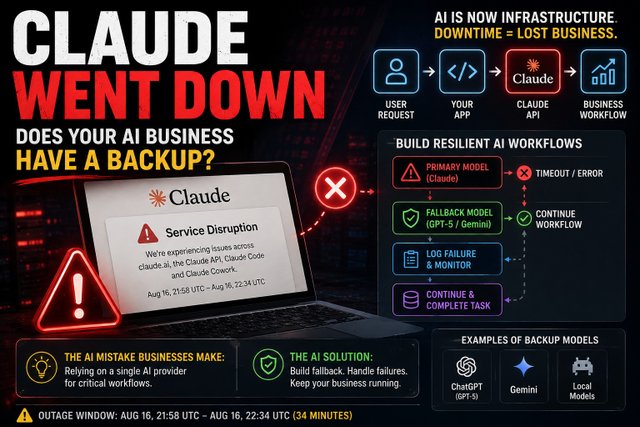
Claude Went Down — And That's a Bigger Problem for AI Businesses
Claude experienced a service disruption overnight affecting several important parts of Anthropic's ecosystem, including Claude.ai, the Claude API, Claude Code and Claude Cowork.
Anthropic's status information shows the incident began at 21:58 UTC on August 16 and was resolved at 22:34 UTC, making the disruption approximately 34 minutes long.
For a normal chatbot user, an outage might simply mean:
"Claude isn't working right now."
But for a business using Claude inside production systems, the consequences can be much bigger.
Imagine a company using Claude for:
Customer support
Code generation
Document processing
Lead qualification
Internal AI assistants
Automated workflows
Data analysis
API-powered applications
If the primary AI provider becomes unavailable, those workflows can stop.
That's the bigger lesson.
AI Is Becoming Infrastructure
Businesses are increasingly treating AI models like infrastructure.
The workflow might look like:
Customer request
↓
Application
↓
Claude API
↓
AI response
↓
Business action
If Claude becomes unavailable, the entire chain can potentially be interrupted.
This creates a new operational question:
What happens when your AI provider goes down?
The Mistake Businesses Make
A common architecture is:
Application → One AI Provider → Done
It's simple, but it creates a single point of failure.
A more resilient architecture can be:
Application
↓
Primary AI Model
↓
Success? → Continue
Failure? → Fallback Model
↓
Log Failure
↓
Continue Workflow
For example:
Claude API
↓
Timeout / Error
↓
Fallback to GPT-5 or Gemini
↓
Continue the task
The goal isn't to run every request through multiple models.
That would increase cost and complexity.
Instead, the fallback model should activate only when the primary provider fails or becomes unavailable.
Why This Matters for AI Agents
This becomes even more important with AI agents.
An agent might be responsible for:
Reading a request → reasoning → calling tools → completing an action
If the model suddenly becomes unavailable halfway through the workflow, the system needs to know what happens next.
A good production system should have:
Timeout handling
Retry logic
Fallback models
Error logging
State recovery
Human escalation for important tasks
Without these safeguards, one external outage can break an entire automation.
You Don't Need Three AI Models Everywhere
Having a backup doesn't mean every application needs three different AI providers.
For many applications, a simple strategy is enough:
Primary model
↓
Retry
↓
Fallback model
↓
Human/system recovery if both fail
The fallback can also be cheaper than the primary model.
For example:
Primary: Frontier model
Fallback: Efficient model
This can provide both resilience and cost control.
The Bigger AI Business Lesson
AI companies are becoming critical infrastructure for businesses.
That means companies need to start thinking about AI reliability the same way they think about:
Cloud outages
Database failures
Payment failures
Network failures
The question isn't whether an AI service will ever experience downtime.
Every large technology service can experience incidents.
The important question is:
What happens to your business when it does?
A reliable AI application shouldn't simply assume:
"The model will always be available."
It should be designed with failure in mind.
Reel Hook
"Claude went down last night—and it exposes a major AI mistake businesses are making."
Reel Flow
AI model
↓
API
↓
Business workflow
↓
Provider outage
↓
Workflow stops
Then:
Primary Model → Error Detection → Fallback Model → Continue
CTA
"If Claude goes down, what's your backup—GPT-5, Gemini, or a local model?"