Claude Mythos: Anthropic’s Cybersecurity AI Expands
Kraken parent Payward has joined Project Glasswing, gaining controlled access to Anthropic’s advanced AI for defensive cybersecurity work.
Source: https://www.anthropic.com/project/glasswing?utm_source=chatgpt.com
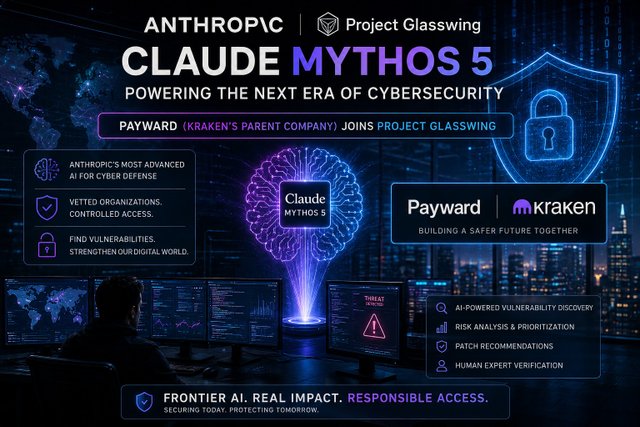
Claude Mythos: Anthropic’s AI Cybersecurity Program Expands
Cybersecurity is entering a new phase.
For years, companies have used automated scanners, intrusion detection systems, vulnerability databases, and security researchers to protect their software. But artificial intelligence is now beginning to change how deeply and how quickly organizations can search for security weaknesses.
The latest example comes from Anthropic’s Project Glasswing, a controlled-access cybersecurity initiative that gives selected organizations access to powerful AI capabilities for defensive security work.
On August 17, Payward, the parent company of cryptocurrency exchange Kraken, announced that it had joined Project Glasswing and would use Anthropic’s Claude Mythos 5 for cybersecurity.
The important part isn't simply that another company is using Claude.
It's how Anthropic is choosing to distribute this capability.
Powerful cybersecurity AI isn't being released universally.
Instead, access is being given to vetted organizations.
And that could tell us a lot about where frontier AI is heading.
What is Project Glasswing?
Project Glasswing is Anthropic's initiative focused on securing important software and digital infrastructure.
The program was announced in April 2026 with organizations including Amazon Web Services, Apple, Broadcom, Cisco, CrowdStrike, Google, JPMorganChase, the Linux Foundation, Microsoft, NVIDIA, and Palo Alto Networks among its initial participants.
Anthropic describes the initiative as a collaborative effort to use advanced AI to help secure critical software.
The basic idea is straightforward:
Give capable AI systems to trusted cybersecurity teams and let them use those systems to find vulnerabilities before attackers do.
That sounds simple.
The technology behind it isn't.
Enter Claude Mythos 5
The AI model at the center of this story is Claude Mythos 5.
Anthropic describes Mythos 5 as its most capable model for finding and fixing software vulnerabilities, with availability restricted to a small set of initial cybersecurity testing partners.
That restriction is important.
A highly capable cybersecurity model can potentially be useful for defensive work, but the same general capabilities could potentially be misused.
That creates a difficult problem for AI companies.
How do you make powerful cyber capabilities available to people who are trying to protect systems without simply making those capabilities universally available to anyone?
Anthropic's answer is controlled access.
Why Payward joining matters
Payward is the parent company of Kraken, one of the better-known cryptocurrency exchanges.
Crypto companies have an especially strong reason to take cybersecurity seriously.
They operate systems involving financial assets, accounts, authentication systems, APIs, wallets, infrastructure, and large amounts of sensitive information.
A security vulnerability isn't just an inconvenience.
Depending on the system involved, it can potentially create serious financial and operational consequences.
Payward says it plans to use Claude Mythos 5 to scan its systems for vulnerabilities, with findings going through its existing security processes for review and remediation. It also said vulnerabilities found in third-party open-source software would be reported to the relevant maintainers.
That last part is particularly interesting.
The goal isn't only to protect one company.
If a vulnerability exists in widely used open-source software, fixing and reporting it could potentially improve security for many organizations using that software.
AI as a security researcher
Think about what a security researcher normally has to do.
They may need to inspect large codebases.
Understand how different components interact.
Identify unusual behavior.
Search for potential vulnerabilities.
Determine whether a weakness can actually be exploited.
Assess the severity.
Then figure out how the problem can be fixed.
That can take significant time.
AI could potentially accelerate several of these steps.
Instead of simply asking an AI chatbot a cybersecurity question, organizations can give a capable model access to appropriate code and security workflows and use it as part of a much larger defensive process.
The AI can help identify potential weaknesses.
Security professionals can then investigate the findings.
This changes the role of AI from a general-purpose assistant into something much closer to a security research partner.
The scale is what makes this interesting
Human security researchers are limited by time.
A company might have thousands or millions of lines of code.
It might also depend on hundreds or thousands of external software packages.
Cloud infrastructure can change constantly.
New versions are deployed.
Dependencies are updated.
Configurations change.
APIs are added.
A vulnerability that didn't exist yesterday could become relevant today.
AI systems can potentially operate at a much larger scale than a human team working manually.
That's one of the biggest reasons Project Glasswing matters.
Anthropic said in June that its initial partners had already found more than 10,000 high- or critical-severity security flaws while deploying Claude Mythos Preview to scan their codebases.
That number illustrates the potential impact of applying advanced AI to large-scale vulnerability discovery.
But there's a catch
The more powerful cybersecurity AI becomes, the more complicated the safety problem becomes.
A model capable of understanding vulnerabilities can be extremely useful to defenders.
But cybersecurity is a dual-use field.
The same knowledge that helps someone fix a vulnerability can potentially help someone understand how that vulnerability could be abused.
That's why the phrase "controlled access" matters so much.
Anthropic isn't treating Claude Mythos like an ordinary consumer chatbot.
Instead, it has built programs around trusted access and cybersecurity verification.
Anthropic has also described a Cyber Verification Program intended to help identify potentially malicious cyber activity while still supporting defenders using Claude to secure their own systems.
This represents a broader pattern we're likely to see more often.
The most capable AI systems may not always be distributed in exactly the same way as ordinary productivity tools.
Some capabilities may require additional verification, monitoring, or access controls.
Why not just give everyone access?
This is where the debate gets interesting.
Imagine an AI system that can automatically inspect software and identify previously unknown vulnerabilities.
That could be incredibly valuable for companies.
But imagine giving exactly the same unrestricted capability to everyone.
The risk profile changes.
You now have to consider not only defenders but also malicious users.
That's why Anthropic's approach resembles a trusted-access model:
Advanced capability → security evaluation → vetted organization → controlled deployment → human security team.
The objective is to maximize defensive value while reducing opportunities for misuse.
Whether that balance will work perfectly remains to be seen.
But the direction is clear.
The future of cybersecurity may be AI vs AI
Cybersecurity has always been an arms race.
Attackers develop new techniques.
Defenders develop new protections.
Attackers automate.
Defenders automate.
Now AI is accelerating both sides.
An attacker could potentially use AI to analyze information faster.
A defender could use AI to scan software faster.
An attacker could potentially search for weaknesses at scale.
A defender could potentially do the same thing first.
That creates a fascinating question:
What happens when the defender's AI becomes faster than the attacker's AI?
If defenders can identify and fix vulnerabilities before attackers discover them, the security advantage could be enormous.
But if attackers gain the advantage first, the threat landscape could become significantly more difficult.
The competition may increasingly be about who can deploy AI effectively and responsibly, rather than simply who has the best human security team.
This could change cybersecurity jobs
There's another important consequence.
AI won't necessarily eliminate cybersecurity professionals.
Instead, it could change what they spend their time doing.
Today, security professionals may spend large amounts of time investigating alerts, reviewing code, analyzing logs, testing systems, documenting findings, and performing repetitive security checks.
AI could potentially automate portions of those activities.
That doesn't mean humans become unnecessary.
It means their role could move toward higher-level work:
validating AI findings
designing security strategies
investigating complex vulnerabilities
managing risk
deciding remediation priorities
reviewing AI-generated fixes
handling incidents
building security architectures
The people who know how to work effectively with AI could become significantly more productive.
AI could make proactive security normal
Traditionally, companies often discover security problems through testing, audits, bug reports, security researchers, or—sometimes—the worst possible method: an actual attack.
AI could help push organizations toward continuous security testing.
Imagine this workflow:
Code and infrastructure
↓
AI security analysis
↓
Potential vulnerability discovered
↓
Risk assessment
↓
Security researcher verification
↓
Patch recommendation
↓
Automated testing
↓
Human approval
↓
Deployment
Instead of treating security as something checked periodically, companies could increasingly treat it as an ongoing process.
Every new change could potentially trigger another security analysis.
That could make software development more secure by default.
Open-source software could benefit too
One of the most interesting parts of Payward's participation is its intention to report validated vulnerabilities found in third-party open-source software to the appropriate maintainers.
That's important because modern software is interconnected.
A company doesn't necessarily build every component of its technology stack itself.
It may rely on open-source libraries, frameworks, databases, operating systems, APIs, and other external dependencies.
If one widely used component contains a serious vulnerability, thousands of organizations could potentially be affected.
AI-assisted vulnerability discovery could therefore have effects beyond the company that originally ran the scan.
One organization's security research could potentially help improve the security of an entire software ecosystem.
But human verification still matters
There is a dangerous misconception that AI finding a vulnerability automatically means the vulnerability is real.
That's not necessarily the case.
AI systems can make mistakes.
They can generate false positives.
They can misunderstand complex code.
They can suggest fixes that introduce new problems.
Security decisions can have significant consequences, so organizations still need experienced professionals to validate findings and approve changes.
The best model is therefore not:
AI replaces the security team.
It's:
AI gives the security team much greater reach.
That distinction is crucial.
Why this story matters beyond Kraken
Payward joining Project Glasswing is important, but the bigger story is the model behind the partnership.
Anthropic is experimenting with a future where extremely capable AI systems are used for high-impact defensive work while access remains controlled.
That could become a template for other areas involving sensitive AI capabilities.
Instead of asking:
"Should everyone get access?"
The question becomes:
"Who should get access, under what conditions, and how can that access be monitored responsibly?"
We may see more programs like this as AI becomes more capable.
The bigger AI shift
A few years ago, much of the AI conversation was about generating content.
Generate an image.
Write an email.
Summarize a document.
Create a video.
Write some code.
Now the conversation is moving toward something much more powerful:
AI that can perform real-world technical work.
Cybersecurity is one of the clearest examples.
An advanced AI system isn't merely answering questions about vulnerabilities.
It can potentially participate in the process of discovering, analyzing, and helping remediate them.
That is a much bigger shift.
The question we should be asking
The most interesting question isn't:
"Is Claude Mythos powerful?"
The more important question is:
"Who should be trusted with powerful AI capabilities?"
Anthropic's Project Glasswing provides one possible answer:
Give advanced cybersecurity AI to organizations that have been vetted, use it for defensive purposes, and integrate its findings into established security processes.
Payward's addition shows that this model is expanding into the cryptocurrency sector.
And if AI continues improving at vulnerability discovery and remediation, controlled-access cybersecurity programs could become increasingly important.
The future of cybersecurity may not simply be humans fighting hackers.
It could become:
AI-assisted defenders vs AI-assisted attackers.
The organizations that adapt fastest may have a major advantage.
And perhaps the most important rule of this new era will be simple:
The best security system isn't the one that waits for an attacker.
It's the one that finds the weakness first.