Claude Gets In-Country AI Inference in India
Claude is now available through Amazon Bedrock with India-based inference, helping organizations process AI workloads within Indian AWS Regions.
Claude Gets In-Country AI Inference in India
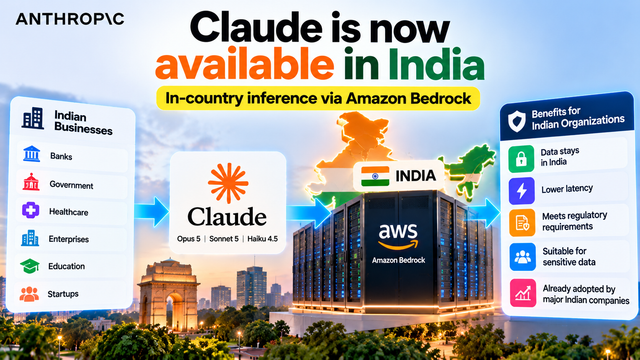
Anthropic's Claude AI models are now available through Amazon Bedrock with India geographic cross-Region inference, giving organizations a way to process Claude workloads within India.
Amazon Web Services announced the availability of Claude Opus 5, Claude Sonnet 5 and Claude Haiku 4.5 through Amazon Bedrock's India geographic inference capability on September 29, 2026. The India setup uses AWS Regions in Mumbai and Hyderabad, allowing inference requests to remain within the India geography.
This is an important development for enterprise AI because many organizations cannot simply send sensitive business data to infrastructure located anywhere in the world.
For banks, healthcare organizations, government departments and other regulated businesses, where AI processing happens can be an important part of deciding whether a model can be used in production.
What does in-country inference mean?
In simple terms, in-country inference means that the AI request is processed within the required geographic area.
For an Indian organization using the India geographic inference profile, Amazon Bedrock can route the request between AWS's Mumbai and Hyderabad Regions.
The request can move between those two Indian Regions for capacity and resilience, but the India geographic profile keeps the inference processing within India.
The workflow can therefore look like:
Indian company
↓
Amazon Bedrock
↓
Claude
↓
Mumbai / Hyderabad AWS Regions
↓
AI response
This is different from using a global inference profile, where the request may be routed to supported AWS Regions outside India.
AWS specifically recommends the India geographic profiles when a workload has local data-processing requirements.
Why businesses care
The biggest reason this matters is data residency.
Businesses increasingly want to use generative AI for real operational tasks.
A bank might want an AI assistant to analyze documents.
A healthcare organization might want AI to help process information.
A large company might want an internal coding assistant.
A government organization might want AI for document processing or citizen services.
These applications can involve sensitive information.
Even when an organization wants to use a powerful AI model, its legal, security and compliance teams may require the underlying processing to stay within a particular geography.
India-based inference can make those conversations easier.
It does not automatically make every AI application compliant with every Indian regulation, but it provides an infrastructure option for organizations that have in-country processing requirements.
Claude models available in India
AWS says the India geographic offering includes:
Claude Opus 5
Claude Sonnet 5
Claude Haiku 4.5
These models can be accessed through Amazon Bedrock using AWS's inference infrastructure.
Developers can work with the models through Amazon Bedrock APIs, including the Anthropic Messages API, Amazon Bedrock InvokeModel API and Converse API.
That means this is not simply a consumer-facing Claude availability announcement.
It is primarily an enterprise infrastructure development.
Companies can integrate Claude into applications and workflows that they are already building on AWS.
Mumbai and Hyderabad are important
One particularly interesting detail is that the India geographic inference profile does not depend on a single Indian data center.
AWS says requests using the India profile can be routed between ap-south-1 Mumbai and ap-south-2 Hyderabad.
This gives organizations access to a broader pool of compute capacity while maintaining the India geographic boundary.
For businesses running AI applications at scale, that can matter when demand suddenly increases.
Instead of having the application tied to the capacity of one location, AWS can distribute inference across the supported India Regions.
Lower latency is another potential benefit
Keeping inference within India can also help reduce network distance for Indian applications.
For an application whose users and backend infrastructure are already in India, processing requests closer to those users can potentially improve responsiveness.
However, latency depends on the complete application architecture, network path, workload and other infrastructure—not simply the location of the AI model.
The biggest enterprise value here is therefore not just speed.
It is the combination of local processing, capacity and infrastructure controls.
Why this matters for Indian AI adoption
India's AI market is increasingly moving from experiments to production systems.
Companies are no longer only asking:
“Can AI answer this question?”
They are asking:
“Can we safely deploy this AI inside our business?”
That second question involves security, governance, compliance, data location, cost, performance and reliability.
In-country inference addresses one important part of that equation.
For regulated industries, having an AI model available through infrastructure that keeps inference within India can remove one potential barrier to deployment.
What about companies already using Claude?
Organizations already using Claude through Amazon Bedrock can choose between different inference approaches depending on their requirements.
AWS also supports global cross-Region inference, which can route workloads to commercial AWS Regions around the world and provide access to broader global capacity.
But if an organization specifically needs inference to remain in India, AWS says it should use the India geographic inference profiles instead.
That distinction is important.
“In India endpoint” does not necessarily mean “processed only in India.”
The organization needs to select the appropriate India geographic inference profile when local processing is a requirement.
Why startups should care
This isn't only relevant to banks and government organizations.
Indian startups building AI products can also benefit from infrastructure that supports local processing requirements.
Consider an Indian SaaS company building an AI document-processing product.
Its customers may ask:
“Where is our data processed?”
If the product uses Claude through Amazon Bedrock's India geographic inference capability, the company has an infrastructure option designed to keep inference within India.
That can become an important part of enterprise sales conversations.
It may also make AI adoption easier for customers that have strict internal policies around data location.
The bigger trend
The important story here is bigger than Claude.
AI infrastructure is becoming increasingly geography-aware.
Different countries and industries have different requirements around where data can be processed.
As AI moves deeper into banking, healthcare, government, enterprise software and other sensitive sectors, model quality will be only one part of the purchasing decision.
Businesses will increasingly care about:
Which model?
Where is it processed?
Who controls the infrastructure?
How is data protected?
What compliance requirements can be supported?
How reliable is the service?
Claude's India geographic inference through Amazon Bedrock is a strong example of this transition.
The future of enterprise AI is not simply about having the smartest model.
It is about making powerful models deployable within the security, infrastructure and regulatory requirements of each market.
For India, that makes local AI inference an important step toward wider enterprise adoption.