Claude AI & the Crisis of Trust in Artificial Intelligence
Anthropic CEO Dario Amodei says AI faces a major trust gap and argues that real-world benefits—not just impressive demos—will determine public confidence.
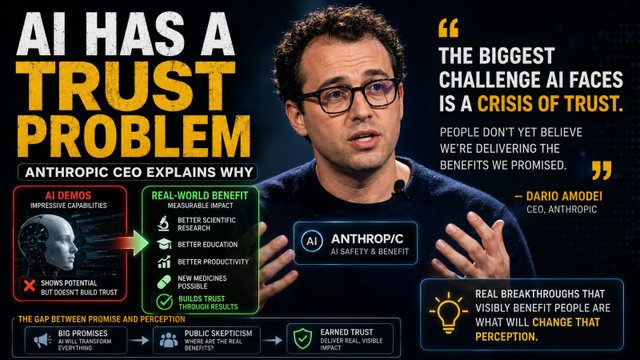
AI Has a Trust Problem
AI companies have spent years showing increasingly impressive demonstrations.
AI can write code, generate images, analyze documents, conduct research and increasingly perform complex tasks.
But there's a problem:
People don't necessarily trust the technology as much as the industry expected.
Anthropic CEO Dario Amodei recently argued that the AI industry is facing a crisis of trust.
His argument is that the problem isn't simply that people hear too much negative news about AI.
The deeper issue is that many people haven't yet seen enough clear, measurable benefits from AI to believe all of the promises being made about it.
The difference is important.
AI Demo
"Look what AI can do!"
↓
Impressive demonstration
↓
People are interested
Real-World Benefit
"Look what AI actually changed."
↓
Better scientific research
↓
Higher productivity
↓
Better education
↓
New medical discoveries
↓
People experience tangible benefits
Amodei argues that the second category is what could fundamentally change public perception.
Why This Matters
The AI industry has made enormous claims about what advanced AI could eventually accomplish.
But public trust isn't built through demonstrations alone.
People want to know:
Does AI actually make my work easier?
Does it improve productivity?
Does it help researchers discover things faster?
Does it improve education?
Can it contribute to developing new medicines?
Those outcomes are much more meaningful than simply having another impressive chatbot demo.
The Trust Gap
The situation can be viewed as:
AI companies' expectations
"AI is going to transform everything."
vs.
Public experience
"Okay, but where is the transformation I can actually see?"
That gap between promised potential and experienced benefit is what Amodei is highlighting.
And this isn't only an Anthropic problem.
It affects the entire AI industry.
OpenAI, Google, Meta, Microsoft, Anthropic and countless startups are all trying to convince businesses and consumers that AI will create meaningful value.
The more ambitious those promises become, the more important measurable results become.
What Would Change People's Minds?
Imagine AI systems helping researchers dramatically accelerate scientific discovery.
Imagine AI tools making high-quality education more accessible.
Imagine businesses using AI to eliminate repetitive work while allowing employees to focus on more valuable tasks.
Imagine AI contributing to breakthroughs in medicine and drug discovery.
Those are fundamentally different from:
"Our model scored higher on a benchmark."
Benchmarks measure capability.
Real-world outcomes create trust.
That's the distinction behind this story.
The Bigger AI Question
The AI industry doesn't only need to build smarter models.
It needs to demonstrate that those models produce real-world value.
The next stage of the AI race may therefore be less about:
Who has the smartest model?
and more about:
Who can turn AI capability into results people actually care about?
That could determine whether public confidence in AI grows—or whether skepticism continues.
Reel Hook
"Anthropic's CEO says AI has a trust problem."
Reel Structure
AI demos
↓
Big promises
↓
Public skepticism
↓
Measurable results
↓
Real-world trust
CTA
"What would AI have to actually achieve before you fully trust it?"